句子种类
- 格式:doc
- 大小:165.50 KB
- 文档页数:18
句子种类○ 陈述句◎肯定句◎否定句⊙一般疑问句:be / 助动词/ 情态动词+ 主语+ 谓语疑问词(+ 被修饰词) + 一般疑问句⊙特殊疑问句疑问词(+ 被修饰词) + 谓语疑问词(+ 被修饰词) + 主句的一般疑问句+ 宾语从句句其他部分○疑问句⊙选择疑问句(由or连接) 一般疑问句语序子特殊疑问句语序(前) 肯定式...(后) 否定式;(前) 否定式...(后) 肯定式种⊙反意疑问句肯定同答与否定同答类其他形式⊕肯定式:以动词原形开头⊕否定式:do not / don’t + 动词原形○祈使句⊕带主语的祈使句⊕祈使句+ and / or + 陈述句◇ what引导:What + (a / an) (+ 形容词) + 名词+ 主语+ 谓语○感叹句◇ how引导:How + (形容词/ 副词) 主语+ 谓语◇ How + 形容词+ a / an + 单数名词+ 主语+ 谓语一.学习指导(Learner’s Guide)英汉两种语言的句子有两个方面的差异:一是词形,二是词序。
英语中无论是陈述句、疑问句、祈使句还是感叹句,句子中的谓语总会有各种形式的变化,而汉语则没有。
另外,要特别注意疑问句和感叹句的语序,汉语里说:你是谁? 英语里却说:Who are you ? 汉语的感叹句中一般使用感叹词,而英语里多由how或what引导。
试比较:她学习多用功啊! How hard she works! 了解了这些差异,有助于掌握英语的句子结构,正确地用英语表达思想。
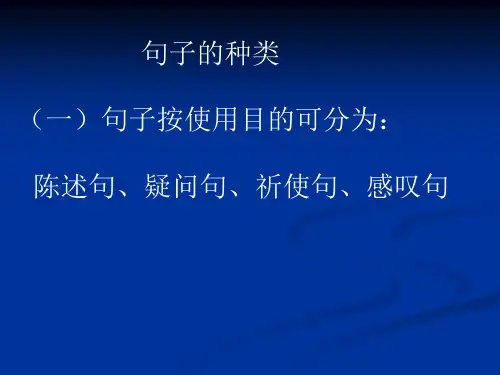
二.语篇填空(Learner’s Pre-test)M:Can you tell me something about your education ?W:Yes.I’m a 1.of Zhengzhou University.I learned business.M:Did you like your business courses ?W:Very much,and I’ve done 2.in all of them.Here are the 3.of my examinations.M:Hm,you were indeed a good student.What about your 4.English ?W:I can talk with foreigners freely 5.I was at college,I often went to the English Corner.We 6.(have) English teachers from Australia.M:Hm.We can hire you.We give the employees 7.salary of 480 dollars a month at the beginning.If you do a good job,you will get a rise in three months’8..W:That’s great.How 9.should I work every day ?M:Four hours every day and two days off in a week.W:Do you offer housing to your employees ?M:Not now.My assistant will tell you 10.you are interested in.W:OK.When shall I begin my work ?M:Next week.三.语法详解(Guide to Grammar)一) 英语的句子按照其用途和使用目的可分为四类:陈述句、疑问句、祈使句、感叹句。
考情分析在这一节内容中,高考考查最频繁的是反义疑问句,各种形式的反义疑问句几乎都考过;其次是祈使句,题干常以“祈使句+ and / or + 陈述句”的形式呈现。
(一) 陈述句(Declarative Sentences)用来说明一个事实或者陈述说话人的看法,通常用降调,句子末尾用句号。
陈述句分为肯定陈述句和否定陈述句。
She arrived quite early.她很早就到了。
He is not fat.他不胖。
提示:谓语动词的否定形式1.用not与谓语动词连用来表示否定,not的缩写为n’t。
直接在肯定句上加not,适用于绝大多数句子;not应加在谓语动词部分的第一个词(助动词、情态动词、be动词、表示“拥有”的have) 后,并常可与该动词缩写成一体。
I don’t know where he is.我不知道他在哪里。
I haven’t been to Guilin.我从未去过桂林。
2.否定中心转移形式上否定主句,意义上否定宾语从句。
这类动词有:think,believe,suppose,feel,expect等。
I don’t think he has time to play with me.我想他没有时间和我玩。
注意:动词hope、guess等不发生否定转移。
I hope you weren’t ill.She doesn’t believe you are wrong.3.有否定意义的副词never,seldom,hardly,scarcely,rarely或barely等的句子视为否定句。
I can hardly (scarcely) recognize you.我几乎认不出你来了。
He is seldom late.他很少迟到。
4.其他成分的否定式:有些句子在结构上属于肯定式,但含有否定意义的词。
Nobody will agree with you.None of us have been there before.We must remember not to come late again.We could find him nowhere.5.双重否定同一句中有两处具有否定含义。
常译作“无……不”或“没有……不”;有时也翻译作肯定句,但比肯定句语气含蓄。
A bird can’t fly without wings.鸟没有翅膀不会飞。
Nobody is absent from the meeting.参加会议的人都到齐了。
Fish won’t live without water.没有水,鱼会死。
6.部分否定all,both,every及every构成的复合词用于否定句中,表示部分否定。
All the answers are not right.并非所有的答案都对。
= Not all the answers are right.= Some of the answers are right;the others are not.Both of the books are not interesting.并非两本书都有趣。
= One of the books is interesting;the other is not.I agree with most of yours but I don’t agree each.我同意你的多数建议,但并非完全同意。
(二) 疑问句(Interrogative Sentences)疑问句用来提出问题,句子末尾用问号(?)。
疑问句通常分为4种:一般疑问句、特殊疑问句、选择疑问句、反意疑问句。
1.一般疑问句(General Questions)以be,have,情态动词或助动词开头,通常要求以yes或no同答(有时也用certainly,all right,probably,perhaps,with pleasure等代替yes;用never,not at all等同答代替no),句子通常用声调。
①— Do you like this picture ? — Yes,I do.(Certainly.)②— Can you pass me that book ? 把那本书递给我,好吗?— Certainly.当然可以。
③— Have you ever been to Russia ? 你去过俄罗斯吗?— Never.从未去过。
说明:(1) 一般疑问句与其简略答语通常用一个助动词或情态动词,但有时也有例外。
— Must I hand in my homework today ? 我今天必须交作业吗?— No,you needn’t.不,没有必要。
(2) 作“拥有”解的have,[英] 直接提到主语前,[美] 在主语前加do,does或did;作“进行某一动作的”解的,一律在主语前加do,does或did。
Has he (Does he have) a pen ? 他有钢笔吗?Did they have a meeting yesterday ? 他们昨天开会了吗?(3) 有时为了表达一种特殊感情或观点,如表示提问人的惊讶、怀疑、邀请、赞叹等,可以用否定形式的一般疑问句,同答这种否定问句时要注意,如果同答是肯定的,就用yes,否则用no。
① Didn’t I tell (Did I not tell) you to come earlier ? 我不是告诉过你早点来吗?②— Haven’t you seen this film ? 你没看过这部电影吗?— Yes,I have.(No,I haven’t.) 不,我看过。
(是的,我没看过。
)2.特殊疑问句(Special Questions)以疑问代词who,whom,whose,which,what和疑问副词when,where,why,how 以及how many,how much等开头的句子;不能用yes或no同来答;句子用降调。
语序:①当疑问代词或由其所修饰的词不作主语时,用一般疑问句语序;②当疑问词或由其所修饰的词作主语时用陈述句语序。
例如:When did you begin to learn English ? 你什么时候开始学习英语的?Who (或Which student) is the tallest in your class ? 你们班谁最高?注意:对think,suppose,guess,expect,believe,say等引起的宾语从句的某一部分提问时,特殊疑问句的结构为:疑问词(+ 被修饰词) + 主句的一般疑问句形式+ 宾语从句的其他部分(陈述句语序),这样的问句就称为双重疑问句。
Why do you think sport is so popular ? 你认为体育为什么如此流行? (think后的宾语从句应为why sport is so popular)Who do you guess broke the glass ? 你猜谁打坏了玻璃杯? (guess后的宾语从句应为who broke the glass)How soon do you suppose he’ll be back ? (suppose后的宾语从句应为how soonhe’ll be back)提出两个(或多个) 选项看哪一个正确的句子,两部分(或多部分) 由or连接,or前的部分读声调,or的部分读降调;or可以连接两个(或多个) 谓语动词、表语、宾语、状语或分句;不能用yes或no来回答;语序为一般疑问句语序。