IP Code
- 格式:doc
- 大小:93.50 KB
- 文档页数:5
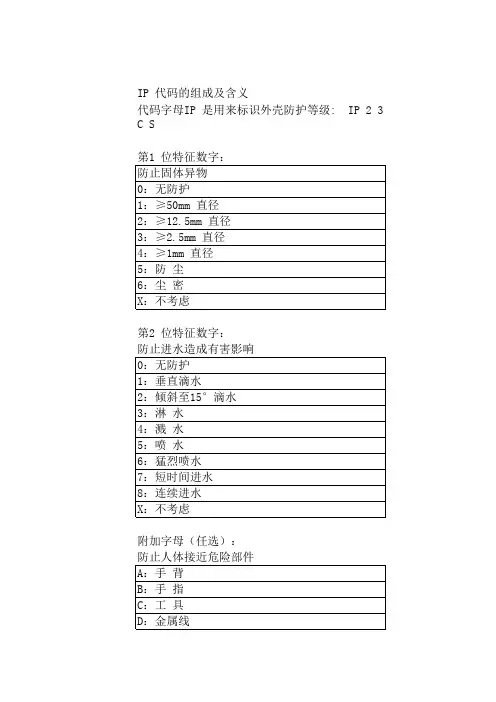
IP CodeThe IP Code (or International Protection Rating[1], sometimes also interpreted as Ingress Protection Rating) consists of the letters IP followed by two digits and an optional letter. As defined in international standard IEC 60529, it classifies the degrees of protection provided against the intrusion of solid objects (including body parts like hands and fingers), dust, accidental contact, and water in electrical enclosures.[2] The standard aims to provide users more detailed information than vague marketing terms such as waterproof. The rating is also known as ingress protection.The digits (characteristic numerals) indicate conformity with the conditions summarized in the tables below. Where there is no protection rating with regard to one of the criteria, the digit is replaced with the letter X.For example, an electrical socket rated IP22 is protected against insertion of fingers and will not be damaged or become unsafe during a specified test in which it is exposed to vertically or nearly vertically dripping water.IP22 or IP2X are typical minimum requirements for the design of electrical accessories for indoor use. Contents[hide]∙ 1 First digit∙ 2 Second digit∙ 3 Additional letters∙ 4 Mechanical impact resistance∙ 5 IP69K∙ 6 NEMA Rating∙7 References∙8 See also∙9 External linksFirst digitThe first digit indicates the level of protection that the enclosure provides against access to hazardous parts (e.g., electrical conductors, moving parts) and the ingress of solid foreign objects.Second digitProtection of the equipment inside the enclosure against harmful ingress of water.Level Protected against Details0not protected —1dripping water Dripping water (vertically falling drops) shall have no harmful effect.2dripping waterwhen tilted up to15°Vertically dripping water shall have no harmful effect when the enclosure is tilted atan angle up to 15° from its normal position.3spraying water Water falling as a spray at any angle up to 60° from the vertical shall have no harmful effect.4splashing water Water splashing against the enclosure from any direction shall have no harmful effect.5water jets Water projected by a nozzle against enclosure from any direction shall have no harmful effects.6powerful water jets Water projected in powerful jets against the enclosure from any direction shall have no harmful effects.7immersion up to 1mIngress of water in harmful quantity shall not be possible when the enclosure isimmersed in water under defined conditions of pressure and time (up to 1 m ofsubmersion).8immersion beyond1 mThe equipment is suitable for continuous immersion in water under conditionswhich shall be specified by the manufacturer.NOTE: Normally, this will mean that the equipment is hermetically sealed.However, with certain types of equipment, it can mean that water can enter but onlyin such a manner that produces no harmful effects.Additional lettersThe standard defines additional letters that can be appended to classify only the level of protection against access to hazardous parts by persons:Further letters can be appended to provide additional information related to the protection of the device:Mechanical impact resistanceAn additional number has sometimes been used to specify the resistance of equipment to mechanical impact. This mechanical impact is identified by the energy needed to qualify a specified resistance level, which is measured in joules (J). This has now been superseded by the separate IK number specified in EN 50102. Although dropped from the 3rd edition of IEC 60529 onwards, and not present in the EN version, older enclosure specifications will sometimes be seen with an optional third IP digit denoting impact resistance. Newer products are likely to be given an IK rating instead. However there is not an exact correspondence of values between the old and new standards.0 ——1 0.225 J 150 g dropped from 15 cm2 0.375 J 250 g dropped from 15 cm3 0.5 J 250 g dropped from 20 cm 5 2 J 500 g dropped from 40 cm 7 6 J 1.5 kg dropped from 40 cm 9 20.0 J 5.0 kg dropped from 40 cmIK number Impactenergy(joules)Equivalent impact00 unprotected no test01 0.150 drop of 200 gram object from 7.5 cm height02 0.200 drop of 200 gram object from 10 cm height03 0.350 drop of 200 gram object from 17.5 cm height04 0.500 drop of 200 gram object from 25 cm height05 0.700 drop of 200 gram object from 35 cm height06 1.00 drop of 500 gram object from 20 cm height07 2.00 drop of 500 gram object from 40 cm height08 5.00 drop of 1.7 kg object from 29.5 cm height09 10.0 drop of 5 kg object from 20 cm height10 20.0 drop of 5 kg object from 40 cm heightIP69KGerman standard DIN 40050-9 extends the IEC 60529 rating system described above with an IP69K rating for high-pressure, high-temperature wash-down applications.[3] Such enclosures must not only be dust tight (IP6X), but also able to withstand high-pressure and steam cleaning. The test specifies a spray nozzle that is fed with 80°C water at 8–10 MPa (80–100 bar) and a flow rate of 14–16 L/min. The nozzle is held 10–15 cm from the tested device at angles of 0°, 30°, 60° and 90° for 30 s each. The test device sits on a turntable that rotates once every 12 s (5 rpm).The IP69K test specification was initially developed for road vehicles, especially those that need regular intensive cleaning (dump trucks, cement mixers, etc.), but also finds use in other areas (e.g., food industry). NEMA RatingNEMA enclosure ratings have equivalent IP ingress protection ratings as follows. NEMA enclosure standards also dictate other product features not addressed by IP codes (such as submersibility, operation under icing conditions, and others). [4]North American enclosure rating systems are defined in NEMA 250, UL 50, UL 508, and CSA C22.2 No. 94.。