
新目标英语七年级上册
- 格式:ppt
- 大小:5.74 MB
- 文档页数:17
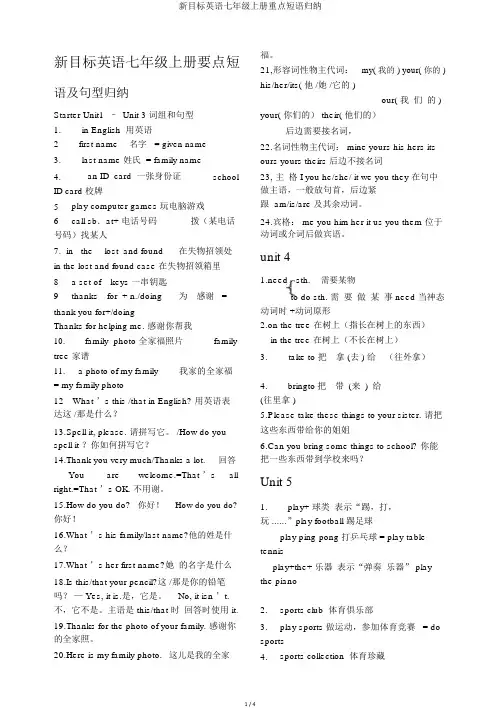
新目标英语七年级上册要点短语及句型归纳Starter Unit1 – Unit 3 词组和句型1.in English 用英语2first name名字= given namest name 姓氏 = family name4. an ID card 一张身份证school ID card 校牌5 play computer games 玩电脑游戏6 call sb.at+ 电话号码拨(某电话号码)找某人7. in the lost and found 在失物招领处in the lost and found case 在失物招领箱里8 a set of keys 一串钥匙9 thanks for + n./doing 为感谢 = thank you for+/doingThanks for helping me. 感谢你帮我10. family photo 全家福照片family tree 家谱11. a photo of my family 我家的全家福= my family photo12---What ’s this /that in English? 用英语表达这 /那是什么?13.Spell it, please. 请拼写它。
/How do you spell it ?你如何拼写它?14.Thank you very much/Thanks a lot.回答-----You are welcome.=That ’s all right.=That ’s OK. 不用谢。
15.How do you do?你好!----How do you do? 你好!16.What ’s his family/last name?他的姓是什么?17.What ’s her first name?她的名字是什么18.Is this/that your pencil?这 /那是你的铅笔吗?— Yes, it is.是,它是。
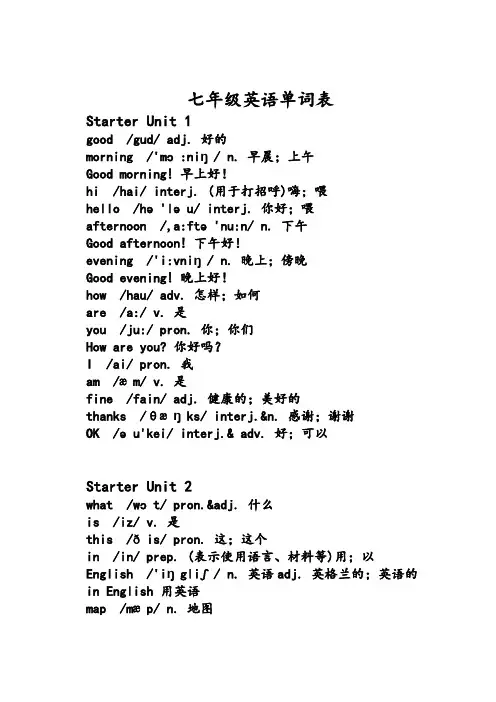
七年级英语单词表Starter Unit 1good /gud/ adj. 好的morning /'mɔ:niŋ/ n. 早晨;上午Good morning! 早上好!hi /hai/ interj. (用于打招呼)嗨;喂hello /hə'ləu/ interj. 你好;喂afternoon /,a:ftə'nu:n/ n. 下午Good afternoon! 下午好!evening /'i:vniŋ/ n. 晚上;傍晚Good evening! 晚上好!how /hau/ adv. 怎样;如何are /a:/ v. 是you /ju:/ pron. 你;你们How are you? 你好吗?I /ai/ pron. 我am /æm/ v. 是fine /fain/ adj. 健康的;美好的thanks /θæŋks/ interj.&n. 感谢;谢谢OK /əu'kei/ interj.& adv. 好;可以Starter Unit 2what /wɔt/ pron.&adj. 什么is /iz/ v. 是this /ðis/ pron. 这;这个in /in/ prep. (表示使用语言、材料等)用;以English /'iŋgliʃ/ n. 英语adj. 英格兰的;英语的in English 用英语map /mæp/ n. 地图cup /kʌp/ n. 杯子ruler /'ru:lə/ n. 尺;直尺pen /pen/ n. 笔;钢笔orange /'ɔrindʒ/ n. 橙子jacket /'dʒækit/ n. 夹克衫;短上衣key /ki:/ n. 钥匙quilt /kwilt/ n. 被子;床罩it /it/ pron. 它a /ə/ art. (用于单数可数名词前)一(人、事、物)that /ðæt/ pron. 那;那个spell /spel/ v. 用字母拼;拼写Starter Unit 3color /'kʌlə/ n. (=colour) 颜色red /red/ adj.& n. 红色(的)yellow /'jeləu/ adj.& n. 黄色(的)green /gri:n/ adj.& n. 绿色(的)blue /blu:/ adj.& n. 蓝色(的)black /blæk/ adj.& n. 黑色(的)white /wait/ adj.& n. 白色(的)purple /'pə:pl/ adj.& n. 紫色(的)brown /braun/ adj.& n. 棕色(的);褐色(的)the /ði; ðə/ art. 指已提到或易领会到的人或事now /nau/ adv. 现在;目前see /si:/ v. 理解;明白can /kæn/ modal v. 能;会say /sei/ v. 说;讲my /mai/ pron. 我的Unit 1name /neim/ n. 名字;名称nice /nais/ adj. 令人愉快的;宜人的to /tu:/ 常用于原形动词之前,该动词为不定式meet /mi:t/ v. 遇见;相逢too /tu:/ adv. 也;又;太your /jɔ:/ pron. 你的;你们的Ms. /miz/ (于女子的姓名前,不指明婚否)女士his /hiz/ pron. 他的and /ænd/ conj. 和;又;而her /hə:/ pron, 她的yes /jes/ interj. 是的;可以she /ʃi:/ pron. 她he /hi:/ pron. 他no /nəu/ interj. 不;没有;不是not /nɔt/ adv. 不;没有one /wʌn/ num. 一two /tu:/ num. 二three /θri:/ num. 三four /fɔ:/ num. 四five /faiv/ num. 五six /siks/ num. 六seven /'sevn/ num. 七eight /eit/ num. 八nine /nain/ num. 九phone /fəun/ n. xx;xx机first /fə:st/ adj. 第一last /la:st/ adj. 最后的;末尾的friend /frend/ n. 朋友China /'tʃainə/ 中国school /sku:l/ n. 学校Unit 2sister /'sistə/ n. 姐;妹mother /'mʌðə/ n. 母亲;妈妈father /'fa:ðə/ n. 父亲;爸爸parent /'peərənt/ n. 父(母)亲brother /'brʌðə/ n. 兄;弟family /'fæməli/ n. 家;家庭who /hu:/ pron. 谁;什么人oh /əu/ interj. 哦;啊they /ðei/ pron. 他(她、它)们well /wel/ interj. 嗯;好吧have /hæv/ v. 经受;经历bye /bai/ interj. (=goodbye)再见son /sʌn/ n. 儿子grandpa /'grænpa:/ n. (外)祖父;爷爷;外公mom /m ɔm/, /ma:m/ n. (=mum)妈妈aunt /a:nt/ n. 姑母;姨母;伯母;婶母;舅母grandma /'grænma:/ n.(外)祖母;奶奶;外婆;dad /dæd/ n. 爸爸photo /'fəutəu/ n. 照片of /ɔv, əv/ prep. 属于(人或物);关于(人或物)next /nekst/ adj.&n. 下一个(的);接下来(的)picture /'piktʃə/ n. 照片;图画girl /gə:l/ n. 女孩dog /dɔg/ n. 狗Unit 3pencil /'pensl/ n. 铅笔book /buk/ n. 书eraser /i'reizə/ n. 橡皮box /bɒks/ n. 箱;盒pencil box 铅笔盒;文具盒schoolbag /'sku:lbæg/ n. 书包dictionary /'dikʃənəri/ n. 词典;字典his /hiz/ pron. 他的mine /main/ pron. 我的hers /hə:z/ pron. 她的excuse /ik'skju:z/ v. 原谅;宽恕me /mi:/ pron. (I的宾格)我excuse me 劳驾;请原谅thank /θæŋk/ v. 感谢;谢谢teacher /'ti:tʃə/ n. 老师;教师about //ə'baut/ prep. 关于What about...?(询问消息或提出建议..怎么样?yours /jɔ:z/ pron. 你的;你们的for /fɔ:/ prep. 为了;给;对thank you for... 为......而感谢help /help/ v.&n. 帮助;援助wele /'welkəm/ adj. 受欢迎的You're wele. 别客气。

新目标英语七年级上册Unit 1:GreetingsLesson 1: Greetings and Introductions1.1 Warm-upTo start the English learning journey, it’s essential to learn how to greet and introduce oneself in English. In this lesson, we will explore some basic greetings and simple introductory phrases.1.2 GreetingsEnglish greetings are an important aspect of daily communication. Let’s learn a few common English greetings:•Hello! - a versatile greeting used in both formal and informal situations.•Hi! - a friendly and informal greeting, often used among friends.•Good morning! - a formal greeting used in the morning until around noon.•Good afternoon! - a formal greeting used from around noon until the evening.•Good evening! - a formal greeting used in the evening and at night.1.3 IntroductionsNext, let’s learn how to introduce ourselves in English. Here’s an example of a basic self-introduction:•A: Hello! My name is Alice. What’s your name?•B: Hi Alice! Nice to meet you. I’m Bob.In English, when introducing oneself, it is essential to include your name and greet the other person. It’s also customary to respond by offering a pleasant response when someone introduces themselves to you.1.4 PracticeTo reinforce the learning, let’s practice greetings and introductions. Role-play different scenarios with your classmates or use the following questions as prompts:•What’s your name?•How old are you?•Where are you from?Remember to use appropriate greetings and polite language during these interactions.1.5 Speaking ChallengeFor the speaking challenge, choose a partner and practice exchanging introductions. Make sure to greet each other and ask questions using the phrases you have learned.Lesson 2: Classroom English2.1 Warm-upIn this lesson, we will learn essential classroom English phrases that will help you communicate effectively with your teachers and peers.2.2 Classroom InstructionsTo ensure smooth classroom activities, teachers often use specific instructions in English. Let’s familiarize ourselves with some common classroom instructions:•Please sit down.•Raise your hand.•Stand up.•Open your book.•Close your book.•Pay attention.•Take out your pen/pencil.•Put away your belongings.2.3 Expressing NeedsWhen you need something in the classroom, it’s important to know how to express your needs. Here are some useful phrases:•Can I borrow a pen, please?•May I go to the restroom?•I need a piece of paper.•Can you help me, please?•I don’t understand.2.4 PracticeTo practice classroom English, engage in role-playing activities with your classmates. Act out different classroom scenarios and use the classroom instructions and phrases you have learned.2.5 Speaking ChallengeFor the speaking challenge, pair up with a classmate and take turns giving instructions or expressing needs. Practice using the phrases from this lesson and respond accordingly.Unit 2: My School LifeLesson 3: Daily Routines3.1 Warm-upIn this lesson, you will learn how to talk about your daily routines in English. Daily routines refer to the regular activities you engage in every day, such as waking up, eating breakfast, going to school, etc.3.2 Talking about Daily RoutinesTo talk about daily routines, we use time expressions and action verbs. Here are some examples:•I wake up at 7 am.•I brush my teeth.•I have breakfast at 7:30 am.•I go to school at 8 am.3.3 Adverbs of FrequencyWhen discussing daily routines, we often mention how frequently we perform certain actions. Adverbs of frequency help us express this. Here are some common adverbs of frequency:•Always•Usually•Often•Sometimes•Rarely•Never3.4 PracticeTo practice talking about daily routines, create a schedule for an average school day. Include the time and actions you typically perform. Share your schedule with a partner and discuss similarities and differences.3.5 Speaking ChallengeFor the speaking challenge, create a dialogue with a classmate where you discuss your daily routines. Incorporate the adverbs of frequency and time expressions into your conversation.Unit 3: My FamilyLesson 4: My Family4.1 Warm-upIn this lesson, we will learn vocabulary related to family members and how to describe them in English.4.2 Family VocabularyLet’s start by learning some common family member vocabulary:•Mother•Father•Sister•Brother•Grandmother•Grandfather•Aunt•Uncle•Cousin4.3 Describing Family MembersOnce you have learned the family member vocabulary, practice describing your family members using simple sentences. For example:•My mother is kind and caring.•My sister is funny and creative.•My grandfather likes to tell stories.4.4 PracticeTo reinforce your understanding and vocabulary, create a family tree. Include the names of your family members and describe their characteristics using adjectives.4.5 Speaking ChallengeFor the speaking challenge, create a presentation about your family. Introduce each family member and describe their personality traits. Use the vocabulary and sentence structures you have learned in this lesson.ConclusionIn this document, we have covered the first three units of the New Target English Grade 7 textbook. These units focused on greetings, classroom English, daily routines, and family vocabulary. By practicing these essential topics, you will be equipped with basic English communication skills that will serve as a foundation for further learning. Keep practicing and exploring the English language!。
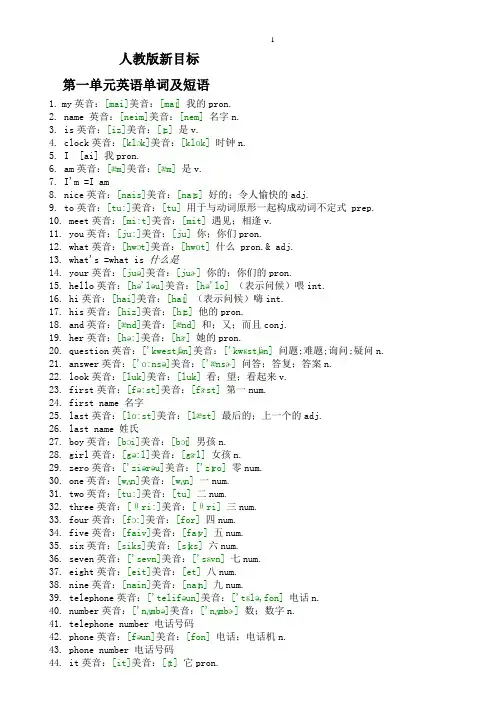
人教版新目标第一单元英语单词及短语1.my英音:[mai]美音:[maɪ]我的pron.2. name 英音:[neim]美音:[nem] 名字n.3. is英音:[iz]美音:[ɪz]是v.4. clock英音:[klɔk]美音:[klɑk]时钟n.5. I [ai] 我pron.6. am英音:[æm]美音:[æm]是v.7. I'm =I am8. nice英音:[nais]美音:[naɪs]好的;令人愉快的adj.9. to英音:[tu:]美音:[tu]用于与动词原形一起构成动词不定式 prep.10. meet英音:[mi:t]美音:[mit]遇见;相逢v.11. you英音:[ju:]美音:[ju]你;你们pron.12. what英音:[hwɔt]美音:[hwɑt]什么 pron.& adj.13. what's =what is 什么是14. your英音:[juə]美音:[juɚ]你的;你们的pron.15. hello英音:[hə'ləu]美音:[hə'lo](表示问候)喂int.16. hi英音:[hai]美音:[haɪ](表示问候)嗨int.17. his英音:[hiz]美音:[hɪz]他的pron.18. and英音:[ænd]美音:[ænd]和;又;而且conj.19. her英音:[hə:]美音:[hɝ] 她的pron.20. question英音:['kwestʃən]美音:['kwɛstʃən]问题;难题;询问;疑问n.21. answer英音:['ɑ:nsə]美音:['ænsɚ]问答;答复;答案n.22. look英音:[luk]美音:[luk]看;望;看起来v.23. first英音:[fə:st]美音:[fɝst]第一num.24. first name 名字25. last英音:[lɑ:st]美音:[læst]最后的;上一个的adj.26. last name 姓氏27. boy英音:[bɔi]美音:[bɔɪ]男孩n.28. girl英音:[gə:l]美音:[gɝl]女孩n.29. zero英音:['ziərəu]美音:['zɪro]零num.30. one英音:[wʌn]美音:[wʌn]一num.31. two英音:[tu:]美音:[tu]二num.32. three英音:[θri:]美音:[θri]三num.33. four英音:[fɔ:]美音:[for]四num.34. five英音:[faiv]美音:[faɪv]五num.35. six英音:[siks]美音:[sɪks]六num.36. seven英音:['sevn]美音:['sɛvn]七num.37. eight英音:[eit]美音:[et]八num.38. nine英音:[nain]美音:[naɪn]九num.39. telephone英音:['telifəun]美音:['tɛlə,fon]电话n.40. number英音:['nʌmbə]美音:['nʌmbɚ]数;数字n.41. telephone number 电话号码42. phone英音:[fəun]美音:[fon]电话;电话机n.43. phone number 电话号码44. it英音:[it]美音:[ɪt]它pron.45 it's=it is它是46. card英音:[kɑ:d]美音:[kɑrd]卡;卡片n47. ID card (ID=identification) 身份证identification英音:[ai,dentifi'keiʃən]美音:[aɪ,dɛntəfə'keʃən]48. family英音:['fæmili]美音:['fæməlɪ]家;家庭n.49. family name 姓氏新目标第二单元单词及短语1. this英音:[ðis]美音:[ðɪs]这;这个pron.& adj.2. pencil英音:['pensl]美音:['pɛns!]铅笔n.3. pen英音:[pen]美音:[pɛn]钢笔n.4. book英音:[buk]美音:[buk]书n.5. eraser英音:[i'reisə]美音:[ɪ'resɚ]橡皮;铅笔擦;黑板擦n.6. ruler英音:['ru:lə]美音:['rulɚ]尺;直尺n.7. case英音:[keis]美音:[kes]箱;盒;橱n.8. pencil case 铅笔盒;文具盒9. backpack英音:['bækpæk]美音:['bæk,pæk]双肩背包n.back英音:[bæk]美音:[bæk]背,背部pack英音:[pæk]美音:[pæk]包;捆;包裹;背包sharpener英音:['ʃɑ:pənə]美音:['ʃɑrpnɚ]磨具10. pencil sharpener 卷笔刀;铅笔刀11. dictionary英音:['dikʃəneri]美音:['dɪkʃən,ɛrɪ] 字典;词典n.12. that英音:[ðæt]美音:[ðæt] 那;那个pron.& adj.13. yes英音:[jes]美音:[jɛs] (表示肯定)是adv.14. no英音:[nəu]美音:[no] (表示否定)不;不是adv.15. not英音:[nɔt]美音:[nɑt] (构成否定形式)不是adv.16. isn't =is not17. thank英音:[θæŋk]美音:[θæŋk] 感谢v.18. OK 好;不错 interj19. in英音:[in]美音:[ɪn] 用(表示方法,媒介,工具等)prep.20. English英音:['iŋgliʃ]美音:['ɪŋglɪʃ] 英语;英文n.21. a英音:[ei]美音:[ə] 一个(只,把,台……)art.22. how英音:[hau]美音:[hau] (指程度)多么;何等;怎样adv.23. do英音:[du:]美音:[du] 做;干;构成否定句、疑问句的助动词v.& aux.24. spell英音:[spel]美音:[spɛl] 拼写v.base英音:[beis]美音:[bes] 基础;基料ball英音:[bɔ:l]美音:[bɔl] 球;球状体25. baseball英音:['beis,bɔ:l]美音:['bes,bɔl] 棒球n.26. watch英音:[wɔtʃ]美音:[wɑtʃ] 手表n.27. computer英音:[kəm'pju:tə]美音:[kəm'pjutɚ] 电脑n.28. game英音:[geim]美音:[gem] 运动;游戏n.29. key英音:[ki:]美音:[ki] 钥匙n.30. notebook英音:['nəutbuk]美音:['not,buk] 笔记本n.31. ring英音:[riŋ]美音:[rɪŋ] 环(状物);戒指n.32. call英音:[kɔ:l]美音:[kɔl] 打电话 v.33. at英音:[æt]美音:[æt] 在…(里面或附近);在…(点、刻);以 prep.34. the英音:[ðə]美音:[ðə] 表示特指的人、物、事或群体art.35. lost英音:[lɔst]美音:[lɔst] 丢失的;遗失的adj.36. found英音:[faund]美音:[faund] (find的过去式,过去分词)找回 v.37. lost and found 失物招领38. please英音:[pli:z]美音:[pliz] (祈使句用作请求的客套话)请interj39. school英音:[sku:l]美音:[skul] 学校 n.40. a set 英音:[set]美音:[sɛt] 一套;一副41. of 英音:[ɔv]美音:[ɑv] (属于)…的42. excuse英音:[iks'kju:z]美音:[ɪk'skjuz] 原谅;宽恕 v.43. excuse me 请原谅第三单元单词及短语1. sister英音:['sistə]美音:['sɪstɚ] 姐;妹n.2. mother英音:['mʌðə]美音:['mʌðɚ] 妈妈;母亲n.3. father英音:['fɑ:ðə]美音:['fɑðɚ] 爸爸;父亲 n.4. parent英音:['pɛərənt]美音:['pɛrənt] 父亲或母亲n.5. brother英音:['brʌðə]美音:['brʌðɚ] 兄;弟n.grand英音:[grænd]美音:[grænd]全部的,总的前缀 pref. 1.表示"祖父母辈的"(如:grandfather) 2.表示"孙子女辈的"(如:granddaughter6. grandmother英音:['grænd,mʌðə]美音:['grænd,mʌðɚ] 祖母;外祖母n.7. grandfather英音:['grænd,fɑ:ðə]美音:['grænd,fɑðɚ] 祖父;外祖父n.8. friend英音:[frend]美音:[frɛnd] 朋友n.9. grandparent英音:['grænd,pɛərənt]美音:['grænd,pɛrənt] 祖父/母;外祖父/母n.10. these英音:[ði:z]美音:[ðiz] 这些 pron.& adj.11. are英音:[ɑ:]美音:[ɑr] 是v.12. those英音:[ðəuz]美音:[ðoz] 那些pron.& adj.13. she英音:[ʃi:]美音:[ʃi] 她pron.14. he英音:[hi:]美音:[hi] 他pron.15. picture英音:['piktʃə]美音:['pɪktʃɚ] 照片;图片 n.16. son英音:[sʌn]美音:[sʌn] 儿子 n.17. cousin英音:['kʌzn]美音:['kʌzn] 堂(表)兄弟;堂(表)姐妹n.18. daughter英音:['dɔ:tə]美音:['dɔtɚ] 女儿 n.19. uncle英音:['ʌŋkl]美音:['ʌŋk!] 叔;伯;舅;姨夫;姑父 n.20. aunt英音:[ɑ:nt]美音:[ænt] 姨母;姑母;伯母;婶母 n.21. dear英音:[diə]美音:[dɪr] (冠于信函中的称谓,以示礼貌)亲爱的adj.25. for英音:[fɔ:]美音:[fɔr] 为了 prep 22. thanks for 为……而感谢23. photo英音:['fəutəu]美音:['foto] 照片;相片n.24. here英音:[hiə]美音:[hɪr] 这里;在这里adv.第四单元单词及短语1. where英音:[hwɛə]美音:[hwɛr]哪里 adv2. table英音:['teibl]美音:['teb!]桌子n.3. bed英音:[bed]美音:[bɛd]床 n.4. dresser英音:['dresə]美音:['drɛsɚ]梳妆台n.5. bookcase英音:['bukkeis]美音:['buk,kes]书柜;书橱n.6. sofa英音:['səufə]美音:['sofə]沙发n.7. chair英音:[tʃɛə]美音:[tʃɛr]椅子n.8. drawer英音:['drɔ:ə]美音:['drɔɚ]抽屉n.9. plant英音:[plɑ:nt]美音:[plænt]植物n.10. under英音:['ʌndə]美音:['ʌndɚ]在..下面 prep.11. they英音:[ðei]美音:[ðe]他们 pron.12. on英音:[ɔn]美音:[ɑn]在..上面 prep.13. know英音:[nəu]美音:[no]知道;了解 v.14. bag英音:[bæg]美音:[bæg]书包;提包;袋子 n.15. math英音:[mæθ]美音:[mæθ]数学 n.alarm英音:[ə'lɑ:m]美音:[ə'lɑrm]警报;警报器16. alarm clock 闹钟compact英音:[kəm'pækt]美音:[kəm'pækt]结实的;带镜粉盒disc英音:[disk]美音:[dɪsk]圆盘;盘状物;圆平面abbreviation英音:[ə,bri:vi'eiʃən]美音:[ə,brivɪ'eʃən]缩写,省略;缩短17. CD (=compact disc) 光盘 abbr.18. video英音:['vidiəu]美音:['vɪdɪ,o]录像;视频 n.19. tape英音:[teip]美音:[tep]录音带 n.20. video tape录像带21. hat英音:[hæt]美音:[hæt]帽子 n.22. take英音:[teik]美音:[tek]拿走;带到 v.23. thing 英音:[θiŋ]美音:[θɪŋ]东西;物 n.prep英音:[prep]美音:[prɛp]预习;预备班(或学校);准备工作24. to英音:[tu:]美音:[tu]朝;向;至;达 prep.25. mom英音:[mɔm]美音:[mɑm] (非正式用语)妈妈 n.modal英音:['məudl]美音:['modl]情态词;形态上的;形式的;程序的26.can英音:[kæn]美音:[kæn]能;可以;会 modal v.27. bring英音:[briŋ]美音:[brɪŋ]拿来;取来;带来 v.pron代词adj形容词28. some英音:[sʌm]美音:[sʌm]一些;若干pron.& adj.29. need英音:[ni:d]美音:[nid]需要 v.30. floor英音:[flɔ:]美音:[flor]地板;地面 n.31. room英音:[ru:m]美音:[rum]房间 n.television英音:['teli,viʒən]美音:['tɛlə,vɪʒən]电视;电视机 (=television) 电视;电视机 abbr.33. desk英音:[desk]美音:[dɛsk]课桌;书桌 n.第五单元单词及短语1. have英音:[hæv]美音:[hæv]有;吃;饮v.2. soccer英音:['sɔkə]美音:['sɑkɚ]英式足球 n.3. ball英音:[bɔ:l]美音:[bɔl] 球 n.4. soccer ball 英式足球5. tennis英音:['tenis]美音:['tɛnɪs]网球 n.6. racket英音:['rækit]美音:['rækɪt](网球、羽毛球的)球拍 n.7. tennis racket 网球拍8. ping-pong英音:['piŋpɔŋ]美音:['pɪŋ,pɑŋ]乒乓球 n.volley英音:['vɔli]美音:['vɑlɪ]齐射出的子弹(或箭等)9.volleyball英音:['vɔli,bɔ:l]美音:['vɑlɪ,bɔl]排球 n.basket英音:['bɑ:skit]美音:['bæskɪt]篮,篓,筐10. basketball英音:['bæskitbɔ:l]美音:['bæskɪt,bɔl]篮球 n.11. bat英音:[bæt]美音:[bæt](乒乓球等的)球拍 n.auxiliary英音:[ɔ:g'ziljəri]美音:[ɔg'zɪljərɪ]助动词;辅助的;补充的12. does英音:[dʌz]美音:[dʌz] (do的第三人称单数)做;干;构成否定句、疑问句的助动词 v.& aux.13. doesn't = dost not14. let英音:[let]美音:[lɛt]允许;让 v.15. us英音:[ʌs]美音:[ʌs]我们(we的宾格)pron.16. let's =let us让我们17. play英音:[plei]美音:[ple]玩;打球 v.18. sound英音:[saund]美音:[saund]听起来v.19. good英音:[gud]美音:[gud]良好的;令人满意的adj.20. sport英音:[spɔ:t]美音:[sport]运动;游戏 n.21. we英音:[wi:]美音:[wi]我们pron.22. many英音:['meni]美音:['mɛnɪ]大量的adj.23. club英音:[klʌb]美音:[klʌb]社团;俱乐部 n.24. more英音:[mɔ:]美音:[mor]更多的;更大的 pron.25. class英音:[klɑ:s]美音:[klæs](一节)课;班级 n.interest英音:['intərist]美音:['ɪntərɪst]兴趣;关注;爱好sting英音:[stiŋ]美音:[stɪŋ]刺痛,使疼痛26. interesting英音:['intəristiŋ]美音:['ɪntərɪstɪŋ]有趣的;令人感兴趣的adj.27. boring英音:['bɔ:riŋ]美音:['borɪŋ]无聊的;令人生厌的adj.28. fun英音:[fʌn]美音:[fʌn]有趣的;令人愉快的adj.29. difficult英音:['difikəlt]美音:['dɪfə,kəlt]困难的adj.30. relaxing英音:[ri'læksiŋ]美音:[rɪ'læksɪŋ]轻松的adj.31. watch英音:[wɔtʃ]美音:[wɑtʃ]观看;注视 v.32. watch TV 看电视33. has英音:[hæz]美音:[hæz](have的第三人称单数形式)有v.34. great英音:[greit]美音:[gret]美妙的;大的adj.35. collection英音:[kə'lekʃən]美音:[kə'lɛkʃən]收藏品;收集物 n.36. but英音:[bʌt]美音:[bʌt]但是conj.sports英音:[spɔ:ts]美音:[spɔrts]运动的;(指衣服等)适用于运动的37. play sports 参加体育运动或比赛conj连接词 adv副词38. only英音:['əunli]美音:['onlɪ]只;仅仅adv.39. them英音:[ðem]美音:[ðɛm] (they的宾格)他(她、它)们pron.they英音:[ðei]美音:[ðe] (主格)他们;她们;它们40. every英音:['evri]美音:['ɛvrɪ]每一;每个adj.41. day英音:[dei]美音:[de]天;日间;白天;一日n.第六单元单词及短语1. like英音:[laik]美音:[laɪk]喜欢 v.2. banana英音:[bə'nɑ:nə]美音:[bə'nænə]香蕉 n.3. hamburger英音:['hæmbə:gə]美音:['hæmbɝgɚ]汉堡包n.4. tomato英音:[tə'meitəu]美音:[tə'meto]西红柿n.5. broccoli英音:['brɔkəli]美音:['brɑkəlɪ]花椰菜n.French英音:[frentʃ]美音:[frɛntʃ]n. 法国人;法语 a. 法国的;法语的fries英音:[fraiz]美音:[fraɪz]炸薯条6. French fries 炸马铃薯条;薯条7. orange英音:['ɔ:rindʒ]美音:['ɔrɪndʒ]橙子n.8. ice英音:[ais]美音:[aɪs]冰n.9. cream英音:[kri:m]美音:[krim]奶油;乳脂n.10. ice cream 冰淇淋11. salad英音:['sæləd]美音:['sæləd]沙拉n.straw英音:[strɔ:]美音:[strɔ]稻草,麦秆berry英音:['beri]美音:['bɛrɪ](葡萄,番茄等)浆果;干果仁;干种子12. strawberry英音:['strɔ:bəri]美音:['strɔbɛrɪ]草莓n.ear英音:[iə]美音:[ɪr]耳朵13. pear英音:[pɛə]美音:[pɛr]梨n.14. have英音:[hæv]美音:[hæv]吃;饮v.15. oh英音:[əu]美音:[o]啊;噢;呀(表示惊讶等)interj.interj. 感叹词table英音:['teibl]美音:['teb!]桌子;餐桌;台countable英音:['kauntəbl]美音:['kauntəb!]可计算的;可数的noun 英音:[naun]美音:[naun]n.【语】名词16. countable noun 可数名词uncountable英音:['ʌn'kauntəbl]美音:[ʌn'kauntəb!]a. 无数的;不可数的17. uncountable noun 不可数名词18. food英音:[fu:d]美音:[fud]食物n.19. egg英音:[eg]美音:[ɛg]蛋;鸡蛋n.20. apple英音:['æpl]美音:['æpl]苹果n.21. carrot英音:['kærət]美音:['kærət]胡萝卜n.22. chicken英音:['tʃikin]美音:['tʃɪkɪn]鸡;鸡肉n.break英音:[breik]美音:[brek]毁坏,弄坏;砸破fast英音:[fɑ:st]美音:[fæst]快的;迅速的;速度快的23. breakfast英音:['brekfəst]美音:['brɛkfəst]早餐n.24. lunch英音:[lʌntʃ]美音:[lʌntʃ]午餐n.25. dinner英音:['dinə]美音:['dɪnɚ]晚餐;正餐n.26. fruit英音:[fru:t]美音:[frut]水果n.27. vegetable英音:['vedʒitəbl]美音:['vɛdʒətəb!]蔬菜;植物n.28. runner英音:['rʌnə]美音:['rʌnɚ]奔跑者n.29. eat英音:[i:t]美音:[it]吃v.30. well英音:[wel]美音:[wɛl]好;对;满意地adv.31. run英音:[rʌn]美音:[rʌn]跑;奔跑v.32. star英音:[stɑ:]美音:[stɑr]星星;明星n.33. lot英音:[lɔt]美音:[lɑt]许多;很多adv.34. lots of 大量;许多heal英音:[hi:l]美音:[hil]治愈,愈合thy英音:[ðai]美音:[ðaɪ]【古】你的(thou的所有格);胸腺抗原thou英音:[ðau]美音:[ðau]【古】(第二人称单数主格)汝,尔,你35. healthy英音:['helθi]美音:['hɛlθɪ]健康的;强健的adj.36. dessert英音:[di'zə:t]美音:[dɪ'zɝt](饭后的)甜食n.37. list英音:[list]美音:[lɪst]清单n.38. Bill英音:[bil]美音:[bɪl]比尔(男名)39. Sandra 桑德拉(女名)40. Clark英音:[klɑ:k]美音:[klɑrk]克拉克(姓)review英音:[ri'vju:]美音:[rɪ'vju]复习功课,温习功课unit英音:['ju:nit]美音:['junɪt]单位;单元Review of units 1---61. furniture英音:['fə:nitʃə]美音:['fɝnɪtʃɚ]家具(总称)n.2. people英音:['pi:pl]美音:['pip!]人;人民n.3. an英音:[æn]美音:[æn](元音前)一个(只,把,台…)art.art英音:[ɑ:t]美音:[ɑrt]艺术;美术4. blank英音:[blæŋk]美音:[blæŋk]空白n.5. conversation英音:[,kɔnvə'seiʃən]美音:[,kɑnvɚ'seʃən]交谈;谈话n.6. other英音:['ʌðə]美音:['ʌðɚ]另外的人(物)pron.7. also英音:['ɔ:lsəu]美音:['ɔlso]也;亦;而且adv.adv. 副词8. Joe英音:[dʒəu]美音:[dʒo]乔(男名)第七单元单词及短语how英音:[hau]美音:[hau](指数量、程度)多少much英音:[mʌtʃ]美音:[mʌtʃ]许多,大量1. how much (价钱)多少2. pants英音:[pænts]美音:[pænts]裤子3. sock英音:[sɔk]美音:[sɑk]短袜n.4. shirt英音:[ʃə:t]美音:[ʃɝt]男衬衣;衬衫n.5. T-shirt T恤衫n.6. shorts英音:[ʃɔ:ts]美音:[ʃɔrts]短裤n.7. sweater英音:['swetə]美音:['swɛtɚ]毛衣n.8. shoe英音:[ʃu:]美音:[ʃu]鞋n.9. skirt英音:[skə:t]美音:[skɝt]裙子n.10. sale英音:[seil]美音:[sel]出售;廉价销售n.11. dollar英音:['dɔlə]美音:['dɑlɚ]元(美国、加拿大等国的货币单位,符号为$)12. color英音:['kʌlə]美音:['kʌlɚ]色;颜色n.13. black英音:[blæk]美音:[blæk]黑色(的)adj.& n.14. white英音:[hwait]美音:[hwaɪt]白色(的)adj.& n.15. red英音:[red]美音:[rɛd] 红色(的)adj.& n.16. green英音:[gri:n]美音:[grin] 绿色(的)adj.& n.17. blue英音:[blu:]美音:[blu]蓝色(的)adj.& n.18. yellow英音:['jeləu]美音:['jɛlo]黄色(的)adj.& n.19. big英音:[big]美音:[bɪg]大的;广大的;重大的adj.20. small英音:[smɔ:l]美音:[smɔl]小的;小号的adj.21. short英音:[ʃɔ:t]美音:[ʃɔrt]短的;矮的adj.22. long英音:[lɔŋ]美音:[lɔŋ]长的adj.23. clerk英音:[klɑ:k]美音:[klɝk](银行、办公室、商店等)职员;办事员n.24. help英音:[help]美音:[hɛlp]帮助;援助v.25. want英音:[wɔnt]美音:[wɑnt]需要;想要v.here英音:[hiə]美音:[hɪr]这里,在这里;向这里26. Here you are. 给你27. welcome英音:['welkəm]美音:['wɛlkəm]不必客气的adj.28. You’re welcome. 不客气。