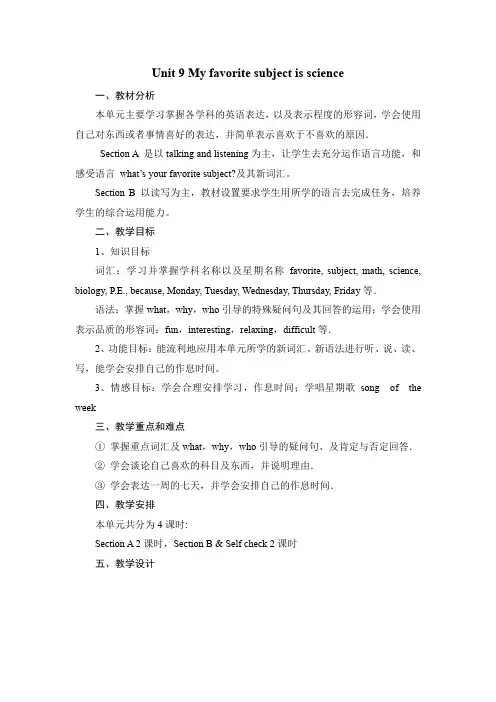
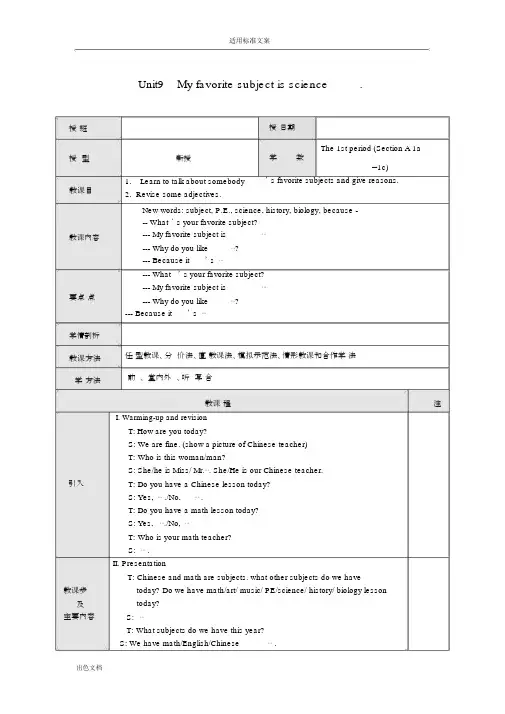
人教版七年级英语上册第九单元教案
- 格式:doc
- 大小:97.21 KB
- 文档页数:7
Unit 9 My favorite subject is science. The First Period (Section A, 1a –2c)Teaching aims and language points:1. Learn these words and expressions, and be able to say, read and write them: ● favorite, subject, science, P.E., music, math, Chinese ● geography, history, why, because2. Be able to talk about preferences and give reasons by using ● What's your favorite subject? ● My favorite subject is art. ● Why do you like P.E.? ● Because it's fun.Teaching steps:1. Warm-up, revision and presentation. (课堂热身和,(1)Daily greeting to the students (日常问候) (2)Present the question: What ’s your favorite ?Teach the Ss the new word: favorite. favorite color?” in pairs. (4)Revise the words of different sports and then get the Ss your favorite sport?” (5)Present the words of subjects and then get the Ss to discuss “W hat ’s yourfavorite subject?” 2. Work on 1a.(1)Match the words with the pictures.(2)Get the Ss to discuss their answers like this: A: Picture c is P.E.B: That ’s right. Picture f is art. ...3. Listening practice.(1) Work on 1b. Listen and circle the subjects. (2) Check the answers. 4. Pair workA: What ’s his/her/your/their favorite subject? B: It ’s ...5. Listening practice. (听力训练)(1) Ask the Ss to read the sentences in the picture in 2a and put them in order. (2) Work on 2a. Listen and check their answers.(3) Work on 2b. Listen and match the subjects with the descriptions. (4) Ask the Ss to report their answers like “P.E. is fun .” (5) Explain: Why do you like P.E.? Because it ’s fun. 6. Group work. (小组活动) Interview your group member (1) Make a chart.(2) Ss ask and answer like the conversation in 2c. A: What's your favorite subject? B: Science.A: Why do you like science? B: Because it's interesting.(3) Fill in the chart while talking.7. Homework (家庭作业)1. Remember the new words we learnt today.2. Write a report of your interview.eg. Liu Ming's favorite subject is science. He likes it because it is interesting. ...Unit 9 My favorite subject is science. The Second Period (Section A, 2d –3c)Teaching aims and language points:1. Learn these words and expressions, and be able to say, read and write them: ● Sunday, Monday, Tuesday, Wednesday, Thursday, Friday, Saturday, for sure2. Be able to talk about subjects, schedules and teachers by using ● --How's your day? ● --It's OK.● I like Monday because I have P.E. and history. ● --When do you have P.E.?● --We have P.E. on Monday and Friday. ● --Who's your P.E. teacher? ● --Mr. Hu.● I think history is interesting.That's for sure.Teaching steps:1. Warm-up and revision (课堂热身和复习)4. 进行小组调查就是为了给学生一个语言交际的理由,使学生运用本课时的单词和句型进行有意义有目的的对话。
教学设计说明1. 通过趣味游戏----“Bingo ” 来复习单词,可以使学生复习单词的拼写,更能较好地复习单词的读音。
(1)Daily greeting to the students (日常问候) (2)Game “Bingo ”. Revise the words of subjects.Write nine of these words in the square below. Then listen and cross out (X) the words you hear. Say “BINGO ” when you get a row of Xs. The first person to get a row of Xs in any direction is the winner.2. Presentation.(引入新知识)(1)Show a picture of calendar. Ask: How many months are there in a year? What are they?(2)Show a calendar of a month and ask: How many days are there in a week? What are they? Help the Ss to answer.(3)Watch a flash of the song: Days of the week. (4)Put the names of the days in order. (5)Ss learn to sing the song. 3. Practice. (操练)(1) Show a schedule of a week. Get the Ss to ask and answer in pairs. A: When do you have P.E.? B: I have P.E. on Monday and Friday.(2) Get some pairs to show their conversations. 4. Work on 2d.(1)Read the conversations and answer the questions about the conversation. (2)Role-play the conversation in 2d. (3)Follow the example in 2d and make up a conversation to talk about theschedule on the screen. 5. Grammar Focus.(1) Read through the sentences.2. 通过日历和月份名称引出星期几的名词,既可以达到复习上个单元旧知识的目的,又能够较为自然地将话题转移到新课的内容上来。
唱英语歌学单词可以使学生在较短时间容易地学会较多的单词,尤其是记住单词的读音。
3. 这个步骤是操练以“when ”开头的问句,并且反复练习表“星期几”的单词。
4. 对话除了按照教材照本宣科外,更要让学生模仿课文自己进行类似的语言交流,把知识转化为能力。
art Chinese Math English music science P.E. geography history computer(2) Ask the Ss to focus on the interrogative words and the answers.6.Working on 3a.(1)Fill in the blanks with what, who or why.(2)Check the answers.(3)Answer any questions the Ss raise.7. Work on 3b.(1) Write questions for the answers.(2) Ss check their answers in groups and then report their answers.8. Interview.(采访)9. Homework(家庭作业)1. Recite the conversation in Section A, 2d.2. Write a report about your interview in 3c.eg. Li Jingjing's favorite subject is music. She likes it because it's fun. And her musicteacher is Ms. Xie.Unit 9 My favorite subject is science.The Third Period (Section B, 1a–2b)Teaching aims and language points:1. Learn these words and expressions, and be able to say, read and write them: (6)free, cool, A.M., P.M., useful, from, from ... to ..., Mrs. , lesson, hour2. Learn these words and expressions, and be able to say and read them: (7)left, right, opposite, schedule, description, the same as3. Be able to talk about subjects, lessons and teachers by using(8)--What do you think of music?(9)--It's relaxing.(10)--When is the class? It's on Monday.(11)--When does Yu Mei have Chinese?(12)--She has Chinese from 8:00 to 8:50.Teaching steps:1. Warm-up. (课堂热身)Daily greeting to the students(日常问候)2. Revision and presentation.T: What subject is it?Ss: It’s music.Get the Ss to listen to a piece of music. Then ask:T: What do you think of music?Help them to answer.Ss: It ’s relaxing.(5) Show a picture of a history book. Ask the Ss: T: What subject is it?Ss: It ’s history.T: What do you think of history?Show some pictures to lead the Ss to give answers like “It ’s easy/fun/useful ”. Present the new word useful . 3. Work on 2a.● Ask some of theT: What do you think of history? Ss: I think it ’s ...T: Yes, I think so. / Oh, but I think it ’s ... ● Revise the adjectives they may use.● Make the Ss follow the sample and exchange ideas. 4. Work on 1a. (1) Read the words in 1a.(3) Teach the new words: free , cool (4) Check the answers. 5. Listening practice.(1) Work on 1b. Listen and check the words in 1a. (2) Read the schedule. (3) Workon 1c. Listen again and circle the classes David schedule.(4) Check the answers together. 6. Pair work.(1) Work on 1d. Ss talk about David ’to present their conversation to the class.(3) Get them to show their conversations in their pairs. 7. Reading.(3)Ss skim the text in 2b and ask: What is the letter about? subjects she doesn ’t like. Check their answers. the text for the third time. Then check their answers.8. Work on 2c.(1) Complete the schedule in 2c.(2) Ss check their answers in their groups.A: When does Yu Mei have Chinese?B: She has Chinese from 8:00 to 8:50.9. Pronunciation.(1) Listen and repeat.(2) Read aloud. Check the Ss’ pronunciation.(3) Talk about the rules of pronunciation and spelling.10. Homework(家庭作业)(1) Recite the text in Section B, 2b aloud.(2) Make a schedule for the week.Unit 9 My favorite subject is science.The Fourth Period (Section B, 2b–3c & Self Check)Teaching aims and language points:1. Consolidate and learn these words and expressions, and be able to use them:●fun, busy, time, class, lesson, finish, for, be OK with ..., thank you for ...2. Learn these words and expressions, and be able to say and read them:●holiday, National Day, discuss, invite … to …3. Be able to discuss activities and write a note by using●At 8:00 I have math.●The teacher says it is useful, but I think it is difficult.●It is difficult but interesting.●It is easy and fun.●Our Chinese teacher, Mrs. Wang, is great fun.●My classes finish at 1:50, but after that I have an art lesson for two hours.Teaching steps: Array 1. Warm-up and revision (课堂热身和复习)(1)Daily greeting to the students(日常问候)(2)Revision: Answer the questions about 2b.2. Studying 2b(1) Read the notes on the text.3. Work on 3a(1) Read the e-mail in 3a.(2) Number the parts of the message.(3) Explain the phrase: Is that OK with you?4. Self Check(1) Work on Activity 1. Ss add more words to eachanswers in groups. their answers in groups. 5. Pronunciation(1) Tell the Ss to note the stresses in the sentences. (2) Listen to the recording as an example.(4) Ss read the sentences one by one in their groups.6. Homework (家庭作业) (1) Fill in the schedule in Section B, 3b.(2) Work on Section B, 3c. Write an e-mail message.。