
新路径英语11册What-a-Mess!课件
- 格式:ppt
- 大小:18.10 MB
- 文档页数:18


《What a Mess!》知识清单在我们的生活中,常常会遇到各种各样混乱不堪的情况,不禁让人感叹“What a Mess!”。
从杂乱无章的房间到错综复杂的人际关系,从混乱无序的工作流程到拥堵不堪的交通状况,混乱似乎无处不在。
那么,让我们来深入探讨一下这个常见却又令人困扰的现象。
首先,我们来看看家庭中的混乱。
比如说,衣物随意扔在沙发上,书籍和杂物堆满了桌面,厨房里的餐具没有及时清洗摆放整齐。
这种混乱不仅影响了家居环境的美观,还可能给我们的生活带来不便。
找东西时费时费力,心情也会因为杂乱的环境而变得烦躁。
工作场所中的混乱同样不容忽视。
文件资料堆积如山,重要的文件可能被埋没在其中,导致工作效率低下。
团队成员之间的沟通不畅,任务分配不清晰,会让整个工作流程陷入混乱,项目进度受到影响。
再说说个人的时间管理混乱。
没有合理的规划,导致一天中很多时间被浪费在琐碎的事情上,重要的任务却被拖延。
学习计划没有条理,知识的积累也变得杂乱无章,无法形成系统的知识体系。
交通混乱也是一个让人头疼的问题。
道路拥堵,车辆乱停乱放,行人不遵守交通规则,这些都会导致交通瘫痪,影响人们的出行效率和安全。
那么,造成这些混乱的原因是什么呢?一方面,可能是缺乏良好的习惯和自律能力。
没有养成随手整理物品、按时完成任务、遵守规则的习惯。
另一方面,缺乏有效的规划和组织能力也是重要原因。
不知道如何合理安排空间、时间和资源,导致混乱的产生。
如何解决这些混乱呢?首先,要培养良好的习惯。
每天花一点时间整理房间,工作结束后及时整理桌面,制定并遵守时间计划。
其次,学会规划和组织。
对物品进行分类整理,制定清晰的工作流程和学习计划。
同时,要学会断舍离,舍弃不需要的物品,减少杂物的堆积。
在面对混乱时,保持冷静和耐心也非常重要。
不要因为一时的混乱而陷入焦虑和恐慌,而是有条不紊地逐步解决问题。
总之,混乱是生活中常见的现象,但我们可以通过培养良好的习惯、提升规划和组织能力,以及保持冷静和耐心来应对。
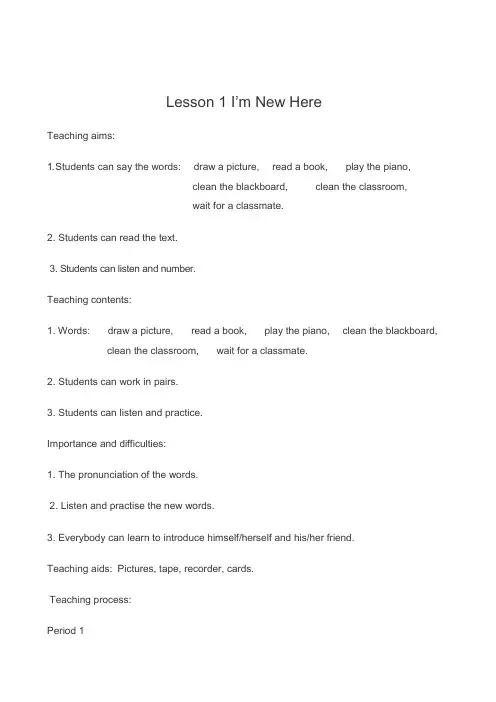
Lesson 1 I’m New HereTeaching aims:1. Students can say the words: draw a picture, read a book, play the piano,clean the blackboard, clean the classroom,wait for a classmate.2. Students can read the text.3. Students can listen and number.Teaching contents:1. Words: draw a picture, read a book, play the piano, clean the blackboard,clean the classroom, wait for a classmate.2. Students can work in pairs.3. Students can listen and practice.Importance and difficulties:1. The pronunciation of the words.2. Listen and practise the new words.3. Everybody can learn to introduce himself/herself and his/her friend.Teaching aids: Pictures, tape, recorder, cards.Teaching process:Period 1Teaching aims:1. Students can read the new words.2. Students can work in pairs.3. Students can listen and number them.Teaching contents:1. Magic box: draw a picture, read a book, play the piano, clean the blackboard,clean the classroom, wait for a classmate.2. Work in pairs.3. Listen and number.Importance and difficulties:1. The pronunciation of the words.2. Let‟s talk about the dialogue.Teaching aids: Pictures, tape, recorderTeaching process:Step 1. Greetings:The teacher and students greet each other.T: Hello, boys and girls!Ss: Hello, Miss Xiang!T: Nice to see you again!Ss: Nice to see you, too!T: What day is it today?Ss: It’s…….T:How’s the weather today?Ss: It’s……Step 2. Work in pairs.1. Say and do :(review some phrases)play football, draw a picture, do housework, ride a bike, read a book, play badminton, plant trees…….2. Play a gameStep 3. Listen and practise1. The teacher shows pictures. Ss look at them and follow the teacher:draw a picture, read a book, play the piano, clean the blackboard, clean the classroom, wait for a classmate.2. Play gamesto consolidate theses words.a. What’s the missing picture?b. What’s NO.2?3. The teacher points to a picture and do ask and answer:eg: What is he doing?He is reading a book.What is she doing?She is drawing a picture.4. Let students practice the sentences in pairs.Step 4. Listen and numberThe teacher plays the tape. Students listen to the tape and number them.⑴ What class are you in? I‟m in Class 7, Grade 6.⑵What are you doing? I‟m waiting for my teacher.⑶What class are you in? I‟m in Class 1, Grade 2.⑷ What is he doing? He is cleaning the classroom.Step 5. Play a gameStudents look at the two circles. Ask them to act as Betty or Simon. The partner choose the other. T: Tick three pictures in your balloon. Ask your partner’s questions.For example: What are you doing? I‟m flying a kite.Step 6. Homework1.Look at the pictures of page3, and write downeg: What is she doing? She is drawing a picture.2. Read the words and recite them.3. Listen to the text and read it.Period 2Teaching aims:1. Students can talk about the text.2. Students can act as the roles in the text.3. Students can read and tick the words.Teaching contents:1. New words:draw a picture, read a book, play the piano, clean the blackboard, clean the classroom, wait for a classmate.2. Look, read and tick the words.3. Read and write.Importance and difficulties:1. The pronunciation of the words.2. Students can understand the meaning of “ first name” and “ family name”.Teaching aids: Pictures, tape, recorderTeaching process:Step 1. Greetings:1.The teacher comes to the class, and say “Hello” to the students.T: Hello, boys and girls!Ss: Hello! Miss Xiang!T: What day is it today?Ss: It’s…….T:How’s the weather today?Ss: It’s……2. Sing an song together.Step 2. Revision:The teacher shows pictures, students look at them and read them. We can review thewords phrases. Then pratice them into groups. At last ask students to make sentences l ike this: I‟m doing housework. We‟re cleaning the classroom.Step 3. Le’s talk:Students look at page 2 and listen to the tape. Then students read after the teacher.T shows questions:1) What‟s the name of the new student?2) Who is talking to him?3) What class is WangTing in?Students answer them one by one. Ask students to act as the dialogue. Then listen to t he tape again and choose the correct answers.Step 4. Look, read and tick the word that matches the picture.Students look at the picture and choose right word. Then read words. Fill in theblanks with the paired words in the box. 1) Birds fly in the sky. 2) My sister is veryshy. 3) Try not to cry. 4) Some pies fell on my tie.Step 5 Read and writeLook at the pictures and read the story. Students can understand the meaning of“ first name” and “ family name”. Then answer the question: What is the boy‟s firstname and family name? The boy‟s first name is Sam, and his family name is Smith. Atlast students can write an article about himself.Step 6. Homework1. Recite the text.2. Finish an article about yourself.Lesson 2 What a Nice SchoolTeaching aims: 1. Students can say the words: teaching building, art room, music room, computer room, teachers’ office, library, toilet, playground.2. Students can read the text.3. Students can listen and number.4. Listen and sing.Teaching contents:1. Words: teaching building, art room, music room, computer room, teachers’ office, library, toilet, playground.2. Students can work in pairs.3. Students can listen and practice.4.Students can say the sentence:Where is the …?It‟s….5. Listen and sing.Importance and difficulties:1. The pronunciation of the words.2. Listen and practise the new words.3. Everybody can learn to introduce school and other things.Teaching aids: Pictures, tape, recorder, cards.Teaching process:Period 1Teaching aims:1. Students can read the new words.2. Students can work in pairs.3. Complete the sentences.Teaching contents:1. Magic box : teaching building, art room, music room, computer room,teachers’ office, library, toilet, playground.2. Work in pairs.3. Complete the sentences.Importance and difficulties:1. The pronunciation of the words.2. Let‟s talk about the dialogue.Teaching aids: Pictures, tape, recorderTeaching process:Step 1. Greetings:1.The teacher and students greet each other.T: Hello, boys and girls!Ss: Hello, Miss Xiang!T: Nice to see you again!Ss: Nice to see you, too!2.Sing an English songStep 2. Review ordinal numbers .The teacher draw a teaching building and write down some numbers.(Step 3. Listen and practise1.New words learning:art room,music room,computer room,teachers‟ romm, library,toilet,playground2.The teacher shows pictures. Ss look at them and follow the teacher:teaching building, art room, music room, computer room, teachers’ office, library, toilet, playground.3.play a game4.PracticeThe teacher points to a picture: Where is the art room? S1: It‟s on the fifth floor.Then points to another picture: Where is the art room? S2: It‟s on the fourth floor.Then ask students to practice the sentences into pairs.Step 4. Complete the sentences:Look at right picture and fill in the blank.(P7)Step 5. Listen and sing.First:Listen the song:The Children on a Bus.Second:Read the words of song.Third:Sing after the tape.Fourth:Match and sing.Step 6. Homework1) Read the words and recite them.2) Listen to the text and read it.Period 2Teaching aims:1. Students can talk about the text.2. Students can act as the roles in the text.3. Students can read and recite the words. Teaching contents: 1. Let‟s talk.2. Look, read and say the words.3. Read and write.Importance and difficulties:1. The correct use of prepositions.2. Letter‟s pronunciation:-oa- ,-oe ,-ow, o.3, Teaching aids: Pictures, tape, recorder Teaching process:Step 1. Greetings:The teacher comes to the class, and say “Hello” to the students.T: Hello, boys and girls!Ss: Hello! Miss Xiang!Then the students sing the song together.Step 2. Revision:The teacher shows pictures, students look at them and read them. We can review the words phrases. Then pratice them into groups. At last ask students to make sentences like this: Where is the art room? It‟s on the fifth floor.Step 3. Let‟s talk:(1)Students look at page 6 and listen to the tape. Then students read after the teacher. T shows questions:1) What are the boy and the girl talking about?2) Where are they now?3) Who is the new pupil?4)What is the girl?Students answer them one by one. Ask students to act as the dialogue. Thenlisten to the tape again and choose the correct answers.(2)Act the text.Step 4. Words’ pronunciation.-oa- -oe- -ow -o-1.Teaching the rules of the pronunciation.2.PracticeStep 5 Read ,write and say.Look at the pictures and read the story. Students can fill in the black. Then answerthe question: 1)What is the title of the text?2) Draw a picture of your school and then introduce it briefly.Step 6. Homework1. Recite the text.2. Introduce your school for your friend.Lesson3 Happy Teacher’s DayTeaching aims:1. Students can say the words: blowing out the candles, cutting the cake, eatingfruit, making a wish, practice English,have a party, tell a story, play a game, tell ajoke, celebrate Christmas2. Students can read the text.3. Students can talk about pictures.Teaching contents:1. Words: blowing out the candles, cutting the cake, eating fruit,making a wish, practice English, have a party, tell a story,play a game, tell a joke, celebrate Christmas2. Students can work in pairs.3. Students can listen and practice.Importance and difficulties:1. The pronunciation of the words.2. Listen and practise the new words.3. Everybody can use the given structures to describle pictures.Teaching aids: Pictures, tape, recorder, cards.Teaching process:Period 1Teaching aims:1. Students can read the new words.2. Students can work in pairs.3. Students can listen and number them.Teaching contents:1. Magic box: blowing out the candles, cutting the cake, eating fruit, making a wish, practice English, have a party, tell a story,play a game, tell a joke, celebrate Christmas2. Work in pairs.3. Listen and number.Importance and difficulties:1. The pronunciation of the words.2. Let’s talk about the dialogue.Teaching aids: Pictures, tape, recorderTeaching process:Step 1. Greetings:The teacher and students greet each other.T: Good afternoon, boys and girls!Ss: Good afternoon, Miss Xiang!T: Nice to see you again!Ss: Nice to see you, too!T: How are you today?Ss: I’m fine, thank you. And you?T: I’m fine, too. Thank you. How’s the weather today?Ss: It’s……Step 2. Lead in.1. Play a game(review the following words)play football, wash my face, dig a hole, clean the blackboard,read a book, play football, draw a picture, ride a bike…..2. Show pictures and practiceeg: What is he doing? He is riding a bike.What is she doing? She is drawing a picture.Step3 New lesson.1. Show pictures and learn the following new words.blowing out the candles, cutting the cake, eating fruit, making a wish, practice English, have a party, tell a story, play a game, tell a joke, celebrate Christmas2. Play games to consolidate these words.a. What’s NO.3?b. What’s the missing words?3. Show pictures and practise the sentence structure.What are they doing?They are practising English.4. Listen and choose.5. Have a chant.Doing, doing, doing.What are they doing?Eating, eating, eating.They are eating fruit.Homework:1. Write down the picture of page11(eg: What are they doing? They areplaying a game.)2. Pre-Reading Lesson 3Period 2.Teaching aims:1. Students can read the new words.2. Students can use the given sentence structure.3. Students can listen and read the dialogue.Teaching contents:1. Magic box: blowing out the candles, cutting the cake, eating fruit,making a wish, practice English, have a party, tell a story, play a game, tell a joke, celebrate Christmas2. Sentence structure : What are they doing? They are …….3. Listen and read the dialogue.Importance and difficulties:1. The sentence structure.2. Let’s talk about the dialogue.Teaching aids: Pictures, tape, recorderTeaching process:Step 1. Greetings:The teacher and students greet each other.T: Hello, boys and girls!Ss: Hello, Miss Xiang!T: Nice to see you again!Ss: Nice to see you, too!T: How are you today?Ss: I’m fine, thank you. And you?T: I’m fine, too. Thank you. How’s the weather today?Ss: It’s……Step 2. Lead in.1.Play a game(review the following words)play football, wash my face, dig a hole, clean the blackboard, read a book, play football, draw a picture, ride a bike….. 2.Show pictures and practiceeg: What is he doing? He is riding a bike.What is she doing? She is drawing a picture.What are they doing? They are practicing English.Step3. Listen and say.1. Listen and do the following exercises.( T or F)( ) Teacher’s Day is on December 10th.( ) They usually send cards and flowers to their teacher.( ) Sam sends roses on Mother’s Day.2 Read the dialogue and check the answers.2. Listen to the dialogue again and answer the following questions.1) What are they doing?2) What’s the date of that day?3) What do they usually do on Teacher’s Day?3. Read the dialogue and check the answers.4. Read the dialogue and perform it.Step4. SummaryShow pictures and review the sentence structure.What is he doing? He is riding a bike.What is she doing? She is drawing a picture.What are they doing? They are practicing English.Homework: 1. Read the text and recite the dialogue.2.Finish page62 “listen to the dialogue and choose the correct answers.Lesson 4 Paying a visitTeaching aims:1. Students can say the words: beside opposite living room dining roomstudy kitchen bathroom take a bath2. Students can listen and number.3.Students can use the sentence structures: Where is the……..? It’s……..Teaching contents:1. Words: beside opposite living room dining room study kitchenbathroom take a bath2. Students can work in pairs.3. Students can listen and practice.Importance and difficulties:1. The pronunciation of the words.2. Listen and practise the new words.3. Everybody can learn to introduce their rooms of the house. Teaching aids: Pictures, tape, recorder, cards.Teaching process:Period 1Step 1. Greetings:The teacher and students greet each other.T: Hello, boys and girls!Ss: Hello, Miss Xiang!T: Nice to see you again!Ss: Nice to see you, too!T: What day is it today?Ss: It’s…….T:How’s the weather today?Ss: It’s……Step 2. Work in pairs.1.Say and do :(review some phrases)play football, draw a picture, do housework, ride a bike, read a book, play badminton, plant trees…….2. Play a gameStep 3. Listen and practise1.The teacher shows pictures. Ss look at them and follow the teacher:Living room, dining room, study, kitchen, bathroom, take a bath, beside, opposite. …….2.Play gamesto consolidate theses words.a. What’s the missing picture?b. What’s NO.2?3.The teacher points to a picture and do ask and answer:Eg: Where is the living room?It’s beside the dining room.4.Practice in pairs.Eg: Where do we cook?We cook in the kitchen.Where is the kitchen?It’s opposite the dining room.5. Draw and say.Draw a picture of your own house and introduce it for us.Eg: Look, This is my house. This is the living room, it’s big, we watch TV here. This is the kitchen, it’s beside the study.Homework: Talk about your house to your family, then write something about your house.<< My house>>Period 2Step 1. Greetings:1.The teacher comes to the class, and say “Hello” to the students.T: Hello, boys and girls!Ss: Hello! Miss Xiang!T: What day is it today?Ss: It’s…….T:How’s the weather today?Ss: It’s……2. Sing an song together.Step 2. Revision:1.The teacher shows pictures, students look at them and read them. We can review thew ords . Then pratice them into groups.2. Let students share their <<My house>> to others. And point out their errors.Step 3. New lesson.1.Show pictures about drinks, and do ask and answers.T: There are so many drinks, I’d like some coffee. What would you like to drink?S1: I’d like some coke.S2: I’d like some juice.2.Let students work in pairs.Eg: What would you like to drink?I’d like some coke.3.Listen and answer my questions:What would Le Le like to drink?What would Summer like to drink?What would Rose like to drink?Where is the bathroom?4.Read the dialogue and check the answers.5.Read the dialogue for 2 minutes and recite it, then let some students perform this dialogue.Homework: Read <<Our fish tank>> and fill the blanks.Lesson 5 Making yourself at home.Teaching aims:1. Students can say the words: ride a bike, . listen to music, go swimming, go tothe park, open the window, close the door, turnon the light, turn off the light, have a look, makea phone call.2. Students can read the text.3. Students can listen and say.Teaching contents:1. Words: ride a bike, . listen to music, go swimming, go to the park, openthe window, close the door, turn on the light, turn off the light,have a look, make a phone call.2. Students can work in pairs.3. Students can listen and practice.Importance and difficulties:1. The pronunciation of the words.2. Listen and practise the new words.Teaching aids: Pictures, tape, recorder, cards.Teaching process:Period 1Teaching aims:1. Students can read the new words.2. Students can work in pairs.3. Students can listen and number them.Teaching contents:1. New words: ride a bike, . listen to music, go swimming, go to the park, open the window, close the door, turn on the light, turn off the light, have a look, make a phone call.2. Work in pairs.3. Listen and number.Importance and difficulties:1. The pronunciation of the words.2. Let‟s talk about the dialogue.Teaching aids: Pictures, tape, recorderTeaching process:Step 1. Greetings:The teacher and students greet each other.T: Hello, boys and girls!Ss: Hello, Miss Xiang!T: Nice to see you again!Ss: Nice to see you, too!T: What day is it today?Ss: It’s…….T:How’s the weather today?Ss: It’s……Step 2. Work in pairs.1.Say and do :(review some phrases)play football, draw a picture, do housework, ride a bike, read a book,play badminton, plant trees…….2.Play a gameStep 3. New lesson.1.New words learning. Show pictures and learn the new words.ride a bike, . listen to music, go swimming, go to the park, open the window, close the door, turn on the light, turn off the light, have a look, make a phone call.2.play a game to consolidate these words.3.Do ask and answer.T: Boys and girls, are you hot today?Ss: Yes…T: I feel very hot, May I open the window?(Do the actions)Ss: Yes.T: May I close the door?S: Yes, of course.T: May I listen to music?S:Yes, of course.T: Ok, very good. Now it's your turn, you ask me, who want to try?S: May I .....?T: Yes,of course.Step 3 presentationGood, boys and girls, now we sill play a game,"pass words". Here are 4 rooms. You have 4 gr oups, so g1 is a kitchen, g2 is a study, g3 is a bathroom, g4 is a living room. And here are 4 br ooms, the first student should clean your seat and then pass my words and the broom one by one. Ok , good job, through this game, we review the words....T: Class, do you help your mum do housework?S: YesT:When you help your mother, you will say: "Can I help you?"Ok, follow me ....... Plese guess, what's the meaning?S:.............T: Very good, now I need help, who can help me to clean the blackboad?S: Can I help you?T: Yes, please......Step 4 practiseHigh low voice: read new words.Paire work: practise the dialogue.Step 5 Homework Review the words and dialogue.Lesson6 What a mess!Teaching Contents:1. Vocabulary: make the bed make the tea cook the meals set the tableclean the table do the dishes wash the cups2. Sentence structure: Can I help you?_____Yes, please water the flowers.Teaching Objectives:1. To master the new words: make the bed make the tea cook the mealsset the table clean the table do the dishes wash the cups2. To enable to use the new words and new structures in communication correctly .3. To learn how to ask for help.Important points and difficult points:1. To enable to distinguish the new words easily.2. To master the new structures and to use the structure to ask for helpTeaching Aids: Pictures, Radio .PPTTeaching process:Step 1. Greetings:The teacher and students greet each other.T: Good afternoon, boys and girls!Ss: Good afternoon, Miss Xiang!T: Nice to see you again!Ss: Nice to see you, too!T: How are you today?Ss: I’m fine, thank you. And you?T: I’m fine, too. Thank you. How’s the weather today?Ss: It’s……Step 2. Lead in.1.Show pictures and do ask and answer:T: In this picture,What can you see?Ss: I can see ..........T: Is the floor dirty?Ss: Yes.T: Yes, it’s so dirty. What a mess!(follow me, What a mess!)Step3 New lesson.1.New words learning.T: Boys and girls,do you help your mother do housework?Ss: Yes.T: You are good boys and girls. Good boys and girls always ask their mother, “Can I help you?” (Let students follow me). Now, I am your mother. I am cleaning the bedroom. Try to be good and help me.Ss: Mom, Can I help you?T: Yes, Please make the bed.( From this way ,we can learn the new words and Know something about he sentence structure)make the bed make the tea cook the meals set the table clean the table do the dishes wash the cups2.Practise3.Listen and do ask and answer.a. How many people are there in the dialogue?b. Who helps to sweep the floor?c. Who helps to wash the cups?d. Who helps to clean the table?4. Perform, Let students read the dialogue and then let some students to perform the dialogue.Homework:Review What we learned, and let students do something for your parents. Lesson 7 Happy HalloweenTeaching Contents:1. Vocabulary: pumpkin, jack-o’-lantern, ghost, witch2. Sentence structure: This /That is a tomato. This /That is nota pumpkin.These / Those are tomatoes. These / Those are not tomatoes.3. Communication: Use the new sentence structure and new words to communicatewith each other.Teaching Objectives:1. To master the new words: pumpkin jack-o’-lantern ghost witch2. To enable to make a conversation using the sentence structure correctly:This /That is a tomato.This /That is not a pumpkin.These / Those are tomatoes.These / Those are not tomatoes.3. To enable to use the new words and new structures in communication correctly .4. To learn how to pay a visit or how to welcome the visitors.Important points and difficult points:1. To enable to distinguish the four new words easily.2. To master the new structures:This /That is a tomato.This /That is not a pumpkin.These / Those are tomatoes.These / Those are not tomatoes.3. To use the structure to ask for yes or no.4. Can change the two sentence structure correctly:This is a tomato.-----Is this a tomato?Teaching Aids: Pictures, Radio .PPTTeaching Procedures:step1 Greetingstep2 Warming up:1). Review: Check the homework- ( Choose two or three groups to act it out .)step3. Lead in : Look at the video on the PPT.step4. Reading the passage about the Halloween and answer the questions.step5. Tell students the backgroud information of Halloween and lead in the newwords.Step6 New words: pumpkin jack-o’-lantern ghost witch1. pumpkin :1)Show a picture of pumpkin ,then teach them read: This is a pumpkin.2) Ask students make sentences use this words.2. jack-o’-lantern :1)teacher ask one students come to the stage, show a pictureof it. Ask the students do right action , then let other students guess . After that teacher tea ch them read :This is a jack-o;-lantern.2) Ask students make sentences use this words.3.witch: 1) Guessing gamelead in and then teach them read: This is a witch2) Ask students make sentences use this words.4.ghost : 1)Teacher do the action and in a strange voice , ask students guess ,thenteach them read: This is a ghost.2) Ask students make sentences use this words.Step7 Play games:1) What's missing2)BoomingStep 8 Practice:1) Match the words and pictures.2)Listen and number.Step 9 New structure:1. Use the game to lead in: What’s this ….2.Teach students read the new structures .3. Practice: work in pairs.Step 10 Consolidates1)Work in pairs : Work in pairs to practice the new words and structures threeminutes ,then ask some pairs to show their conversations on the stage.2)Play a game: One student come to the stage face to the students, wear the hatwith new words, and he should ask like this : “Am I a pumpkin?” Other students answer “Yes, you are./No you are not.”3)Practice : Play the game on page 44.Step11 Listen to the tape and finish the task1) Tick the words .2) Order the pictures.3) Fill in the blanks.1. That -----a pumpkin.2.That –---a jack-o’-lantern.3.what’s ----? It’s an orange.4.------are clowns.Summary :Ask students sum up what we have learnt in this class, and then teacher do some additions.Homework: 1) Write the new words and make sentences.2) Tell the story of Halloween to others and get ready for a party of Halloween. Lesson8 Thanksgiving Day.Teaching concept :Create an comfortable, happy, exciting teamwork environmentfor all the pupils.Teaching aims :Know more about the oriental andwestern culture and tradition.Learn tointroduce one of your favourite festivals to your friends.Important and difficult points :Distinguish the differences between the oriental andwesternculture.And introduce one of your favourite festivals to your friend.Teaching preparation: Text recording,PPTTeaching proceduresStep1:Warm up1. Greetings2.Duty reportStep 2:Presentation1.In last lesson,we learned a festival-Halloween. It’s very popular. When is Halloween? (It’s o n October 31st.)2.Today we are going to learn another festival. It’s popular,too. Look at the pictures. Guess:W hat festival is it ?Step 3:Practice1.I want to introduce some useful words to you. They can help you learn easier.(celebrate, harvest, pumpkin pie, Thanks for, Chinese lunar calendar)2. Here is an e-mail about Thanksgiving Day .It’s from Summer to Tingting.Let’s listen to thetape. And please think about these questions.When is Thanksgiving Day?What food do we eat on Thanksgiving Day ?Why do we eat these food? What do we do on Thanksgiving Day?Tingting sends an e-mail to summer to introduce our Mid-autumn Festival. And please think about these questions.When is Mid-autumn Festival?What food do we eat on Mid-autumn Festival ?Why do we eat this food? What do we do on Mid-autumn Festival ?。

