
ZARA渠道研究 英文版
- 格式:ppt
- 大小:10.05 MB
- 文档页数:29
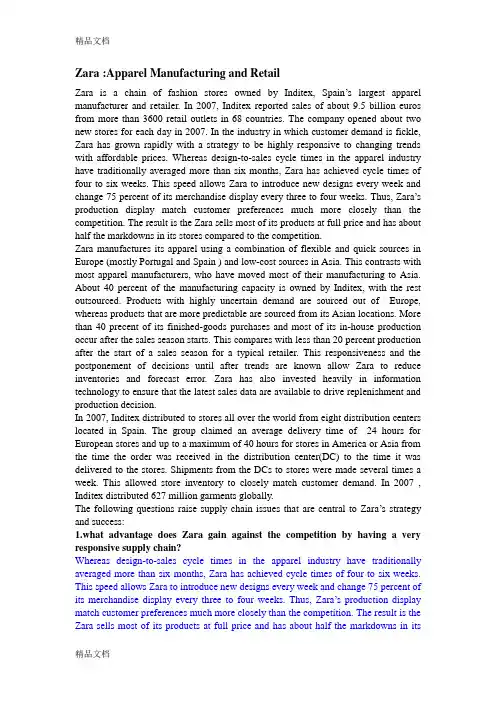
Zara :Apparel Manufacturing and RetailZara is a chain of fashion stores owned by Inditex, Spain’s largest apparel manufacturer and retailer. In 2007, Inditex reported sales of about 9.5 billion euros from more than 3600 retail outlets in 68 countries. The company opened about two new stores for each day in 2007. In the industry in which customer demand is fickle, Zara has grown rapidly with a strategy to be highly responsive to changing trends with affordable prices. Whereas design-to-sales cycle times in the apparel industry have traditionally averaged more than six months, Zara has achieved cycle times of four to six weeks. This speed allows Zara to introduce new designs every week and change 75 percent of its merchandise display every three to four weeks. Thus, Zara’s production display match customer preferences much more closely than the competition. The result is the Zara sells most of its products at full price and has about half the markdowns in its stores compared to the competition.Zara manufactures its apparel using a combination of flexible and quick sources in Europe (mostly Portugal and Spain ) and low-cost sources in Asia. This contrasts with most apparel manufacturers, who have moved most of their manufacturing to Asia. About 40 percent of the manufacturing capacity is owned by Inditex, with the rest outsourced. Products with highly uncertain demand are sourced out of Europe, whereas products that are more predictable are sourced from its Asian locations. More than 40 precent of its finished-goods purchases and most of its in-house production occur after the sales season starts. This compares with less than 20 percent production after the start of a sales season for a typical retailer. This responsiveness and the postponement of decisions until after trends are known allow Zara to reduce inventories and forecast error. Zara has also invested heavily in information technology to ensure that the latest sales data are available to drive replenishment and production decision.In 2007, Inditex distributed to stores all over the world from eight distribution centers located in Spain. The group claimed an average delivery time of 24 hours for European stores and up to a maximum of 40 hours for stores in America or Asia from the time the order was received in the distribution center(DC) to the time it was delivered to the stores. Shipments from the DCs to stores were made several times a week. This allowed store inventory to closely match customer demand. In 2007 , Inditex distributed 627 million garments globally.The following questions raise supply chain issues that are central to Zara’s strategy and success:1.what advantage does Zara gain against the competition by having a very responsive supply chain?Whereas design-to-sales cycle times in the apparel industry have traditionally averaged more than six months, Zara has achieved cycle times of four to six weeks. This speed allows Zara to introduce new designs every week and change 75 percent of its merchandise display every three to four weeks. Thus, Zara’s production display match customer preferences much more closely than the competition. The result is the Zara sells most of its products at full price and has about half the markdowns in itsstores compared to the competition.ZARA的灵敏供应链系统,大大提高了ZARA的前导时间。

ZARA的分销渠道分析一、前言对企业来说,其市场竞争优势主要来自两个基本方面:比竞争对手具有更低成本和具有独特特色的经营方式。
良好的分销渠道可以在这两个方面为企业以至为整个分销渠道组织创造和加强竞争优势,获取更多利润。
那今天,我们就来分析一下ZARA的分销渠道。
二、ZARA集团概况ZARA是西班牙Inditex集团旗下的一个子公司,它既是服装品牌,也是专营ZARA品牌服装的连锁零售品牌。
1975年设立于西班牙的ZARA,被喻为“时装行业中的戴尔电脑”、“时装行业的斯沃琪手表”,为全球排名第三、西班牙排名第一的服装零售商,在世界各地56个国家内,设立超过两千多家的服装连锁店,2004年度全球营业收入46亿欧元,利润4.4亿欧元,获利率9.7%,比美国第一大服饰连锁品牌GAP的6.4%还要出色。
ZARA旗下拥有400余位的专业设计师,一年推出的商品超过120000款,可说是同业的5倍之多。
ZARA公司是从西班牙西北部拉科鲁尼亚的港口城市加利西亚走向世界的,该公司独特的供应链管理,使其成为全球服装行业中,在响应速度与弹性管理上的标竿化企业。
三、ZARA分销渠道ZARA作为世界上最成功的持续增长的企业之一,其成功关键在于它的垂直分销系统和快速反应。
ZARA的垂直分销系统:产品开发——生产制造——批发——零售终端——消费者。
而快速反应是ZARA的核心竞争力,ZARA的一件产品从设计开始到选料、染整、剪裁、针锋、整烫、运送乃至成品上架,最长只需3周的快速供应体系。
下面具体了解一下ZARA运作模式:ZARA的运作模式:高效的集成式生产模式与高速的物流配送系统。
工厂工作人员收到设计师的原型裁片,在电脑上以最节省布料成本的方式排版。
布料裁剪后,按服饰各部位的布片分袋包装,送往工厂生产。
为追求速度,代工厂50%以上在西班牙总部附近区域,以及摩洛哥和葡萄牙。
任何地方代工的产品最后都集中到总部,再统一配送出去。
ZARA总部有世界最长的成衣地下轨道。
