现在完成时和过去完成时
- 格式:doc
- 大小:56.50 KB
- 文档页数:5
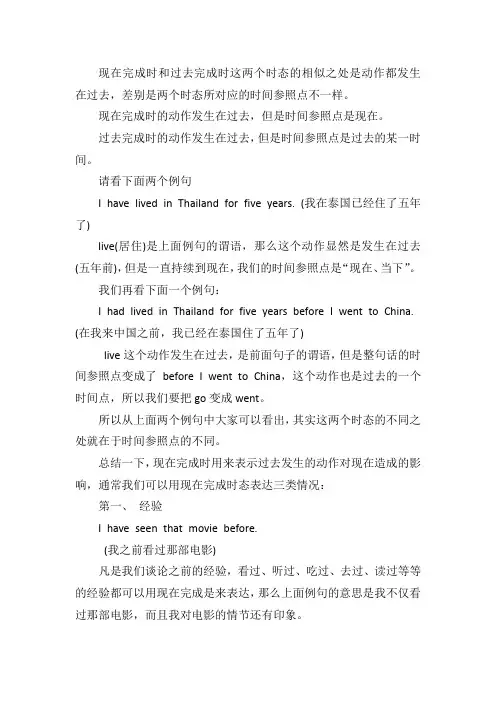
现在完成时
第一部分:
现在完成时表示过去发生或已经完成的动作对现在造成的影响或结果,也可表示过去已经开始,一直延续到现在的动作或状态。学习现在完成时,先从结构和句式开始:
构成:主语 + have / has + 过去分词 + 其他(当主语是第三人称单数时用has,其余人称用have。过去分词:规则动词的过去分词构成与动词过去式相同;不规则动词需要特殊记忆。)
否定式:主语 + haven’t / hasn’t + 过去分词 + 其他
疑问式:Have / Has + 主语 + 过去分词 + 其他?
简略答语:Yes, 主语 + have / has.(肯定)
No, 主语 + haven’t / hasn’t.(否定)
第二部分:
现在完成时的含义之一是过去完成的动作对现在仍有影响,用以下四大标志词可以表达这种含义:
以already, just和yet为标志
already, just和yet表示到现在为止动作或状态已经、刚刚或还没有发生。
He has already got her help. 他已得到她的帮助。
He has just seen the film. 他刚刚看过这场电影。
He hasn’t come back yet. 他还没有回来。
以ever和never为标志
ever和never表示到现在为止动作或状态曾经或从来没有发生过。
This is the best film I have ever seen. 这是我曾经看过的最好的一部电影。
He has never been to Beijing. 他从没有到过北京。
以动作发生的次数为标志
若某一动作到现在为止已经发生了若干次,则要使用现在完成时。
He says he has been to the USA three times. 他说他已经去过美国三次了。
以so far为标志
so far往往表示到目前为止动作或状态已经发生。
He has got to Beijing so far. 到目前为止他已到了北京。
She has passed the exam so far. 到目前为止她已经通过了考试。
第三部分:
过去已经开始的动作一直延续到现在,甚至有可能继续延续下去,我们可以从动作“延续”的特性和“时间”点段的区分入手,进一步学习现在完成时。
“终止”、“延续”要转换 英语中的动词从词义上可以分为延续性和非延续性两种。在现在完成时态中一定要注意动词这一特性,应将这类非延续性动词转换为延续性动词。如:
“Cats” has been on for half an hour. 《猫》已经开演半个小时了。
How long have you had this dictionary? 这本字典你买了多久了?
初中阶段常见的有:come—be, go out—be out, leave—be away (from),
begin—be on, buy—have, borrow—keep, join—be a member / 介词短语,
die—be dead, become—be, open (v.)—be open (adj.) 等。
时间“点”、“段”须分清
过去开始的动作可以延续到某一点结束,也可能继续延续,这时就要根据时间“点”、“段”选择相应的介词for或since。如:
He has been away for two years. 他已走了两年。(for +时间段)
He has been an English teacher since 1992. 自从1992年以来他一直当英语教师。 (since +过去某一时刻)
第四部分:
A) 选用have, has填空:
1. I _______ told him the news.
2. She _______ come back from school.
3. You _______ won the game.
B) 按要求改写下列各句:
4. They have bought a computer. (改成否定句)
_________________________________________
5. He has lost his book. (先改成一般疑问句,再作肯定与否定回答)
— ______________________
— ______________________
句型转换
1.They have been here since 2000. (对划线部分提问)
_______ _______ they been here?
2. The old man _________ last year.
He _________ _________ _________ for a year. (die) (动词填空)
3. Miss Gao left an hour ago. (同义句转换)
Miss Gao ________ _______ ________ ________ an hour .
4. Her mother has been a Party member for three years .(同义句)
Her mother _______ the Party three years _______.
5. The bus has arrived here. It arrived ten minutes ago. (把两个句子合并成一个句子) ____________________________________________________.
用for或since填空
1. Jill has been in Ireland_______ Monday.
2. Jill has been in Ireland_______ three days.
3. My aunt has lived in Australia_______ 15 days.
4. Margaret in her office.She has been there ______ 7 o'clock.
5. India has been an indendent country_____ 1974.
用never, ever, already, just, yet, for, since填空
1. I have _______ seen him before, so I have no idea about him.
2. Jack has _________ finished his homework.
3. Mr. Wang has taught in this school ________ ten years.
4. “Have you ________ seen the film?” “No, I have ________ seen it.”
5. “Has the bus left _______?” “Yes, it has _________ left.”
选择
1、Both his parents look sad. Maybe they _________what's
happened(发生) to him .
A. knew B. have known C. must know D.will know
2、 I _____this book for two weeks, I have to return it now.
A borrowed B have borrowed C kept D have kept
3、Have you met Mr Li ______?
A. just B. ago C.before D. a moment ago
4、The famous writer _____ one new book in the past two years .
A. is writing B.was writing C.wrote D.has written
5、—Our country ______ a lot so far .
—Yes . I hope it will be even ______ .
A. has changed ; well B. changed ; good
C. has changed ; better D. changed ; better
6、Zhao Lan ______already ______in this school for two years .
A. was ; studying B. will ; study
C. has ; studied D. are ; studying
7、—These farmers have been to the United States . —Really ?
When _____ there ?
A. will they go B. did they go
C. do they go D. have they gone
13、—How long have you ____ here ? —About two months .
A. been B. gone C. come D. arrived 过去完成时
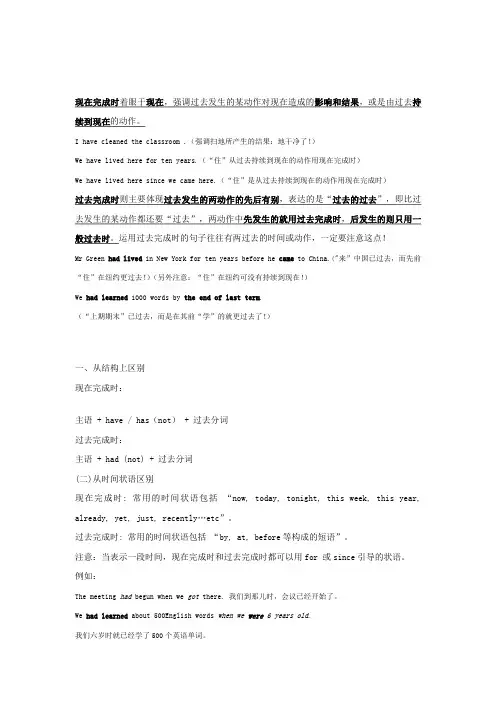
(1)表示在过去某一时刻或动作以前完成了的动作,也可以说过去的时间关于过去的动作。即“过去的过去”。
例如: By nine o’clock last night, we had got 200 pictures from the
spaceship.
(2)表示由过去的某一时刻开始,一直延续到过去另一时间的动作或状态,常和for, since构成的时间状语连用。
例如: I had been at the bus stop for 20 minutes when a bus finally
came.
(3)叙述过去发生的事情,在已叙述了过去发生的事情后,反过来追述或补述以前发生的动作时,常使用过去完成时。
例如: Mr. Smith died yesterday. He had been a good friend of mine.
(4)在含有定语从句的主从复合句中,如果叙述的是过去的事,先发生的动作常用过去完成时。
例如: I returned the book that I had borrowed.我已归还了我借的书。
(5)状语从句:在过去不同时间发生的两个动作中,发生在前,用过去完成时;发生在后,用一般过去时。
例如: When I woke up, it had already stopped raining. 我醒来时雨已停了。