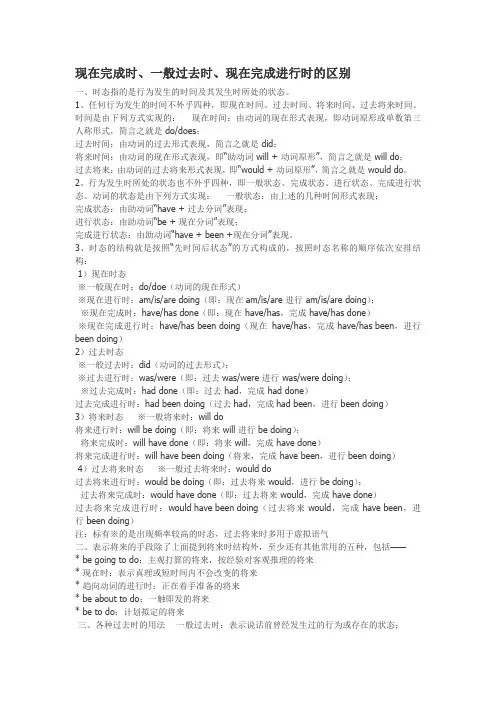
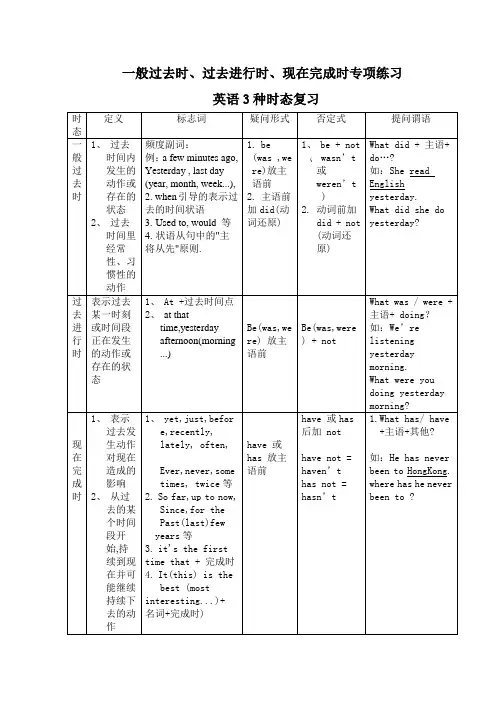
过去进行时与现在完成时
- 格式:doc
- 大小:34.50 KB
- 文档页数:3
1 / 3
过去进行时
一、概念:过去进行时表示在过去某一时刻或某一段时间内进行或发生的动作。
二、结构:
肯定句:主语+was /were + 动词ing形式+其它
We were watching TV at nine last night.
否定句:主语+was /were + not+动词ing形式+其它
We were not watching TV at nine last night.
一般疑问句:Was /Were+主语+ 动词ing形式+其它+?
Were we watching TV at nine last night.? Yes,we were. No,we weren’t.
特殊疑问句:特殊疑问词+was/were+主语+doing+其它+?
三、常用的时间状语
at 7 last night, at this time ,at that time, this morning, the whole morning,
all day yesterday, from nine to ten, last evening, when, while,as引导的过去时间状语连用
如:My brother fell while he was riding his bicycle and hurt himself.
It was raining when they left the station.
When I got to the top of the mountain, the sun was shining.
例题: As she ___ the newspaper, Granny ___ asleep.
A.read; was falling B. was reading; fell C. was reading; was falling D. read;fell
答案B.句中的as = when, while,意为"当……之时"。描述一件事发生的背景时,用过去进行;一个长动作发生的时候,另一个短动作发生。句意为 "在她看报纸时,奶奶睡着了。
昨天晚上七点到九点的时候我们在看电视。
一.按要求进行句型转换。
1. Kate was reviewing her lessons at eight last night .
一般疑问句:
肯/否回答:
对划线部分提问:
1. He ran in the park .(用at this time yesterday改写)
2. They were playing computer games at nine last night.( 对划线部分提问)
二.根据汉语提示完成句子。
1.他们那时不在打排球。They _______ _______ volleyball at that time.
2.当你回来时,他在看电视吗?_______ he _______ Tv when you came back?
3.昨天中午他在哪里等你?_______ _______ he _______ for you at noon yesterday ?
4.当我离开时,他正在做家庭作业。He ________ ________ his homework when I left.
5.正当他们扫地的时候,老师进来了。
While they_______ _______ the floor , the teacher came in.
三.选择题:
( )1.My brother ___ while he ___ his bicycle and hurt himself.
A. fell, was riding B. fell, were riding C. had fallen, rode D. had fallen, was riding
( )2. Tom ___ into the house when no one ___.
A. slipped, was looking B. had slipped, looked C. slipped, had looked D. was slipping, looked
( )3.The last time I __ Jane she ___ cotton in the fields.
A. had seen, was picking B. saw, picked C. had seen, picked D. saw, was picking
( )4.I don ' t think Jim saw me; he ___ into space.
A. just stared B. was just staring C. has just stared D. had just stared
( )5.I first met Lisa three years ago. She ___ at a radio shop at the time.
A. has worked B. was working C. had been working D. had worked
( )6.---Hey, look where you are going! ---Oh, I ' m terribly sorry.________.
A. I ' m not noticing B. I wasn ' t noticing C. I haven ' t noticed D. I don ' t notice
( )7. The reporter said that the UFO ___ east to west when he saw it.
2 / 3 A. was traveling B. traveled C. had been traveling D. was to travel
( )8. I ___ my breakfast when the morning post came.
A. had B. had been having C. have been having D. was having
( )9.When I arrived at his office, he ___ on the phone.
A. was speaking B. spoke C. had been speaking D. had spoken
( )10. “ What ' s the matter, Ali? You look sad. ”
“ Oh, nothing much. As a matter of fact, I ___ of my friends back home. ”
A. just thought B. have just been thinking C. was just thinking D. have just though
现在完成时
一、概念:现在完成时表示过去发生或已经完成的动作对现在造成的影响或结果,也可表示过已经开始,一直延续到现在的动作或状态。 (过去已经开始的动作一直延续到现在, 甚至有可能继续延续下去 )
二、构成:
肯定陈述句:主语 + have/has + 动词过去分词 + 其他。(当主语是第三人称单数时用has,其余人称用have。过去分词:规则动词的过去分词构成与动词过去式相同;不规则动词需要特殊记忆。)
否定式: 主语 + haven't/hasn't +动词过去分词 + 其他。
疑问式: Have /Has + 主语 + 动词过去分词 + 其他?
肯/否答语: Yes, 主语 + have/has. No, 主语 + haven't/hasn't.
* 以already, just和yet为标志 already, just和yet 表示到现在为止动作或状态已经、刚刚或还没有发生。
* 以ever和never为标志 ever和never 表示到现在为止动作或状态曾经或从来没有发生过。
* 以动作发生的次数为标志 若某一动作到现在为止已经发生了若干次,则要使用现在完成时。
* 以so far为标志 so far往往表示到目前为止动作或状态已经发生。
* since +时间点 for+ 时间段
注意:①现在完成时不能和表示明确的过去时间连用。如:in 1998, last morning等
②have/has been to 表示"去过"(去而已归) have/has gone to 表示"去了"(去而未归)
如:Where has she gone?(句中所指的人不在)
Where has she been?(句中作指的人在)
例: I ______ you for a long time. Where ______ you ______?
A. Didn't seen; did, go B. didn't see; have, gone C. haven't seen; have, been D. haven't seen; have
gone
解析:for+段时间一般预先在完成时连用。"你去哪儿了? "(在这段时间你不在)应选C
常见的瞬间动词与延续性动词的转换有
come→be here,begin/start→be on,borrow→keep, buy→have,die→be dead,
end/finish→be over,get up→be up,go(get)out→be out, fall asleep→be asleep, leave→be away from, join→be
in/be a member of,put on→wear,catch a cold→have a cold, open (动词) → be open (形容词), close (动词) → be closed(形容词), get up →be up ,finish →be over, start/begin→ be on ,borrow →keep, buy→
have等。
练习:
( )1、Both his parents look sad . Maybe they ______what's happened to him .