Unit_6_Trade
- 格式:ppt
- 大小:2.60 MB
- 文档页数:33

UNIT 6 When was it invented?Section A(1a-4c)核心单词1. __style__n. 样式;款式2. __project__n. 项目;工程3. __pleasure__ n. 高兴;愉快4. __daily__adj. 每日的;日常的5. __website__n. 网站6. __pioneer__ n. 先锋;先驱7. __list__v. 列表;列清单 n. 名单;清单8. __mention__ v. 提到;说到9. __ruler__n. 统治者;支配者10. __boil__v. 煮沸;烧开11. __remain__v. 保持不变;剩余12. __smell__n. 气味 v. 发出……气味;闻到13. __national__adj. 国家的;民族的14. __trade__ n. 贸易;交易 v. 做买卖;从事贸易15. __doubt__ n. 疑惑;疑问 v. 怀疑16. __fridge__ n. 冰箱17. __low__ adj. 低的;矮的18. __somebody__ pron. 某人n. 重要人物19. __translate__v. 翻译20. __lock__ v. 锁上;锁住 n. 锁21. __ring__v. (使)发出钟声或铃声;打电话 22. __earthquake__n. 地震23. __sudden__adj. 突然(的) 24. __bell__n. 钟(声);铃(声) 25. __biscuit__n. 饼干26. __cookie__ n. 曲奇饼27. __musical__adj. 音乐的;有音乐天赋的28. __instrument__ n. 器械;仪器;工具单词变形1. smell—__smelt/smelled__(过去式)—__smelt/smelled__(过去分词)2. ring—__rang__(过去式)—__rung__(过去分词)3. invent—__inventor__(名词)—__invention__(名词)4. pleasure—__pleased__(形容词)—__pleasant__(形容词)核心短语1. __have__a__point__ 有道理2. __by__accident____偶然;意外地3. __take__place____ 发生;出现4. __without__doubt____毫无疑问;的确5. __all__of__a__sudden____突然;猛地6. __fall__in____掉进7. __less__than__ 少于;不超过8. __on__the__telephone____在电话上重点句型1. I think the TV was __invented__before the car.我认为电视机的发明在汽车之前。
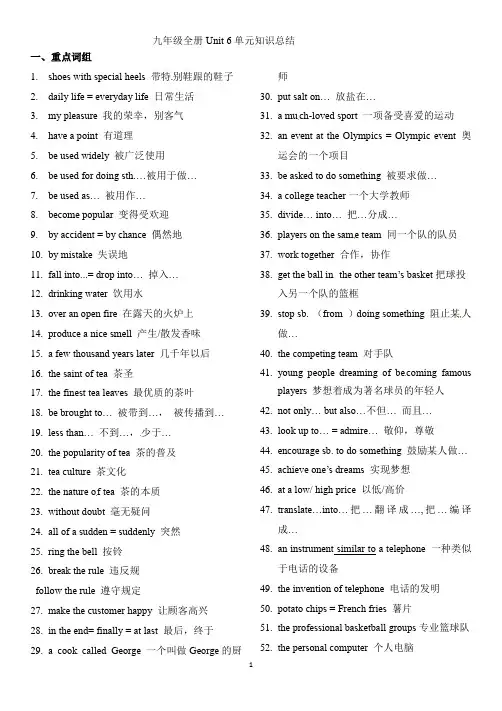
九年级全册Unit 6单元知识总结一、重点词组1.shoes with special heels 带特别鞋跟的鞋子2.daily life = everyday life 日常生活3.my pleasure 我的荣幸,别客气4.have a point 有道理5.be used widely 被广泛使用6.be used for doing sth.…被用于做…7.be used as… 被用作…8.become popular 变得受欢迎9.by accident = by chance 偶然地10.by mistake 失误地11.fall into...= drop into… 掉入…12.drinking water 饮用水13.over an open fire 在露天的火炉上14.produce a nice smell 产生/散发香味15.a few thousand years later 几千年以后16.the saint of tea 茶圣17.the finest tea leaves 最优质的茶叶18.be brought to… 被带到…,被传播到…19.less than… 不到…,少于…20.the popularity of tea 茶的普及21.tea culture 茶文化22.the nature of tea 茶的本质23.without doubt 毫无疑问24.all of a sudden = suddenly 突然25.ring the bell 按铃26.break the rule 违反规follow the rule 遵守规定27.make the customer happy 让顾客高兴28.in the end= finally = at last 最后,终于29.a cook called George 一个叫做George的厨师30.put salt on… 放盐在…31.a mu ch-loved sport 一项备受喜爱的运动32.an event at the Olympics = Olympic event 奥运会的一个项目33.be asked to do something 被要求做…34.a college teacher一个大学教师35.divide… into… 把…分成…36.players on the same team 同一个队的队员37.work together 合作,协作38.get the ball in the other team’s basket把球投入另一个队的篮框39.stop sb. (from )doing something 阻止某人做…40.the competing team 对手队41.young people dreaming of be coming famousplayers 梦想着成为著名球员的年轻人42.not only… but also…不但… 而且…43.look up to… = admire… 敬仰,尊敬44.encourage sb. to do something 鼓励某人做…45.achieve one’s dreams 实现梦想46.at a low/ high price 以低/高价47.translate…into…把…翻译成…,把…编译成…48.an instrument similar to a telephone 一种类似于电话的设备49.the invention of telephone 电话的发明50.potato chips = French fries 薯片51.the professional basketball groups专业篮球队52.the personal computer 个人电脑53.someone else’s idea 另外的人的主意54.lead to … 导致,引起55.It is said that 据说It is believed that人们相信It’s reported that据报道It’s known that 众所周知二、重点语法句式---When was the zipper invented? --- It was invented in 1893.---Who was it invented by? --- It was invented by Whitcomb Judson.---What is the hot ice-cream scoop used for? --- It’s used for serving really cold ice-cream.Unit6基础复习熟记本单元单词、短语、句型;2. 语法复习:过去时的被动语态。

Unit 6Goodbye, Free Trade?Exercises1.Answer the questions on the text.1) What was the result when the House of Representatives passed theHawley-Smoot Tariff Act in 1930?The economic recession in the United States became even worse.2) According to the author, what happens when a currency appreciates?It diminishes the export advantage of the country and makes it difficult to increase exports or even maintain the status quo.3) How did American politicians take advantage of the public’s stronganti-free-trade sentiment in the United States?They created a talking point in charges of unfair trade so that they thought they could benefit in the mid-term elections.4) What did American politicians and economists agree and disagree over theHawley-Smoot Tariff Act?Almost all of them agreed that it was a bad law, but they disagreed whether it triggered the Great Depression in the 1930s.5) What did Milton Friedman think were the more important reasons for theGreat Depression?The malfunctioning gold standard system and inept monetary policy of the Federal Reserve.6) What was the foreign reaction unexpected by the American lawmakers afterthe Hawley-Smoot Tariff Act was enacted?The trading partners were angered and imposed discriminatory tariffs on American goods. Canada in particular, as the largest export market for the US, reacted fiercely and handed its market over to the British competitors.7) Why is it unlikely for the US to adopt another Smoot-Hawley today in the eyeof the author?(1)The US is much more integrated into the world economy today than it was inthe 1930s.(2)Import restrictions seldom achieve their intended goals, instead, often end uphurting American industries and consumers.(3)The Americans have learned to consider the possible strong foreignretaliation against US exporters.8) What were the respective results for those countries withdrawing from thegold standard and those clinging to it during the 1930s according to the author?Those countries going off the gold standard allowed their currencies to depreciate, avoided protectionist trade policies and, instead, used monetary policy to end price deflation and stimulate economic growth.Those countries choosing to stay on pursued protectionist trade policies by imposing high tariffs, import quotas and exchange controls, which did little in boosting their economic growth. Thus they suffered a longer economic depression.9) How does the author justify his support for the policy of "quantitativeeasing"?(1) Historically, the most important tool for resisting protectionist sentiment in the1930s was a monetary policy that would promote economic growth.Today the US is in a similar situation. Taking right monetary policy can alleviate the pressure on Washington to adopt protectionist trade policy and can help to raise output before it leads to a high inflation.(2) He also quotes what Charles Evens said: Additional measures taken by the Fedto stimulate growth should condoned, not condemned.(3) What Mr. Friedman wrote 1997 about Japan: The surest road to a healthyeconomic recovery is to increase the rate of monetary growth, to shift from tight money to easier money.10) What does the author imply about the US Congress?In comparison with the Fed, the US Congress is following a trade protectionist policy in blaming other countries for its unemployment and may cause serious trade retaliations from trading partners.2. Fill in each blank of the following sentences with one of the phrases in the list given below. Make changes when necessary.1)As the financial scandal involves so many people, the probe in to it could dragon for another year.2)In the age of globalization more individuals are forced to integrate intomultinational work teams.3)Many in Europe are now very much worried that it may sink into a Japan-styleeconomic recession.4)But the business leaders yesterday warned against interest rate rises, arguing thatinflation was being driven not by consumer spending, but by rising commodity prices.5)After the call scandal, the American automakers and some politicians there wereso eager to keep their rival Toyota at bay in the auto market.6)Under the current labor law, two categories of employees are exempt fromminimum wage and overtime requirements.7)Though the local partner made a revised offer, the foreigner investor refused andreverted back to the original agreement conditions.8)Last Friday the two parties met for more than five hours only to end up walkingaway from the table once again, reaching no agreement at all.9)When the government supervises banks, it should take into account their payand bonus structures which may often be the source of corruption.10)The customers severely affected in the incident demanded that the company putin place effective measures to avoid occurrence of such things in the future. 11)It’s critical to take hold of any opportunity coming your way because it willnever come back again once lost.12)At times of economic depression, people are more inclined to unethical means intheir business.3. Match the terms in column A with the definitions in column B:A__________________________ B____________________________________ 1)unfair trade A) Restrictions that governments put in placeon the purchase or sale of a foreign or localcurrency, particularly by those in shortageof hard currencies. 62) real estate B) Escalation of protectionism between two ormore countries that impose punitive tariffsand barriers in retaliation for each other. 83) business cycle C) A general decline in prices often caused bya reduction in the money supply or a decreasein spending. 54) trade protectionism D) Unjustifiable and discriminatory policiesand supports by a government to its ownfirms, ranging from export subsidies to anti-competitive practices. 15) price deflation E) Land, buildings, homes or anything fixed,immovable, or permanently attached that canbe traded in the market. 26) exchange control F) The policy of imposing duties or quotas onimports in order to protect home jobs,markets or industries from overseascompetition. 97) competitive currency devaluation G) A company or country with whom you havean ongoing business relationship and engagein importing or exporting activities. 108) trade war H) A predictable long-term pattern ofeconomic activity that an economyexperiences four stages including decline,recession, recovery and boom. 39) import barriers I) The currency devaluation by a governmentto make its goods more competitive in theinternational markets. 710) trading partner L) The economic policy of restrainingbusiness between states through a variety ofgovernment actions to discourage importsand prevent foreign take-over of domesticmarkets and companies. 44. Translate the following passage into Chinese.按官方的说法,中美间过去三天日益严重的贸易纠纷涉及轮胎、鸡肉和汽车,但实际上远远超出此范围。