
英语小报-口语对话总结
- 格式:doc
- 大小:39.50 KB
- 文档页数:1
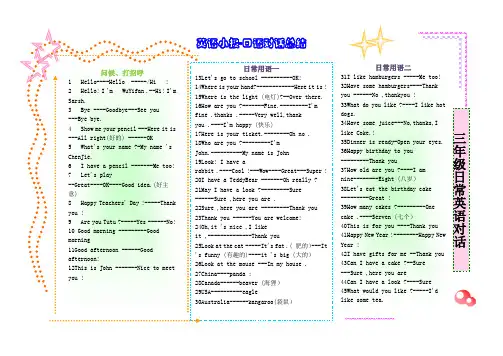

英语口语日常情景对话用语一、祝愿、祝贺和应答1.- Well done and congratulations to you. - Thanks very much.2.- I hope you‘ll succeed in everything. - So do I.3.- I wish you success. - Thank you.4.- We send you our best wishes. - Thank you very much.5.- Happy new year ! - Happy new year! (The same to you.)6.- A merry Christmas to you. - Thank you.7.- I hope you‘ll have a good time. - Thank you.8.- Happy birthday! - Thank you.二、邀請和应答1.- Would you like to come to the party? - Oh yes, thank you.2.- I hope you can come to the dance next Saturday. - I‘m sorry, but I can‘t.3.- Will you go dancing with us? - Of course. I‘ll be glad to.4.- Will you come to our English Evening? - Yes, thank you.5.- Would you please give us a talk on English Learning? - OK. When?6.- You and your friends must come over to my house and see mooncakes.- OK. Thank you very much.三、表示同意和不同意1.- I think the shop is closed at this time of day. - No, I think it‘s open.2.- I think foreign languages are more interesting than science.- I really can‘t agree with you. I prefer science.3.- I think I shall read a book instead.- Good idea. That‘s much better than watching a bad TV Programme.4.- I don‘t think that it‘s true. He‘s always telling strange stories.- I know. But this time I can‘t decide if he is right or not.5.- I think Chinese is more popular than any other subject. - Maybe. But I prefer art.6.- Don‘t think in Chinese when you‘re speaking English. - You are quite right.四、道歉和应答1.- Sorry to trouble you. - That‘s all right.2.- Oh, I am so sorry. - That‘s quite all right.3.- I‘m sorry to give you so much trouble. - No trouble at all.4.- I‘m soory. I lost the key to your bike. - It doesn‘t matter.5.- Sorry to have kept you waiting for a long time. - It doesn‘t matter.6.- You haven‘t paid for it yet. - Oh, I‘m really very sorry.五、劝告和建议1.- The park isn‘t far from here. Shall we walk there? - OK.2.- You‘d better close the windows. It‘s cold in the room. - All right.3.- If you are not better by then, I‘ll take you to see the doctor. - OK. Thank you very much.4.- You must look after yourself and keep healthy. - Yes, I will. Thanks.5.- The museum is very far from here. Let‘catch a bus, shall we? - OK. Let‘s catc h a bus.6.- You must remember the saying: Whatever you do, do it well. - Thank you for your advice.六、打电话1.- Hello! - Hello, Bill? - No, this is Sam. - Hi, Sam. This is Mike. How are you?2.- Hello. - Hello. May I speak to Mr Green?3.- No. 5 Middle School.- Mr Green, please.- I‘m sorry. Mr Green is not in.- When will he be back?- About six this afternoon.- All right. I‘ll ring again then.- Very well.4.- Hello!- Hello, Ham Mei. Could I borrow your Chinese-English Dictionary please?- Sorry! It‘s not a very good line. Could you speak more loudly?- Could I borrow your Chinese-English dictionary?- Sure. I‘ll bring it to you tomorrow.- Thank you. Goodbye.七、請求允許和应答1.- Please let me help you. - No, thanks. I can carry it.2.- Can I see your licence, please? - OK.3.- May I call you James? - Of course, if you wish.4.- Could I borrow a pen, please? - Of course. With pleasure.5.- Excuse me. May I use your dictionary? - Yes, here you are.6.- May I ask you several questions? - Yes, of course.八、提供…和应答1.- May I help you? - Oh yes, thank you.2.- Let me help you with the bags. - Well, I can manage all right. Thanks just the same.3.- Can we help you? - I want to go to hospital. But I can‘t. My leg hurts.4.- Must I clean the classroom now? - Oh, you needn‘t.5.- Would you like a cup of tea? - Yes, please.6.- What can I do for you? - I‘d like to have an English-English dictionary.九、问路和应答1.- Excuse me. Where is the washroom, please? - Oh, it‘s over there.2.- Excuse me. Can you tell me where the bookshop is? - Look! It‘s on the other side of the road.3.- How far is the post office, please? - Only a few kilometers.4.- Will you please tell me the way to the railway station?- Go down this street. At the end of the road you‘ll see it.5.- Excuse me. Could you tell me how I can get to the supermarket?- Go straight along this road. Then go over the bridge and turn right at the bookshop. You‘ll fi ndit.十、购物1.- What can I do for you? - I‘d like some apples.2.- Where can I buy some stationery?- Let‘s look at the shopping guide. Oh, it‘s on the ground Floor.3.- Could I buy half a kilo oranges? - Certainly. Here you are.4.- Will you please show me that radio? - Certainly.5.- How much is the radio? - Ninety yuan.6.- Good morning, sir. May I help you? - Yes, I‘d like to buy a sweather.十一、谈论天氣1.- It‘s a fine day for a walk. - Yes, the air is nice and clean.2.- Oh dear! It‘s very cold to day. - Yes, you need to wear warmer clothes.3.- What‘s the weather like today? - It‘s fine.4.- What‘s the weather like in your country now? - It‘s very hot.5.- Lovely weather, isn‘t it? - Yes, isn‘t it?6.- I missed the weather report this morning. Did you hear it?- Yes. It said partly cloudy today, with a strong wind from The northwest.十二、时间或日期和应答1.- Hi, Mary. What time is it now? - It‘s about three.2.- What day is it today? - It‘s Wednesday.3.- Excuse me. Could you tell me what time the plane leaves?- Certainly. It leaves at ten in the evening.4.- What‘s the time? My watch has stopped. - Let me see. It‘s five to ten.5.- Excuse me. Have you got the time? - Yes, it‘s six twenty.6.- Excuse me. Could you tell me the time? - Oh sorry, I don‘t have my watch with me.十三、約会1.- Are you free next Wednesday evening? I want to go to the cinema with you? - Yes, I‘d like to.2.- When shall we meet, this evening or tomorrow evening? - I don‘t mind. Either time is OK.3.- Are you free later today? - Sorry, I‘m free every day except today.4.- Are you able to come tomorrow morning? - I think so.5.- Are you free this afternoon? - Oh no. Will this evening be all right?6.- I‘m busy today. What about tomorrow afternoon?- That would be fine. Shall we make it nine o‘clock?十四、禁止和警告1.- Don‘t climb that ladder! It‘s broken. - OK. Thank you.2.- Look out! There‘s a car coming. - Oh, thank you.3.- You mustn‘t play on the street. It‘s dangerous. - No, we won‘t.4.- Don‘t touch the machine when it is working. - No, I won‘t. Thank you.5.- You are not allowed to smoke here. - Oh, I‘m so rry.6.- You can‘t walk your dog in the park. - Oh, I‘m sorry. I‘ll never do it again.十五、看病1.- I‘m feeling tired, doctor. - Have a good rest and then you‘ll feel better.2.- How are you feeling today? - I‘m feeling even worse.3.- Doctor, she is not feeling well. - Nothing serious, I hope.4.- Doctor, do I have to take the medicine before or after meals? - Three times a day after meals.5.- What‘s the matter? - I‘ve got a headache.6.- What‘s your trouble? - I‘ve had a pain in my stomach since morn ing.十六、语言困难1.- I don‘t quite follow you, Mr Green. Will you please say it again? - OK.2.- Do you follow what I‘m saying? - Sorry, I can‘t follow you.3.- I beg your pardon. Will you say it again? - All right.4.- Will you say it again more slowly? I can‘t follow you. - OK.5.- Will you please repeat what you‘ve just said? - OK. I‘ll repeat what I have said.6.- I‘m sorry, I don‘t understand French. Do you speak English? - Yes, I do.介绍:A: Mary, this is Joe's brother David.B; I'm very glad to meet you.C: It's a pleasure to meet you.B: How do you like Texas so far?C: It's really different from what I expected.B: Don't worry. You'll get used to it in no time.2.A: Mrs. Smith, I'd like to introduce a friend of mine, Pierre Dubois.B: How do you do?C: Hello.B: What's your impression of the United States?C: Well, I can't get over how different the weather is here.B: Oh, you'll get used to it soon!3.A: Wendy, I'd like you to meet my brother Sam.B: Hi.C: Nice to meet you.B: What do you think of Dallas?C: Well, I'm still feeling a little homesick and so many things seem strange to me.B: You're bound to feel that way at first, I guess.4.A: Mrs.Hughs, this is Peter Brown.B: Pleased to meet you.C: How do you do?B: I hope you're enjoying your stay here.C: If it weren't for the climate, I'd like it here very much.B: It always takes time to get used to a new place.。

小学英语口语对话素材整理Nowadays, learning English has become increasingly important for elementary school students. English oral communication skills play a crucial role in their language development. To enhance these skills, it is essential for teachers to provide students with useful and engaging English dialogues. In this article, we will present a compilation of effective and diverse English dialogue materials that can be used in elementary school English classes.1. Introducing Oneself:Dialogue 1:A: Hello, my name is Lisa. What's your name?B: Hi, Lisa. I'm Jack. Nice to meet you.A: Nice to meet you too, Jack. Where are you from?B: I'm from New York. How about you?A: I'm from Los Angeles. What grade are you in?B: I'm in fourth grade. How about you?A: I'm in fifth grade.In this dialogue, students learn how to introduce themselves and ask simple questions about someone's name, place of origin, and grade level. It encourages them to have basic conversations with their peers.2. Talking About Hobbies:Dialogue 2:A: What do you like to do in your free time?B: I love playing soccer. It's so much fun.A: Oh, I enjoy playing soccer too. Do you play any other sports?B: Yes, I also like swimming. What about you?A: I like swimming as well. Have you ever tried playing basketball?B: No, I haven't. Maybe we can try it together someday.In this dialogue, students practice discussing their hobbies and exploring common interests. They learn how to ask follow-up questions and suggest doing activities together, fostering social interaction and bonding among classmates.3. Ordering Food at a Restaurant:Dialogue 3:A: Good afternoon. Welcome to our restaurant. How many people are in your party?B: There are four of us.A: Great. Please follow me to your table. Here are the menus.B: Thank you. Can I have a glass of water, please?A: Of course. What would you like to order?B: I'll have a cheeseburger and fries, please.A: Anything to drink?B: I would like a coke, please.This dialogue allows students to practice ordering food at a restaurant. By role-playing as customers and servers, they learn essential vocabulary related to food and beverages, as well as polite phrases for restaurant interactions.4. Talking About Daily Routines:Dialogue 4:A: What do you usually do after school?B: First, I finish my homework. Then, I play with my friends.A: What time do you have dinner?B: I usually have dinner at 6:30 pm.A: Do you watch TV before bedtime?B: No, I prefer reading books before going to sleep.This dialogue focuses on daily routines and encourages students to talk about their after-school activities and evening habits. It helps develop their ability to express time, sequence, and personal preferences.5. Planning an Outing:Dialogue 5:A: Hi, Sarah. What are you doing this weekend?B: Hi, Mark. I don't have any plans. Why?A: I was thinking we could go to the park. What do you think?B: That sounds like a great idea. What time should we meet?A: Let's meet at 10 am near the entrance. Don't forget to bring some snacks.B: Okay, see you on Saturday!This dialogue allows students to practice planning and organizing an outing with a friend. It helps them develop skills in suggesting and accepting ideas, arranging meeting times, and reminding each other about necessary preparations.These dialogues provide a range of topics for elementary school students to practice their English oral communication skills. Incorporating these materials into classroom activities will undoubtedly engage students in meaningful conversations while improvingtheir proficiency in spoken English. By providing them with opportunities to practice authentic dialogues, we can empower our young learners to become confident English speakers.。

二年级英语手抄报好词好句在二年级学习英语的过程中,除了掌握基本的单词和句子结构外,学生们也应该开始培养用一些好词好句来进行表达的能力。
在这篇手抄报中,我们将会介绍一些适合二年级学生使用的好词好句,希望能够帮助他们提高英语写作的水平。
一、简短问候语1. Good morning!2. How are you?3. Nice to meet you!4. What's your name?5. Can I help you?这些简短的问候语适用于日常交流中,能够展示学生的礼貌和友善。
学生们可以将这些问候语融入到自己的口语表达当中。
二、描述外貌的好词好句1. She has long hair.2. He is tall and strong.3. She has big eyes.4. He is wearing a red shirt.5. She looks beautiful today.这些句子可以帮助学生描述他们的家人、朋友或者其他人的外貌特征。
通过使用这些好词好句,学生们能够增强他们的观察力和描述能力。
三、讲述喜好的好词好句1. I like playing football.2. My favorite color is blue.3. He enjoys reading books.4. She loves singing and dancing.5. They are interested in learning new things.这些句子可以帮助学生们表达他们的兴趣爱好,并且能够让他们更好地了解自己和他人的喜好。
四、描述日常活动的好词好句1. I get up at 7 o'clock every morning.2. She brushes her teeth before going to bed.3. They have breakfast together.4. He goes to school by bus.5. We play games in the park on weekends.这些句子可以帮助学生们描述他们的日常生活,让他们了解如何用英语来表达自己的日常活动。
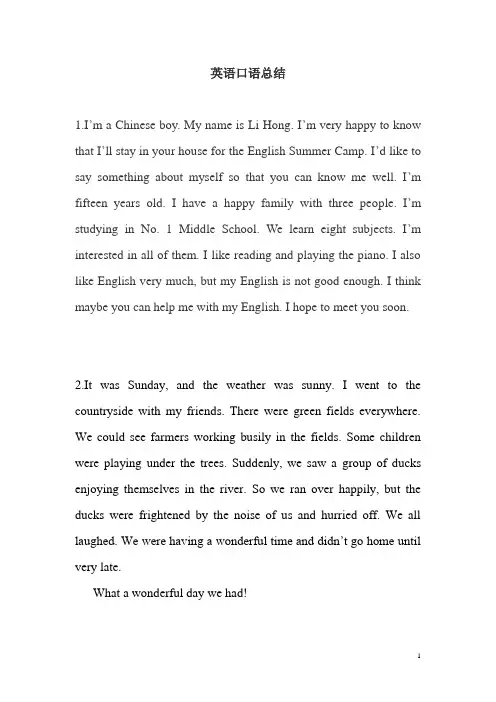
1.I’m a Chinese boy. My name is Li Hong. I’m very happy to know that I’ll stay in your house for the English Summer Camp. I’d like to say something about myself so that you can know me well. I’m fifteen years old. I have a happy family with three people. I’m studying in No. 1 Middle School. We learn eight subjects. I’m interested in all of them. I like reading and playing the piano. I also like English very much, but my English is not good enough. I think maybe you can help me with my English. I hope to meet you soon.2.It was Sunday, and the weather was sunny. I went to the countryside with my friends. There were green fields everywhere. We could see farmers working busily in the fields. Some children were playing under the trees. Suddenly, we saw a group of ducks enjoying themselves in the river. So we ran over happily, but the ducks were frightened by the noise of us and hurried off. We all laughed. We were having a wonderful time and didn’t go home until very late.What a wonderful day we had!3.What is my favorite teacher like?Firstly my favorite teacher should be able to play different roles in school. He can care about us like a father. He can give us knowledge like a tutor. And he can play games and discuss problems with us like a friend.Secondly, my favorite teacher should be patient and helpful. When we are in trouble, he can always help us patiently.Thirdly, a good teacher should be fair. He should have the same rules for everyone. Fourthly, a good teacher should be humorous. He can make his class interesting and make us laugh. I think students can learn better with the help of this kind of teacher.4. I’m sorry to hear that you are not very well and feel unhappy. Here is my advice about how to keep healthy. A balanced diet can help you to keep in good health. You’d better eat more healthy food. It’s good for you to eat a lot of vegetables, fruit(s) and drink milk every day. And you should do more exercise,such as playing ball games, running swimming and so on. Good food and exercise will be helpful. You also need enough sleep. It’s really important. What’s more,keep yourself happy. Try to smile every day. I hope you will be better and enjoy your life.st week our class had a parents’ meeting, all the parents talked about whether doing a lot of homework was useful or not .Many parents thought that doing much homework was useful . They thought by doing a lot of homework, the students could review what they had learned. It would also help to develop the students’ minds and stop them playing computer games.But a few parents thought that too much homework was useless. Because doing much homework took a lot of times and thus students could not have a good rest。