直接引语和间接引语语法讲解
- 格式:doc
- 大小:27.00 KB
- 文档页数:3
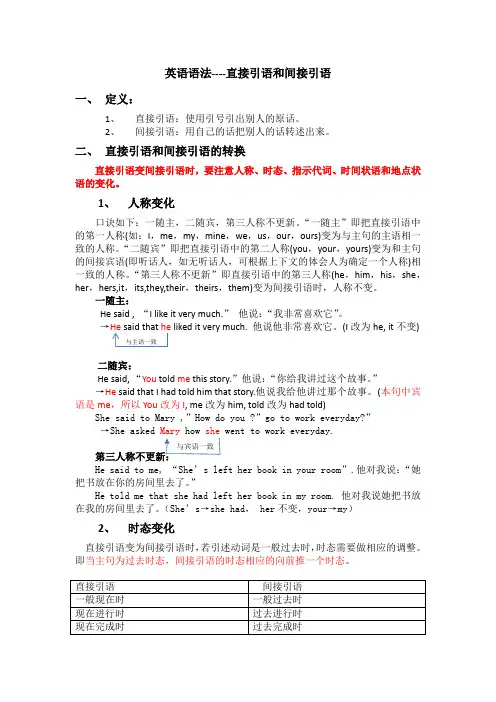
直接引语和间接引语Name ____________ No._________一、直接引语:直接引用别人的原话。
具有以下特点:①直接引语通常置于引号内,不作任何改动。
②没有时态呼应的问题。
③引用原话前可以用逗号“,”,也可以用冒号“:”。
④第二个引号前,亦即用重述的话之末,按其类别放一个句号(.)或问号(?)等。
二、间接引语:用自己的话转述别人的意思,或引用自己说过的话。
间接引语多数用宾语从句来表达。
间接引语具有以下特点:①不要逗号,冒号,引号。
②要考虑人称的变化(人称的变化与汉语是一样的)。
③要考虑时态的变化。
④要考虑时间状语的变化,地点状语的变化和指示代词的变化。
三、直接引语与间接引语的转换。
㈠转述陈述句或感叹句,去冒号和引号连词用that (that,无词意,不作成分,口语中可省))接宾语从句,,从句中要作人称、时态等相应的变化(时态为“主现从实,主过从相过”;人称/物主/反身等代词:引号内的第一人称改为与主句的主语相同的人称;第二人称改为第一人称;第三人称不变。
)。
例如:"You speak English very well." She said.她说,“你英语讲得不错”。
She said that I spoke English very well.她说我英语讲得不错。
㈡转述一般疑问句,去冒号和引号。
连词用if/whether(有词意"是否",不作成分,不可省)接宾语从句,其后改用陈述句语序。
从句中要作人称、时态等相应的变化。
注意:①当助动词为do/does/did时,改为宾语从句时应去掉,而在谓语动词上体现时态,但如为don't/doesn't/didn't时,则不能去掉。
②当连词为if/whether时,其前谓语动词say/says/said →ask/asks/asked,say/says/said to sb→ask/asks/asked sb例如:He said,"do you have a knife?"→He asked if/whether I had a knife.He asked ,"Have you ever been to the Great Wall?"他问,"你去过长城吗?"He asked (me) if /whether I had ever been to the Great Wall?他问我是否去过长城?㈢转述特殊疑问句,去冒号和引号。
用疑问词作连词(有词意,要作成分,不可省)引导宾语从句,改用陈述句语序,其后改用陈述句语序。
从句中要作人称、时态等相应的变化。
注意:①当助动词为do/does/did时,改为宾语从句时应去掉,而在谓语动词上体现时态,但如为don't/doesn't/didn't时,则不能去掉。
②当连词为疑问词时,其前谓语动词say/says/said →ask/asks/asked,say/says/said to sb→ask/asks/asked sb 例如:Li Lei said,"Why didn't he go to school?"→LiLei asked why he didn't go to school.She said:"Where are you from?" 她说:“你去哪里?”She asked (me) where I was from.她问我要去哪里。
㈣转述祈使句或疑问形式的祈使句,通常改为"Sb ask/asks/asked/tell/tells/told/order /orders/ordered+宾语+不定式"的简单句。
ask表"请求",tell表“吩咐”,order表“命令”例如:"Open the door." The teacher said.老师说:“把门打开”。
The teacher told me to open the door.老师要我把门打开。
"Would you please show me the book?"He said.他说:"你能把书递给我吗?"He asked me to show him the book. 他要我把书递给他。
四、直接引语变间接引语不仅有人称、时态的变化,有时还要把物主代词、指示代词,时间状语、地点状语作相应的变化。
变化列表如下:①动词的时态:(时态为“主现从实,主过从相过”)引语前或后的主句谓语动词是过去时,宾语从句的谓语动词作如下调整:一般现在时→一般过去时一般过去时→过去完成时/一般过去时一般将来时→过去将来时现在进行时→过去进行时现在完成时→过去完成时过去完成时→过去完成时注意:时态不变的情况:⒈当直接引语表示真理或经常性的特点时,保持原来的一般现在时。
例如:She said,"The earth is round."她说:“地球是圆的”。
She said that the earth is round. 她说地球是圆的。
⒉当直接引语中有绝对具体的一般过去时间作状语时,保持原来的一般过去时。
例如:He said,“I joined the army in 1934.”他说:“我是1934 年参军的”。
He said that he joined the army in 1934.他说他是1934 年参军的。
②人称/物主/反身等代词:引号内的第一人称改为与主句的主语相同的人称;第二人称改为第一人称;第三人称不变。
③指示代词:this/these 改为that/those.④时间状语:now→then,today→that day,tonight→that night,tomorrow→the next day,next week→the next week,last night→the night before,yesterday→the day before,the day before yesterday→two days ago,ago→before.⑤地点状语:here改为there⑥动词:come,bring分别改为go,take三、直接引语改为间接引语(宾语从句)的注意事项:1、当直接引语为客观真理时,从句的时态不变,与主句无关。
The teacher tells/told us,"The moon moves round the earth."→The teacher tells/told us that the moon moves round the earth2、当助动词为do/does/did时,改为宾语从句时应去掉,而在谓语动词上体现时态,但如为don't/doesn't/didn't 时,则不能去掉。
He asked,"do you have a knife?"→He asked if/whether I had a knife.Li Lei asked,"Why didn't he go to school?"→LiLei asked why he didn't go to school.3、当疑问词作主语及其定语时,改为宾语从句后其后的语序不变。
Who's on duty? What's in the box?What's wrong/the matter/trouble with ...? What happened to...?Which is the way to...? Whose daughter is Ann? Which boy is Bill?How many of you go to school by bike?4、当连词为if/whether及疑问词作连词时,其前谓语动词say/says/said →ask/asks/asked,say/says/said to sb→ask/asks/asked sbHe says to you ,"Can you fly a kite?" →He asks you if/whether you can fly a kite.5、如果主句为Could/Would you tell me时,不表过去时态,而是语气较Can/Will you tell me更委婉的表达方式。
因此从句时态不变。
(直接引语中的二人称不变)Could you tell me? Are you a teacher?→Could you tell me if/whether you are a teacher.6、直接引语中,有any,anything,anybody,anyone时,改为宾语从句后,不能改为some及其合成词。
Do you know? Does anyone live here?→Do you know if/whether anyone lives here?7、if与whether的区别在以下情况中只用whether不用if.①放在句前时:I don't know whether /if he will come.= Whether he will come, I don't know.②与or not连用时:"Do you like English or not?" He asked.→He asked Whether I liked English or not.③与to do连用时:He wants to know whether /if we will go .=He wants to know whether to go.④做介词的宾语时:He thinks about whether he was born in China.⑤从句中有两种选择时:Tell me whether you go with us or stay at home.8、if/when引导宾语从句及状语从句的区别:I want to know if/when he _____(come) . If/When he _______(come), I_________(tell) you.(=I_________(tell) you if/when he _______(come) . )9、选择连词填空时⑴缺什么选什么: 缺时间选→when/what time 缺地点选→where,缺定语选→which/whose/how much/how many/ what class/grade,缺状语选→how/how often/how soon/how long, 缺人选→who/whom⑵不缺的则选that或if/whether,动词为say/say to sb/tell sb则选→that(整个句子表达陈述语气时);动词为ask/ask sb则选→if/whether(整个句子表达疑问语气时)10、当直接引语为祈使句时,改为复合宾语,句型为:Sb tell/ask/order sb (not) to do stheg: Jim asked Li Lei,"Clean the floor twice a week."→Jim asked LiLei to clean the floor twice a week.The teacher said "Don't talk in class."→The teacher told/asked/ordered the students(LiLei) not to talk in class.11. think/believe/expect/suppose/guess等引导的宾语从句,从句不用否定式,如果要用,常转移到主句的谓语动词。