(完整版)初中英语语法之动词的分类讲解加练习答案
- 格式:doc
- 大小:84.38 KB
- 文档页数:17
动词的分类Present for GirlfriendAt a jewelry store, a young man bought an expensive locket as a present for his girlfriend. "Shall I engrave her name on it?" the jeweler asked.The customer thought for a moment, andthen said, "No-engrave it ‘To my one andonly love‘. That way, if we ever break up, Ican use it again."送给女友的礼物在一家珠宝店里,一位年轻人买了一个贵重的小金盒作为送给女友的礼物。
“要我把她的名字刻在上面吗?”珠宝商问道。
那名顾客想了一会儿,然后说道:“不--在上面刻‘给我唯一的爱’。
这样,如果我们闹崩了,我还可以再用到它。
”C-动词的分类什么是动词动词是用来表示主语做什么(即行为动词),或表示主语是什么或怎么样(即状态动词)的词例如:The boy runs fast.(这个男孩跑得快。
)runs表示主语的行为He is a boy.(他是个男孩。
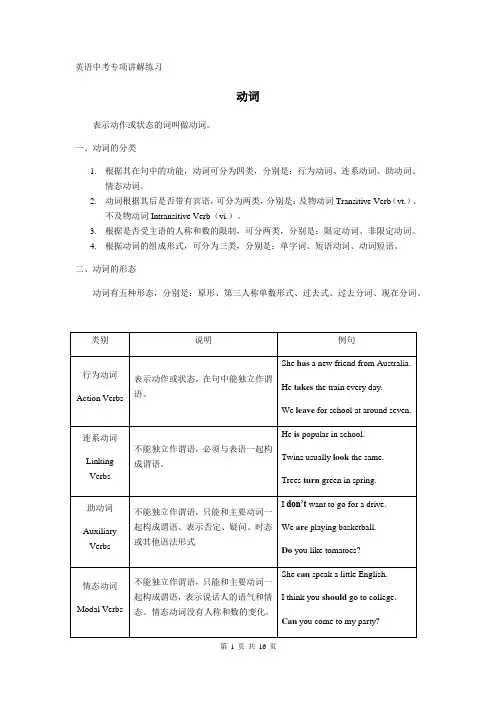
)is与后面的表语a boy表示主语的状态动词的分类一、动词可以按照含义及它们在句中的作用分成四类,即行为动词(也称实义动词)、连系动词、助动词和情态动词。
(一)、行为动词行为动词(实义动词)是表示行为、动作或状态的词。
它的词义完整,可以单独作谓语。
例如:I live in Beijing with my mother.(我和我妈妈住在北京。
)live,住It has a round face.(它有一张圆脸。
)has,有(二)、连系动词系动词亦称连系动词(Link Verb),作为系动词,它本身有词义,但不能单独用作谓语,后边必须跟表语(亦称补语),构成系表结构说明主语的状况、性质、特征等情况。
系动词后不可接副词,接的是形容词。
大致分七种1)状态系动词用来表示主语状态,只有be一词,例如:He is a teacher. 他是一名教师。
(is与补足语一起说明主语的身份。
)I am fine.2)持续系动词用来表示主语继续或保持一种状况或态度,主要有keep, rest, remain, stay, lie, stand, 例如:He always kept silent at meeting. 他开会时总保持沉默。
This matter rests a mystery. 此事仍是一个谜。
3)表像系动词用来表示"看起来像"这一概念,主要有seem, appear, look, 例如:He looks tired. 他看起来很累。
He seems (to be) very sad. 他看起来很伤心。
4)感官系动词感官系动词主要有feel, smell, sound, taste, 例如:This kind of cloth feels very soft. 这种布手感很软。
This flower smells very sweet. 这朵花闻起来很香。
5)变化系动词这些系动词表示主语变成什么样,变化系动词主要有become, grow, turn, fall(asleep), get go, come, run. 例如:He became mad after that. 自那之后,他疯了。
She grew rich within a short time. 她没多长时间就富了。
6)终止系动词表示主语已终止动作,主要有prove, turn out, 表达"证实","变成"之意,例如:The rumor proved false. 这谣言证实有假。
The search proved difficult. 搜查证实很难。
His plan turned out a success. 他的计划终于成功了。
(turn out表终止性结果)7)使役动词:let,have,makeThe story make me happy.这个故事使我感到很开心。
[难点解释]注意区别以下一些动词的用法,它们既可以作为行为动词,又可以作为连系动词。
1、look看;看起来He is looking at the picture.(他正在看这图片。
)行为动词It looks beautiful.(它看上去很美丽。
)连系动词2、fell摸;感觉1)I felt someone touch my arm.(我感到有人碰我的手臂。
)行为动词Are you felling better today than before?(你今天比以前感到好些了吗?)连系动词3、smell嗅;闻起来My little brother likes to smell the apple before he eats it.(我的小弟弟喜欢在吃苹果前闻一闻。
)行为动词Great! The flowers smell nice.(这些花闻起来多香啊!)连系动词4、sound弄响,发音;听起来The letter “h”in hour is not sounded.(在hour这个词中字母h是不发音的。
)行为动词The gun sounded much closer.(枪声听起来更近了。
)连系动词5、taste辨味;尝起来Please taste the soup.(请尝一口汤。
)行为动词The soup tastes terrible.(这汤尝起来味道太差了。
)连系动词6、get得到,获得;变There are some bananas on the table. Each of you can get one.(桌上有些香蕉,你们每个人可以拿一个。
)行为动词7、grow生长,种植;变Do you grow rice in your country?(你们的国家种水稻吗?)行为动词It’s too late. It’s growing dark.(太迟了,天渐渐变暗了。
)连系动词8、turn转动,翻动,使变得;变The earth turns around the sun.(地球绕着太阳转。
)行为动词When spring comes, the trees turn green and the flowers come out.(春天来了,树叶变经绿了,花儿开了。
)连上述句子中的动词如grow、get、turn等,既可以作连系动词,又可以作行为动词。
如何来辨别它们呢?有一个最简便的方法,即用连系动词be替换句子中的这些动词,句子仍然成立就是连系动词;反之,不能替换的,就是行为动词。
例如:The trees turn/are green when spring comes.(春天来临,树叶变绿。
)The earth runs around the sun.(地球绕着太阳转。
)这第二句句子中的turn是行为动词,意为“转动”。
无法以is替换。
小练习:1. _______ everyone here today?A. BeB. AreC. IsD. Am2. Harry is older than I. But he _______ younger than I.A. lookB. looksC. lookedD. looking3. It _______ like the singing of the birds.A. soundsB. looksC. smellsD. tastes4. This kind of cake tastes _______.A. goodB. wellC. to be goodD. to be well5. The children all looked _______ at the broken model plane and felt quite _______.A. sad, sadB. sadly, sadlyC. sad, sadlyD. sadly, sad1. C。
当复合不定代词作主语时,谓语动词用单数。
2. B。
根据句意和前句时态,后句应用一般现在时。
3..A。
根据语境,只有sounds(听起来)符合题意。
looks意为“看起来”,smells意为“闻起来”,tastes意为“尝起来”4. A。
连系动词taste后应接形容词作表语。
5.D。
根据句意,句中的look at是行为动词,所以修饰此动词时应用副词;在连系动词feel后应用形容词作表语。
(三)助动词这类词本身无词义,不能单独作谓语,只能与主要动词一起构成谓语,表示不同的时态、语态、表示句子的否定和疑问,例如:He does not speak English well.(他英语讲得不好。
)句中的does是助动词,既表示一般现在时,又与not一起构成否定形式。
A dog is running after a cat.(一条狗正在追逐一只猫。
)句中的is 是助动词,和run的现在分词一起构成现在进行时。
Did he have any milk and bread for his breakfast ?(他早餐喝牛奶、吃面包吗?)句中的did是助动词,既表示一般过去时,又和动词have一起构成疑问。
(四)情态动词这类词本身虽有意义,但不完整。
它们表示说话人的能力、说话人的语气或情态,如“可能”、“应当”等。
这类动词有can, may, must, need, dare, could, might等。
它们不能单独作谓语,必须与行为动词(原形)一起作谓语,表示完整的意思情态动词的主要特征试比较下列几组句子,看情态动词的特点:1、He borrows some books from the library.(他常从图书馆借些书。
)He can borrow some books from the library.(他可以从图书馆借到一些书。
)can, 可以2、I run fast.(我跑得快。
)I can’t run fast(我跑得不快。
)can’t, 不会,不能3、Must he go now?(他必须现在走吗?)must, 必须Did he go last night?(他昨晚去了吗?)4、They may be there.(他们可能在那儿。
)may, 可能They werent t’here.(他们不在那儿。
)从上述四组句子中,可以看出以下几个特点:1、can、may、must都有各自的词义,表示能力、可能、允诺、愿意、请求等情态,因词义不完全,不能单独作谓语,只能和动词原形一起构成谓语。