Grammar-虚拟语气(I)
- 格式:ppt
- 大小:3.63 MB
- 文档页数:48

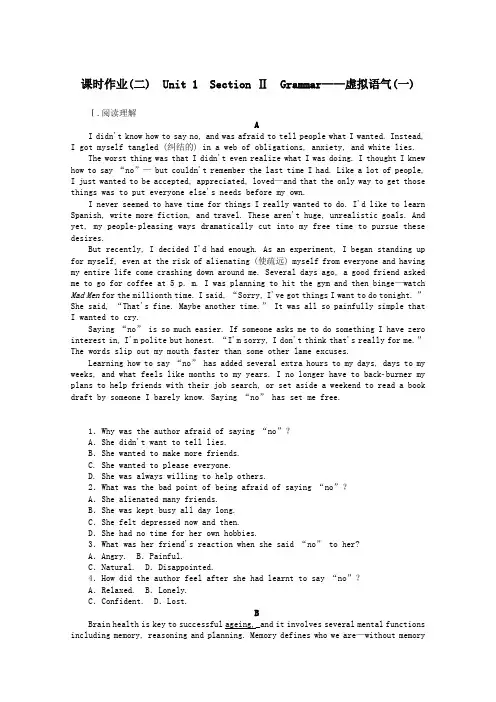
课时作业(二) Unit 1 Section ⅡGrammar——虚拟语气(一)Ⅰ.阅读理解AI didn't know how to say no, and was afraid to tell people what I wanted. Instead, I got myself tangled (纠结的) in a web of obligations, anxiety, and white lies.The worst thing was that I didn't even realize what I was doing. I thought I knew how to say “no”— but couldn't remember the last time I had. Like a lot of people, I just wanted to be accepted, appreciated, loved—and that the only way to get those things was to put everyone else's needs before my own.I never seemed to have time for things I really wanted to do. I'd like to learn Spanish, write more fiction, and travel. These aren't huge, unrealistic goals. And yet, my peoplepleasing ways dramatically cut into my free time to pursue these desires.But recently, I decided I'd had enough. As an experiment, I began standing up for myself, even at the risk of alienating (使疏远) myself from everyone and having my entire life come crashing down around me. Several days ago, a good friend asked me to go for coffee at 5 p. m. I was planning to hit the gym and then binge—watch Mad Men for the millionth time. I said, “Sorry, I've got things I want to do tonight. ” She said, “That's fine. Maybe another time.” It was all so painfully simple that I wanted to cry.Sayi ng “no” is so much easier. If someone asks me to do something I have zero interest in, I'm polite but honest. “I'm sorry, I don't think that's really for me.” The words slip out my mouth faster than some other lame excuses.Learning how to say “no” has add ed several extra hours to my days, days to my weeks, and what feels like months to my years. I no longer have to backburner my plans to help friends with their job search, or set aside a weekend to read a book draft by someone I barely know. Saying “no” h as set me free.1.Why was the author afraid of saying “no”?A.She didn't want to tell lies.B.She wanted to make more friends.C. She wanted to please everyone.D. She was always willing to help others.2.What was the bad point of being afraid of saying “no”?A.She alienated many friends.B.She was kept busy all day long.C.She felt depressed now and then.D.She had no time for her own hobbies.3.What was her friend's reaction when she said “no” to her?A.Angry. B.Painful.C.Natural. D.Disappointed.4.How did the author f eel after she had learnt to say “no”?A.Relaxed. B.Lonely.C.Confident. D.Lost.BBrain health is key to successful ageing,_and it involves several mental functions including memory, reasoning and planning. Memory defines who we are—without memorywe have no past, cannot plan for the future and are unable to enjoy the present. Our reasoning and planning skills help us create and maintain healthy lifestyle habits that protect our bodies and minds.People are living much longer than ever before. Those born in 1900 would have been lucky to reach their 50th birthday. Today, life expectancy in many countries exceeds 80, but unfortunately agerelated diseases such as Alzheimer's and diabetes can diminish quality of life.As we age, brain cells that normally fight off infection and repair tissue begin to attack healthy brain cells. This causes inflammation (炎症) and can lead to cognitive deficits and disease. But adopting healthy lifestyle habits, such as eating fish, getting a good night's sleep and doing physical exercise, can slow and even reverse the process.The typical 45yearold has worse memory than the 25yearold, and our brains will continue to decline if we do nothing to protect them. However, if we intervene (干预)early, we can slow the decline. It's always easier to protect a healthy brain than to try to repair damage once it is extensive.Although there is a genetic component to healthy ageing, lifestyle habits may be more critical than genes. The landmark MacArthur Studies of Successful Ageing showed t hat, on average, nongenetic factors are more important than genetics in determining how well and long we live, suggesting that we have more control than we realize over remaining healthy as we get older.5.What does the underlined word “ageing” mean in the first paragraph?A.The process of getting old.B.Mental functions.C.Life expectancy.D.Healthy lifestyle.6.What can we do to slow the decline of our brains?A.Enjoying the present.B.Staying in a good mood.C.Working as long as possible.D.Adopting healthy lifestyle habits.7.What does MacArthur Studies of Successful Ageing suggest?A.Agerelated diseases affect our quality of life.B.Genetic factors determine how well we live.C.We can do something to live better and longer.D.Sometimes we don't know how to keep healthy.8.What is the main idea of the text?A.Daily habits determine your longevity.B.You should protect your brains early.C.Good health results from right food.D.Body exercise also benefits mental health.Ⅱ.完形填空Cathy and I met a few days after I first arrived in China. I was walking around the English academy which had __1__ me, introducing myself to my new colleagues, most of __2__ were Chinese. I entered Cathy's __3__, saw her, and immediately felt some __4__ and happy emotions (情感). She __5__ so kind, yet professional. I couldn't stop smiling like a (n) __6__. After introducing ourselves and exchanging __7__ questions.I asked whether she knew anyone who could __8__ me in Chinese. She said she could, and agreed to meet outside work.We sometimes exchanged nonromantic texts in the evening. After a couple __9__,I invited her to my apartment. I was very nervous. Later, I asked if she would consider __10__ me. She didn't immediately __11__, but said she would tell me the next day.I found it very difficult to __12__, but I did.This was a __13__ difference. In American culture, starting to date someone is not a big, important __14__, but I think in Chinese culture it is. Well, she said “yes”, and so we spent lots of time together, and __15__ love. I asked her to __16__ me about 6 or 7 months later.We had a Chinese style __17__ in Cathy's hometown. My parents came, and it was great. It went really __18__. Everyone was very __19__. It was a very fun and interesting __20__ for me, very different from a Western style wedding.1.A.hired B.firedC.educated D.hated2.A.which B.themC.whom D.what3.A.life B.classroomC.bedroom D.heart4.A.interesting B.awkwardC.disappointed D.looked5.A.talked B.taughtC.smelled D.looked6.A.father B.actorC.fool D.genius7.A.basic B.seriousC.practical D.strange8.A.match B.persuadeC.communicate D.tutor9.A.hours B.weeksC.years D.decades10.A.dating B.teachingC.cheering D.praising11.A.leave B.argueC.agree D.answer12.A.sleep B.laughC.wait D.complain13.A.temporary B.nationalC.cultural D.political14.A.risk B.decisionC.trouble D.fault15.A.traded B.fell inC.talked about D.broke in16.A.marry B.wait forC.test D.go with17.A.breakup B.partyC.gettogether D.wedding18.A.steady B.wellC.annoying D.fast19.A.curious B.politeC.sad D.happy20.panion B.lessonC.experience D.story课时作业(二)Ⅰ.阅读理解A【语篇解读】本文是一篇记叙文。


ContentsUnit One MarriageDialoguePassage A Arranged MarriagePassage B The familyGrammar 非谓语动词–动词不定式(一)四级新题型练习Unit Two WeatherDialoguePassage A Weather ForecastPassage B The Weather SongGrammar 非谓语动词–动词不定式(二)四级新题型练习Unit Three MannersDialoguePassage A Road MannersPassage B Rules for Behavior in Public PlacesGrammar 非谓语动词–现在分词(一)四级新题型练习Unit Four Universe and SpaceDialoguePassage A China Lunches Its First Manned Spacecraft Passage B Have You Ever Seen a Flying Saucer?Grammar 非谓语动词–现在分词(二)四级新题型练习Unit Five AdvertisementDialoguePassage A Who Is Guiding Our Kids?Passage B The Power of AdvertisementGrammar 非谓语动词–过去分词四级新题型练习Unit Six InsuranceDialoguePassage A InsurancePassage B How to Choose a Health Care Plan Grammar 非谓语动词–动名词(一)四级新题型练习Unit Seven SuperstitionsDialoguePassage A SuperstitionsPassage B Superstitious? Here Is Why?Grammar 非谓语动词–动名词(二)四级新题型练习Unit Eight Fairy-tales and LegendsDialoguePassage A Sleeping BeautyPassage B The Golden TouchGrammar 虚拟语气(一)四级新题型练习Unit Nine Culture ShockDialoguePassage A My Teaching in ChinaPassage B Misunderstanding Means East- West Cultural Clash Grammar 虚拟语气(二)四级新题型练习Unit Ten Life StyleDialoguePassage A The State of SubhealthPassage B The Secret to Long LifeGrammar 同位语从句四级新题型练习Unit Eleven TaxDialoguePassage A Types of Taxes in the Unites StatesPassage B Tax Revision Calls More ReformGrammar 省略四级新题型练习Unit Twelve Aging and RetirementDialoguePassage A AgingPassage B RetireeGrammar 倒装四级新题型练习Unit One Marriage Exercises to the textI. Answer the following questions:1. Two. They are arranged marriage and liberal marriage.2. The Chinese modern system of arranged marriage is similar to blind dating in theWest.3. When a person reaches marriageable age, the parents (or relatives, friends and colleagues) compile a packet of information about her or him, including a photograph and descriptions of the family background, education, hobbies, accomplishments, and interest. They then inquire among their friends and acquaintances to see if anyone knows a boy or girl who would be a suitable marriage partner for the girl or boy. The person who does becomes the matchmaker.4. Even if the person has not found the love of his or her life, he or she might find someone who can get along with and make a match.5. A girl over 25 worries more.6. Y oung people’s parents are more concerned about marriage.7. A steady job, a good income, and having an apartment are the major factors.8. T hey are …II. Fill in the blanks with the right forms of the given words:1. marriage2. arrangement3. education4. relatively5. manageable6. description7. optional 8. approval 9. freedom 10. uncommonIII. Put the following sentences into Chinese, paying attention to the meanings of the italic words:match1. 她划了一根火柴并点燃一堆火。