
中山大学240英语(单考)2015年考研专业课真题试卷
- 格式:pdf
- 大小:7.24 MB
- 文档页数:10

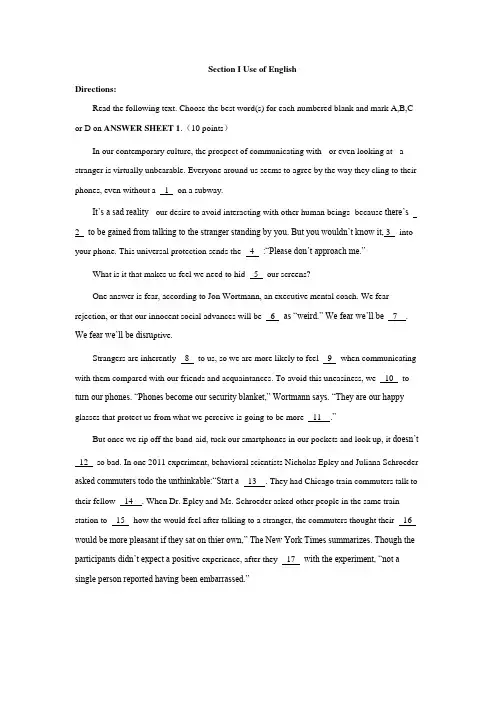
Section I Use of EnglishDirections:Read the following text. Choose the best word(s) for each numbered blank and mark A,B,C or D on ANSWER SHEET 1.(10 points)In our contemporary culture, the prospect of communicating with - or even looking at - a stranger is virtually unbearable. Everyone around us seems to agree by the way they cling to their phones, even without a 1 on a subway.It‘s a sad reality - our desire to avoid interacting with other human beings- because there‘s2 to be gained from talking to the stranger standing by you. But you wouldn‘t know it,3 into your phone. This universal protection sends the4 :―Please don‘t approach me.‖What is it that makes us feel we need to hid5 our screens?One answer is fear, according to Jon Wortmann, an executive mental coach. We fear rejection, or that our innocent social advances will be 6 as ―weird.‖ We fear we‘ll be 7 . We fear we‘ll be disru ptive.Strangers are inherently 8 to us, so we are more likely to feel 9 when communicating with them compared with our friends and acquaintances. To avoid this uneasiness, we 10 to turn our phones. ―Phones become our security blanket,‖ Wortmann says. ―They are our happy glasses that protect us from what we perceive is going to be more 11 .‖But once we rip off the band-aid, tuck our smartphones in our pockets and look up, it doesn‘t 12 so bad. In one 2011 experiment, behavioral scientists Nicholas Epley and Juliana Schroeder asked commuters todo the unthinkable:―Start a 13 . They had Chicago train commuters talk to their fellow 14 . When Dr. Epley and Ms. Schroeder asked other people in the same train station to 15 how the would feel after talking to a stranger, the commuters thought their 16 would be more pleasant if they sat on thier own,‖ The New York Times summarizes. Though the participants didn‘t expect a positi ve experience, after they 17 with the experiment, ―not a single person reported having been embarrassed.‖18 these commutes were reportedly more enjoyable compared with those without communication, which makes absolute sense, 19 human beings thrive off of social connections. It's that 20 : Talking to strangers can make you feel connected.1.[A]ticket [B]permit [C]signal [D]record2.[A]nothing [B]little [C]another [D]much3.[A]beaten [B]guided [C]plugged [D]brought4.[A]message [B]code [C]notice [D]sign5.[A]under [B]beyond [C]behind [D]from6.[A]misinterpreted [B]misapplied [C]misadjusted [D]mismatched7.[A]fired [B]judged [C]replaced [D]delayed8.[A]unreasonable [B]ungrateful [C]unconventional [D]unfamiliar9.[A]comfortable [B] anxious [C] confident [D]angry10.[A]attend [B]point [C]take [D]turn11.[A]dangerous [B] mysterious [C]violent [D]boring12.[A]hurt [B] resist [C]bend [D]decay13.[A]lecture [B]conversation [C]debate [D]negotiation14.[A]trainees [B]employees [C]researchers [D]passengers15.[A]reveal [B]choose [C]predict [D]design16.[A]voyage [B]flight [C]walk [D]ride17.[A]went through [B]did away [C]caught up [D]put up18.[A]In turn [B]In particular [C]In fact [D]In consequence19. [A]unless [B]since [C]if [D]whereas20. [A]funny [B]simple [C]logical [D]rareSection II Reading ComprehensionPart ADirections:Read the following four texts. Answer the questions below each text by choosing A,B,C,or D. Mark your answers on ANSWER SHEET 1.(40 points)Text 1A new study suggests that contrary to most surveys,people are actually more stressed at home than at work. Researchers measured people‘s cortisol, which is a stress marker, while they were at were work and while they were at home and found it higher at what is supposed to be a place of refuge.―Further contradicting conventional wisdom, we found that women as well as men have lower levels of stress at work than at home.‖Write one of the researchers, Sarah Damaske.In fact women even say they feel better at work, she notes, ―It is men, not women, who report being happier at home than at work.‖ Another surprise is that the findings hold true for both those with children and without, but more so for nonparents. This is why people who work outside the home have better health.What the study doesn‘t measure is whether people are still doing work when they‘re at home, whether it is household work or work brought home from the office. For many men, the end of the workday is a time to kick back. For women who say home, they never get to leave the office. And for women who work outside the home, they often are playing catch—up—with—household tasks. With the blurring of roles, and the fact that the home front lags well behind the workplace in making adjustments for working women, it‘s not surprising that women are more stressed at home.But it‘s not just a gender thing. At work, people pretty much know what they‘re supposed to be doing:working, making money, doing the tasks they have to do in order to draw an income. The bargain is very pure; Employee puts in hours of physical or mental labor and employee draws out life—sustaining moola.On the home front, however, people have no such clarity. Rare is the household in which the division of labor is so clinically and methodically laid out. There are a lot of tasks to be done,there are inadequate rewards for most of them. Your home colleagues—your family—have no clear rewards for most of them. Your home colleagues—your family—have no clear rewards for their labor; they need to be talked into it, or if they‘re teenagers, threatened with complete removal ofall electronic devices. Plus, they‘re your family. You cannot fire your family. You ne ver really get to go home from home.So it‘s not surprising that people are more stressed at home. Not only are the tasks apparently infinite, the co—workers are much harder to motivate.21.According to Paragraph 1,most previous surveys found that home .[A]was an unrealistic place for relaxation[B]generated more stress than the workplace[C]was an ideal place for stress measurement[D]offered greater relaxation than the workplace22.According to Damaske,who are likely to be the happiest at home?[A]Working mothers[B]Childless husbands[C]Childless wives[D]Working fathers23.The blurring of working women‘s roles refers to the fact that .[A]they are both bread winners and housewives[B]their home is also a place for kicking back[C]there is often much housework left behind[D]it is difficult for them to leave their office24.The word ―moola‖(Tine 4,Para 4)most probably means .[A]energy[B]skills[C]earnings[D]nutrition25.The home front differs from the workplace in that .[A]home is hardly a cozier working environment[B]division of labor at home is seldom clear-cut[C]household tasks are generally more motivating[D]family labor is often adequately rewardedText 2For years, studies have found that first-generation college student – those who do not have a parent with a college degree –lag other students on a range of education achievement factors. Their grades are lower than and their dropout rates are higher. But since such students are most likely to advance economically if they succeed in higher education, colleges and universities have pushed for decades to recruit more of them. This has created ―a paradox‖ in that recruiting first-generation student, but then watching many of them fail, means that higher education has ―continued to reproduce and widen, rather than close.‖ An achievement gap based on social class, according to the depressing beginning of a paper forthcoming in the journal Psychological Science.But the article is actually quite optimistic, as it outlines a potential solution to this problem, suggesting that an approach (which involves a one-hour, next-to-no-cost program) can close 63 percent of the achievement gap (measured by such factors as grades) between first-generation and other students.The authors of the paper are from different universities, and their findings are based on a study involving 147 students (who completed the project) at an unnamed private university. First generation was defined as not having parent with four-year college degree. Most of the first-generation students (59.1 percent) were recipients of Pell Grants, a federal grant of undergraduates with financial need, while this was true only for 8.6 percent of the students with at least one parent with four-year degree.Their thesis – that a relatively modest intervention could have a big impact – was based on the view that first-generation students may be most lacking not in potential but in practical knowledge about how to deal with the issues that face most college students. They cite past research by several authors to show that this is the gap that must be narrowed to close the achievement gap.Many first-generation students ―struggled to navigate the middle-class culture of higher education, learn the ‗rules of the game,‘ and take advantage of college resources,‖ they write. And this becomes more of a problem when colleges don‘t talk about the class advantages and disadvantages of different groups of students. Because US colleges and universities seldom acknowle dge how social class can affect students‘ educational experiences, many first-generationstudents lack of sight about why they are struggling and do not understand students ‗like them‘ can improve.‖26. Recruiting more first-generation students has .[A]. reduced their dropout rates[B]. narrowed the achievement gap[C]. missed its original purpose[D]. depressed college students27. The author of the research article are optimistic because .[A]. the problem is solvable[B]. their approach is costless[C]. the recruiting rate has increased[D]. their findings appeal to students28. The study suggests that most first-generation students .[A]. study at private universities[B]. are from single-parent families[C]. are in need of financial support[D]. have failed their college29. The author of the paper believe that first-generation students .[A]. are actually indifferent to the achievement gap[B]. can have a potential influence on other projects[C]. may lack opportunities to apply research projects[D]. are inexperienced in handling their issues at college30. We may infer from the last paragraph that .[A]. universities often reject the culture of their middle-class[B]. students are usually to blame for their lack of resources[C]. social class greatly helps enrich educational experiences.[D].colleges are partly responsible for the problem in questionText 3Even in traditional offices, ―the lingua franca of corporate America has gotten much more em otional and much more right-brained than it was 20 years ago,‖ said Harvard Business School prof essor Nancy Koehn. She started spinning off examples. ―If you and I parachuted back to Fortune 5 00 companies in 1990, we would see much less frequent use of terms like journey, mission, passio n. There were goals, there were strategies, there were objectives, but we didn‘t talk about energy; we didn‘t talk about passion.‖Koehn pointed out that this new era of corporate vocabulary is very ―team‖-oriented—and no t by coincidence. ―Let‘s not forget sports—in male-dominated corporate America, it‘s still a big de al. It‘s not explicitly conscious; it‘s the idea that I‘m a coach, and you‘re my team, and we‘re in thi s together. There are lots and lots of CEOs in very different companies, but most think of themselv es as coaches and this is their team and they want to win.‖These terms are also intended to infuse work with meaning—and, as Khurana points out, incr ease allegiance to the firm. ―You have the importation of terminology that historically used to be a ssociated with non-profit organizations and religious organizations: Terms like vision, values, pass ion, and purpose,‖ said Khurana.This new focus on personal fulfillment can help keep employees motivated amid increasingly loud debates over work-life balance. The ―mommy wars‖ of the 1990s are still going on today, pr ompting arguments about why women still can‘t have it all and books like Sheryl Sandberg‘s Lean In, whose title has become a buzzword in its own right. Terms like unplug, offline, life-hack, ban dwidth, and capacity are all about setting boundaries between the office and the home. But if your work is your ―passion,‖you‘ll be more likely to devote yourself to it, even if that means going ho me for dinner and then working long after the kids are in bed.But this seems to be the irony of office speak: Everyone makes fun of it, but managers love it , companies depend on it, and regular people willingly absorb it. As Nunberg said, ―You can get p eople to think it‘s nonsense at the same time that you buy into it.‖ In a workplace that‘s fundament ally indifferent to your life and its meaning, office speak can help you figure out how you relate to your work—and how your work defines who you are.31. According to Nancy Koehn ,office languages become_____.[A] more emotional[B] more objective[C] less energetic[D] less strategic32.‖Team‖-oriented corporate vocabulary is closely related to_____.[A] historical incidents[B] gender difference[C] sports culture[D] athletic executives33.Khurana believes that the importation of terminology aims to_____.[A] revive historical terms[B] promote company image[C] forster corporate cooperation[D] strengthen employee loyalty34.It can be inferred that Lean In_____.[A]voices for working women[B] appeals to passionate workaholics[C] triggers debates among mommies[D] praises motivated employees35.Which of the following statements is ture about office speak?[A]Managers admire it but avoid it.[B] Linguists believe it to be nonsense.[C]Companies find it to be fundamental.[D] Regular people mock it but accept it.Text 4Many people talked of the 288,000 new jobs the Labor Department reported for June, along with the drop in the unemployment rate to 6.1percent, as good news. And they were right. For now it appears the economy is creating jobs at a decent pace. We still have a long way to go to get back to full employment, but at least we are now finally moving forward at a faster pace.However, there is another important part of the jobs picture that was largely overlooked. There was a big jump in the number of people who report voluntarily working part-time. Thisfigure is now 830,000 (4.4 percent) above its year ago level.Before explaining the connection to the Obamacare, it is worth making an important distinction. Many people who work part-time work because this is all they can get. An increase in involuntary part-time work is evidence of weakness in the labor market and it means that many people will be having a very hard time making ends meet.There was an increase in involuntary part-time in June, but the general direction has been down. Involuntary part-time employment is still far higher than before the recession, but it is down by 640,000(7.9percent) from is its year level.We know the difference between voluntary and involuntary part-time employment because people tell us. The survey used by the Labor Department asks people if they worked less than 35 hours in the reference week. If the answer is ―yes,‖ they are classified as working part-time. The survey then asks whether they worked less than 35 hours in that week because they wanted to work less than full time or because they had no choice. They are only classified as voluntary part-time workers if they tell the survey taker they chose to work less than 35 hours a week.The issue of voluntary part-time relates to Obamacare because one of the main purpose was to allow people to get insurance outside of employment. For many people, especially those with serious health conditions or family members with serious health conditions, before Obamacare the only way to get insurance was through a job that provided health insurance.However, Obamacare has allowed more than 12 million people to either get insurance through Medicaid or the exchanges. These are people who may previously have felt the need to get a full-time job that provided insurance in order to cover themselves and their families. With Obamacare there is no longer a link between employment and insurance.36.Which part of the jobs picture was neglected?[A] The prospect of a thriving job market.[B] The increase of voluntary part-time jobs.[C] The possibility of full employment.[D] The acceleration of job creation.37.Many people work part-time because they_____.[A] prefer part-time jobs to full-time jobs.[B] feel that is enough to make ends meet.[C] cannot get their hands on full-time jobs.[D] haven‘t seen the weakness of the market.38.Involuntary part-time employment in the US____.[A] is harder to acquire than one year ago.[B] shows a general tendency of decline.[C] satisfies the real need of the jobless.[D] is lower than befor the recession.39.It can be learned that with Obamacare,_____.[A] it is no longer easy for part-times to get insurance.[B] employment is no longer a precondition to get insurance.[C] it is still challenging to get insurance for family members.[D] full-time employment is still essential for insurance.40.The text mainly discusses_____.[A] employment in the US.[B] part-timer clssification.[C] insurance through Medicaid.[D] Obamacare‘s trouble.PART BDirections:Read the following text and answer the questions by choosing the most suitable subheading from the list A-G for each paragraph (41-45). There are two extra subheadings which you do not need to use. Mark your answers on the ANSWER SHEET. (10 points)[A]You are not alone[B]Don‘t fear responsibility for your life[C]Pave your own unique path[D] Most of your fears are unreal[E] Think about the present moment[F]Experience helps you grow[G]There are many things to be grateful forSome Old Truths to Help You Overcome Tough TimesUnfortunately, life is not a bed of roses. We are going through life facing sad experiences. Moreover, we are grieving various kinds of loss: a friendship, a romantic relationship or a house. Hard times may hold you down at what usually seems like the most inopportune time, but you should remember that they won't last forever.When our time of mourning is over, we press forward, stronger with a greater understanding and respect for life. Furthermore, these losses make us mature and eventually move us toward future opportunities for growth and happiness. I want to share these old truths I've learned along the way.41.Fear is both useful and harmful. This normal human reaction is used to protect us by signaling danger and preparing us to deal with it. Unfortunately, people create inner barriers with a help of exaggerating fears. My favorite actor Will Smith once said, ―Fear is not real. It is a product of thoughts you create. Do not misunderstand me. Danger is very real. But fear is a choice.‖I do completely agree that fears are just the product of own luxuriant imagination.42.If you are surrounded by problems and cannot stop thinking about past, try to focus on the present moment. Many of us are weighed down by the past or anxious about the future. You may feel guilt over your past, but you are poisoning the present with the things and circumstances you cannot change. Value the present moment and remember how fortunate you are to be alive. Enjoy the beauty of the world around and keep the eyes open to see the possibilities before you. Happiness is not point of future and not a moment from the past, but a mindset thancan be designed in to the present.43.Sometimes it is easy to feel bad because you are going to through tough times. You can beeasily caught up by life problems that you forget to pause and appreciate the things you have. Only strong people prefer to smile and value their life instead of crying and complaining about something.44.No matter how isolated you might feel and how serious the situation is, you should always remember that you are not alone. Try to keep in mind that almost everyone respects and wants to help you if you are trying to make a good change in your life, especially your dearest and nearest people. You may have a circle of friends or relatives, try to participate in several online communities, full of people who are always willing to share advice and encouragement.45.Today many people find it difficult to trust their own opinion and seek balance by gaining objectivity from external sources. This way you devalue your opinion and show that you are incapable of managing your own life. When you are struggling to achieve something important you should believe in yourself and be sure that your decision is the best. You live in your skin, think your own thoughts, have your own values and make your own choices.Section III Translation46. DirectionsTranslate the following text into Chinese. Write your translation on the ANSWER SHEET. (15 points)Think about driving a route that‘s very familiar. It could be your comminutes to work, a trip into town or the way home. Whichever it is, you know every twist step turn like the back of your hand. On these steps of trips it‘s easy to lose concentration is that you perceive that the trip has taken less time than it actually has.This is the well-travelled road effect. People tend to underestimate the time it takes to travel a familiar route.The effect is caused by the way we allocate our attention. When we travel down a well-known route, because we don‘t have to concentrate much, time seems to flow more quickly. And afterward, when we come to think back on it, we can‘t remember the journey well because we didn‘t pay much attention to it. So we as sume it was shorter.Section IV WritingPart A47. DirectionsSuppose your university is going to host a summer camp for high school students. Write a note to1)briefly introduce the camp activities, and2)call for volunteersYou should write about 100 words on the ANSWER SHEET.Do not use your name or the name of your university.Do not write your address. (10 points)Part B48. Directions:Write an essay based on the following chart. In your writing, you should1)interpret the chart, and2)give your commentsYou should write about 150 words on the ANSWER SHEET.(15 points)。

2013年中山大学240英语(单考)考研真题及详解Section Ⅰ: Use of English (10 points)Directions: Read the following text Choose the best word(s) for each numbered blank and mark A, B, C or D on the ANSWER SHEET.With 950 million people, India ranks second to China among the most populous countries. But since China (1)_____ family planning program in 1971. India has been closing the (2)_____ Indians have reduced their birth rate but not nearly(3)_____ the Chinese have. If current growth rates continue, India’s population will(4)_____ China’s around the year 2028 (5)_____ about 1.7 billion.Should that happen, it won’t be the (6)_____ of the enlightened women of Kerala, a state in southern India.(7)_____ India as a whole adds almost 20 million people a year, Kerala’s population is virtually(8)_____ . The reason is no mystery: nearly two-thirds of Kerala women practice birth control, (9)_____ about 40% in the entire nation.The difference (10)_____ the emphasis put on health programs, (11)_____ birth control, by the state authorities, (12)_____ in 1957 became India’s first elected Communist (13)_____. And an educational tradition and matrilineal customs in parts of Kerala help girls and boys get (14)_____ good schooling. While one in three Indian women is (15)_____, 90% of those in Kerala can read and write.Higher literacy rates (16)_____ family planning. “Unlik e our Parents, we knowthat we can do more for our children if we have (17)_____ of them,” says Lai la Cherian, 33, who lives in the Village of Kudamaloor. She has limited herself (18)_____ three children—one below the national (19)_____ of four. That kind of restraint will keep Kerala from putting added (20)_____on world food supplies.1. A. discoveredB. circulatedC. launchedD. transmitted2. A. gapB. topC. bitD. bet3. A. as many asB. as well asC. as soon asD. as much as4. A. shakeB. passC. rocketD. impress5. A. onB. inC. atD. for6. A. forceB. fightC. falseD. fault7. A. WhileB. SinceC. BecauseD. Suppose8. A. reliableB. stableC. countableD. flexible9. A. benefited fromB. involved withC. compared withD. resulted from10. A. lies inB. shows offC. results inD. departs from11. A. revivingB. includingC. practicingD. containing12. A. thatB. sinceC. whatD. which13. A. groupB. allianceC. governmentD. bureau14. A. equallyB. officiallyC. sharplyD. proudly15. A. culturalB. literateC. nativeD. responsible16. A. fosterB. hamperC. reformD. advocate17. A. lessB. moreC. fewerD. better18. A. inB. atC. asD. to19. A. statisticsB. averageC. tendencyD. category20. A. increaseB. challengeC. pressureD. complaint【答案与解析】1. C 根据上文可知“印度9.5亿人口,在世界上是仅次于中国的第二人口大国。

2015年考研英语真题及答案解析Directions:Read the following text. Choose the best word(s) for each numbered blank and mark A, B, C or D on ANSWER SHEET. (10 points)Though not biologically related, friends are as “related” as fourth cousins, sharing about 1% of genes. That is _(1)_a study, published from the University of California and Yale University in the Proceedings of the National Academy of Sciences, has__(2)_.The study is a genome-wide analysis conducted _(3)__1,932 unique subjects which __(4)__pairs of unrelated friends and unrelated strangers. The same people were used in both_(5)_.While 1% may seem_(6)_,it is not so to a geneticist. As James Fowler, professor of medical genetics at UC San Diego, says, “Most people do not even _(7)_their fourth cousins but somehow manage to select as friends the people who_(8)_our kin.”The study_(9)_found that the genes for smell were something shared in friends but not genes for immunity .Why this similarity exists in smell genes is difficult to explain, for now,_(10)_,as the team suggests, it draws us to similar environments but there is more_(11)_it. There could be many mechanisms working together that _(12)_us in choosing genetically similar friends_(13)_”functional Kinship” of being friends with_(14)_!One of the remarkable findings of the study was the similar genes seem to be evolution_(15)_than other genes Studying this could help_(16)_why human evolution picked pace in the last 30,000 years, with social environment being a major_(17)_factor.The findings do not simply explain people’s_(18)_to befriend those of similar_(19)_backgrounds, say the researchers. Though all the subjects were drawn from a population of European extraction, care was takento_(20)_that all subjects, friends and strangers, were taken from the same population.1. [A] when [B] why [C] how [D] what【答案】[D] what【解析】该题考查的是语法知识。

1/10【育明教育】中国考研考博专业课辅导第一品牌官方网站: 12015年中山大学考研指导育明教育,创始于2006年,由北京大学、中国人民大学、中央财经大学、北京外国语大学的教授投资创办,并有北京大学、武汉大学、中国人民大学、北京师范大学复旦大学、中央财经大学、等知名高校的博士和硕士加盟,是一个最具权威的全国范围内的考研考博辅导机构。
更多详情可联系育明教育孙老师。
650亚太研究院(电话:84114832)19030200政治学(1)101思想政治理论(2)201英语一(3)683国际政治学(4)913国际关系史复试专业课:F6501专业基础理论与时事评论01国际政治02国际关系选择考研!!由此开启人生中崭新的一篇!!嶳围弹匈秤$6-9星%2/10【育明教育】中国考研考博专业课辅导第一品牌官方网站: 2政治在这阶段的复习,可以分两种情况来进行:⒈基础比较差的。
在马原上要认真一些,考研政治辅导书起码要看一到两遍。
同时还要抓练习选择题,这是比较有效的。
但不管是做题还是看书,政治理论复习当中都要结合实际问题进行思考。
⒉基础比较好的。
这样的同学在政治理论课复习当中可以看辅导教材一到两遍,基础练习题挑着做一做,主要是抽出精力思考重要问题。
英语考研英语的阅读应该从以下几个方面来准备:第一充足的词汇量;第二,把握文章重要信息,把握重要信息的能力,直接关系到做题的命中率。
一篇文章的重要信息包括文章涉及的各主要方面以及作者的观点。
考生要充分利用这些线索、达到对作者观点的准确把握。
把握文章的重点信息不仅帮助考生正确地回答涉及作者观点的题,而且对整个文章的理解会起到强有力的引导作用。
如果有充足的时间,阅读量达到一定程度并且在阅读的过程中进行有效的积累会对考研英语有很大的帮助。
但是由于时间有限,所以要精读和泛读并举。
如果不精读文章就难以有积累,这些积累包括词汇量的扩大,尤其是重点词汇的积累;对语法结构和词语用法更熟练的掌握,尤其是把握复杂句结构的能力。