
Hawthorne
- 格式:ppt
- 大小:159.00 KB
- 文档页数:14
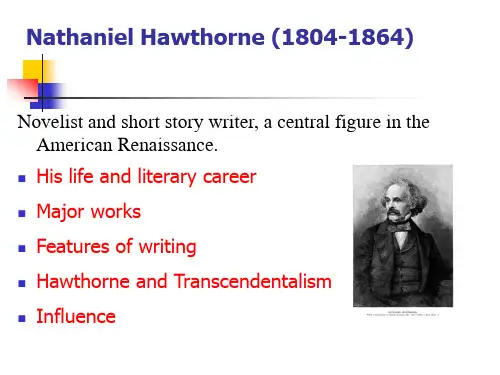


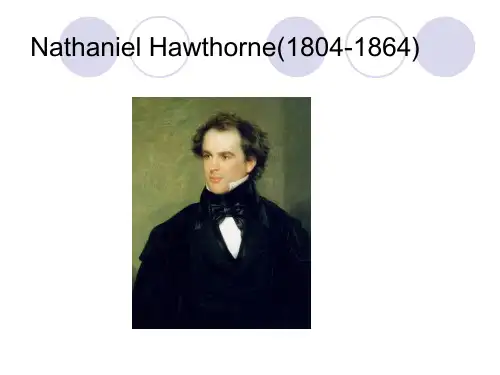

The Birth-MarkHawthorne, Nathaniel Published:1843Type(s):Short FictionSource:About Hawthorne:Nathaniel Hawthorne was born on July4,1804,in Salem,Massachu-setts,where his birthplace is now a museum.William Hathorne,who emigrated from England in1630,was the first of Hawthorne's ancestors to arrive in the colonies.After arriving,William persecuted Quakers. William's son John Hathorne was one of the judges who oversaw the Salem Witch Trials.(One theory is that having learned about this,the au-thor added the"w"to his surname in his early twenties,shortly after graduating from college.)Hawthorne's father,Nathaniel Hathorne,Sr., was a sea captain who died in1808of yellow fever,when Hawthorne was only four years old,in Raymond,Maine.Hawthorne attended Bow-doin College at the expense of an uncle from1821to1824,befriending classmates Henry Wadsworth Longfellow and future president Franklin Pierce.While there he joined the Delta Kappa Epsilon fraternity.Until the publication of his Twice-Told Tales in1837,Hawthorne wrote in the comparative obscurity of what he called his"owl's nest"in the family home.As he looked back on this period of his life,he wrote:"I have not lived,but only dreamed about living."And yet it was this period of brooding and writing that had formed,as Malcolm Cowley was to de-scribe it,"the central fact in Hawthorne's career,"his"term of apprentice-ship"that would eventually result in the"richly meditated fiction." Hawthorne was hired in1839as a weigher and gauger at the Boston Custom House.He had become engaged in the previous year to the illus-trator and transcendentalist Sophia Peabody.Seeking a possible home for himself and Sophia,he joined the transcendentalist utopian com-munity at Brook Farm in1841;later that year,however,he left when he became dissatisfied with farming and the experiment.(His Brook Farm adventure would prove an inspiration for his novel The Blithedale Ro-mance.)He married Sophia in1842;they moved to The Old Manse in Concord,Massachusetts,where they lived for three years.There he wrote most of the tales collected in Mosses from an Old Manse. Hawthorne and his wife then moved to Salem and later to the Berkshires,returning in1852to Concord and a new home The Wayside, previously owned by the Alcotts.Their neighbors in Concord included Ralph Waldo Emerson and Henry David Thoreau.Like Hawthorne, Sophia was a reclusive person.She was bedridden with headaches until her sister introduced her to Hawthorne,after which her headaches seem to have abated.The Hawthornes enjoyed a long marriage,often taking walks in the park.Sophia greatly admired her husband's work.In one of her journals,she writes:"I am always so dazzled and bewildered withthe richness,the depth,the…jewels of beauty in his productions that I am always looking forward to a second reading where I can ponder and muse and fully take in the miraculous wealth of thoughts."In1846, Hawthorne was appointed surveyor(determining the quantity and value of imported goods)at the Salem Custom House.Like his earlier appointment to the custom house in Boston,this employment was vul-nerable to the politics of the spoils system.A Democrat,Hawthorne lost this job due to the change of administration in Washington after the pres-idential election of1848.Hawthorne's career as a novelist was boosted by The Scarlet Letter in1850,in which the preface refers to his three-year tenure in the Custom House at Salem.The House of the Seven Gables (1851)and The Blithedale Romance(1852)followed in quick succession. In1852,he wrote the campaign biography of his old friend Franklin Pierce.With Pierce's election as president,Hawthorne was rewarded in 1853with the position of United States consul in Liverpool.In1857,his appointment ended and the Hawthorne family toured France and Italy. They returned to The Wayside in1860,and that year saw the publication of The Marble Faun.Failing health(which biographer Edward Miller speculates was stomach cancer)prevented him from completing several more romances.Hawthorne died in his sleep on May19,1864,in Ply-mouth,New Hampshire while on a tour of the White Mountains with Pierce.He was buried in Sleepy Hollow Cemetery,Concord,Massachu-setts.Wife Sophia and daughter Una were originally buried in England. However,in June2006,they were re-interred in plots adjacent to Nath-aniel.Nathaniel and Sophia Hawthorne had three children:Una,Julian, and Rose.Una was a victim of mental illness and died young.Julian moved out west,served a jail term for embezzlement and wrote a book about his father.Rose married George Parsons Lathrop and they became Roman Catholics.After George's death,Rose became a Dominican nun. She founded the Dominican Sisters of Hawthorne to care for victims of incurable cancer. Source: WikipediaAlso available on Feedbooks for Hawthorne:•The Scarlet Letter(1850)•The House of the Seven Gables(1851)•Rappaccini's Daughter(1844)•The Minister's Black Veil(1837)• A Bell's Biography(1837)•Young Goodman Brown(1835)•The Marble Faun(1860)•Biographical Stories(1842)• A Book of Autographs(1844)•The Blithedale Romance(1852)Note:This book is brought to you by Feedbooks.Strictly for personal use, do not use this file for commercial purposes.In the latter part of the last century there lived a man of science,an emin-ent proficient in every branch of natural philosophy,who not long before our story opens had made experience of a spiritual affinity more attract-ive than any chemical one.He had left his laboratory to the care of an as-sistant,cleared his fine countenance from the furnace smoke,washed the stain of acids from his fingers,and persuaded a beautiful woman to be-come his wife.In those days when the comparatively recent discovery of electricity and other kindred mysteries of Nature seemed to open paths into the region of miracle,it was not unusual for the love of science to rival the love of woman in its depth and absorbing energy.The higher intellect,the imagination,the spirit,and even the heart might all find their congenial aliment in pursuits which,as some of their ardent votar-ies believed,would ascend from one step of powerful intelligence to an-other,until the philosopher should lay his hand on the secret of creative force and perhaps make new worlds for himself.We know not whether Aylmer possessed this degree of faith in man's ultimate control over Nature.He had devoted himself,however,too unreservedly to scientific studies ever to be weaned from them by any second passion.His love for his young wife might prove the stronger of the two;but it could only be by intertwining itself with his love of science,and uniting the strength of the latter to his own.Such a union accordingly took place,and was attended with truly re-markable consequences and a deeply impressive moral.One day,very soon after their marriage,Aylmer sat gazing at his wife with a trouble in his countenance that grew stronger until he spoke. "Georgiana,"said he,"has it never occurred to you that the mark upon your cheek might be removed?""No,indeed,"said she,smiling;but perceiving the seriousness of his manner,she blushed deeply."To tell you the truth it has been so often called a charm that I was simple enough to imagine it might be so." "Ah,upon another face perhaps it might,"replied her husband;"but never on yours.No,dearest Georgiana,you came so nearly perfect from the hand of Nature that this slightest possible defect,which we hesitate whether to term a defect or a beauty,shocks me,as being the visible mark of earthly imperfection.""Shocks you,my husband!"cried Georgiana,deeply hurt;at first red-dening with momentary anger,but then bursting into tears."Then why did you take me from my mother's side?You cannot love what shocks you!"To explain this conversation it must be mentioned that in the centre of Georgiana's left cheek there was a singular mark,deeply interwoven,as it were,with the texture and substance of her face.In the usual state of her complexion—a healthy though delicate bloom—the mark wore a tint of deeper crimson,which imperfectly defined its shape amid the sur-rounding rosiness.When she blushed it gradually became more indis-tinct,and finally vanished amid the triumphant rush of blood that bathed the whole cheek with its brilliant glow.But if any shifting motion caused her to turn pale there was the mark again,a crimson stain upon the snow,in what Aylmer sometimes deemed an almost fearful distinct-ness.Its shape bore not a little similarity to the human hand,though of the smallest pygmy size.Georgiana's lovers were wont to say that some fairy at her birth hour had laid her tiny hand upon the infant's cheek, and left this impress there in token of the magic endowments that were to give her such sway over all hearts.Many a desperate swain would have risked life for the privilege of pressing his lips to the mysterious hand.It must not be concealed,however,that the impression wrought by this fairy sign manual varied exceedingly,according to the difference of temperament in the beholders.Some fastidious persons—but they were exclusively of her own sex—affirmed that the bloody hand,as they chose to call it,quite destroyed the effect of Georgiana's beauty,and rendered her countenance even hideous.But it would be as reasonable to say that one of those small blue stains which sometimes occur in the purest statuary marble would convert the Eve of Powers to a monster. Masculine observers,if the birthmark did not heighten their admiration, contented themselves with wishing it away,that the world might pos-sess one living specimen of ideal loveliness without the semblance of a flaw.After his marriage,—for he thought little or nothing of the matter before,—Aylmer discovered that this was the case with himself.Had she been less beautiful,—if Envy's self could have found aught else to sneer at,—he might have felt his affection heightened by the pret-tiness of this mimic hand,now vaguely portrayed,now lost,now steal-ing forth again and glimmering to and fro with every pulse of emotion that throbbed within her heart;but seeing her otherwise so perfect,he found this one defect grow more and more intolerable with every mo-ment of their united lives.It was the fatal flaw of humanity which Nature,in one shape or another,stamps ineffaceably on all her produc-tions,either to imply that they are temporary and finite,or that their per-fection must be wrought by toil and pain.The crimson hand expressed the ineludible gripe in which mortality clutches the highest and purest ofearthly mould,degrading them into kindred with the lowest,and even with the very brutes,like whom their visible frames return to dust.In this manner,selecting it as the symbol of his wife's liability to sin,sor-row,decay,and death,Aylmer's sombre imagination was not long in rendering the birthmark a frightful object,causing him more trouble and horror than ever Georgiana's beauty,whether of soul or sense,had given him delight.At all the seasons which should have been their happiest,he invari-ably and without intending it,nay,in spite of a purpose to the contrary, reverted to this one disastrous topic.Trifling as it at first appeared,it so connected itself with innumerable trains of thought and modes of feeling that it became the central point of all.With the morning twilight Aylmer opened his eyes upon his wife's face and recognized the symbol of im-perfection;and when they sat together at the evening hearth his eyes wandered stealthily to her cheek,and beheld,flickering with the blaze of the wood fire,the spectral hand that wrote mortality where he would fain have worshipped.Georgiana soon learned to shudder at his gaze.It needed but a glance with the peculiar expression that his face often wore to change the roses of her cheek into a deathlike paleness,amid which the crimson hand was brought strongly out,like a bass-relief of ruby on the whitest marble.Late one night when the lights were growing dim,so as hardly to be-tray the stain on the poor wife's cheek,she herself,for the first time,vol-untarily took up the subject."Do you remember,my dear Aylmer,"said she,with a feeble attempt at a smile,"have you any recollection of a dream last night about this odious hand?""None!none whatever!"replied Aylmer,starting;but then he added, in a dry,cold tone,affected for the sake of concealing the real depth of his emotion,"I might well dream of it;for before I fell asleep it had taken a pretty firm hold of my fancy.""And you did dream of it?"continued Georgiana,hastily;for she dreaded lest a gush of tears should interrupt what she had to say."A ter-rible dream!I wonder that you can forget it.Is it possible to forget this one expression?—'It is in her heart now;we must have it out!'Reflect, my husband; for by all means I would have you recall that dream."The mind is in a sad state when Sleep,the all-involving,cannot confine her spectres within the dim region of her sway,but suffers them to break forth,affrighting this actual life with secrets that perchance belong to adeeper one.Aylmer now remembered his dream.He had fancied himself with his servant Aminadab,attempting an operation for the removal of the birthmark;but the deeper went the knife,the deeper sank the hand, until at length its tiny grasp appeared to have caught hold of Georgiana's heart;whence,however,her husband was inexorably resolved to cut or wrench it away.When the dream had shaped itself perfectly in his memory,Aylmer sat in his wife's presence with a guilty feeling.Truth often finds its way to the mind close muffled in robes of sleep,and then speaks with uncom-promising directness of matters in regard to which we practise an unconscious self-deception during our waking moments.Until now he had not been aware of the tyrannizing influence acquired by one idea over his mind,and of the lengths which he might find in his heart to go for the sake of giving himself peace."Aylmer,"resumed Georgiana,solemnly,"I know not what may be the cost to both of us to rid me of this fatal birthmark.Perhaps its removal may cause cureless deformity;or it may be the stain goes as deep as life itself.Again:do we know that there is a possibility,on any terms,of un-clasping the firm gripe of this little hand which was laid upon me before I came into the world?""Dearest Georgiana,I have spent much thought upon the subject," hastily interrupted Aylmer."I am convinced of the perfect practicability of its removal.""If there be the remotest possibility of it,"continued Georgiana,"let the attempt be made at whatever risk.Danger is nothing to me;for life, while this hateful mark makes me the object of your horror and dis-gust,—life is a burden which I would fling down with joy.Either remove this dreadful hand,or take my wretched life!You have deep science.All the world bears witness of it.You have achieved great wonders.Cannot you remove this little,little mark,which I cover with the tips of two small fingers?Is this beyond your power,for the sake of your own peace, and to save your poor wife from madness?""Noblest,dearest,tenderest wife,"cried Aylmer,rapturously,"doubt not my power.I have already given this matter the deepest thought—thought which might almost have enlightened me to create a being less perfect than yourself.Georgiana,you have led me deeper than ever into the heart of science.I feel myself fully competent to render this dear cheek as faultless as its fellow;and then,most beloved,what will be my triumph when I shall have corrected what Nature left imperfect inher fairest work!Even Pygmalion,when his sculptured woman assumed life, felt not greater ecstasy than mine will be.""It is resolved,then,"said Georgiana,faintly smiling."And,Aylmer, spare me not,though you should find the birthmark take refuge in my heart at last."Her husband tenderly kissed her cheek—her right cheek—not that which bore the impress of the crimson hand.The next day Aylmer apprised his wife of a plan that he had formed whereby he might have opportunity for the intense thought and constant watchfulness which the proposed operation would require;while Geor-giana,likewise,would enjoy the perfect repose essential to its success. They were to seclude themselves in the extensive apartments occupied by Aylmer as a laboratory,and where,during his toilsome youth,he had made discoveries in the elemental powers of Nature that had roused the admiration of all the learned societies in Europe.Seated calmly in this laboratory,the pale philosopher had investigated the secrets of the highest cloud region and of the profoundest mines;he had satisfied him-self of the causes that kindled and kept alive the fires of the volcano;and had explained the mystery of fountains,and how it is that they gush forth,some so bright and pure,and others with such rich medicinal vir-tues,from the dark bosom of the earth.Here,too,at an earlier period,he had studied the wonders of the human frame,and attempted to fathom the very process by which Nature assimilates all her precious influences from earth and air,and from the spiritual world,to create and foster man,her masterpiece.The latter pursuit,however,Aylmer had long laid aside in unwilling recognition of the truth—against which all seekers sooner or later stumble—that our great creative Mother,while she amuses us with apparently working in the broadest sunshine,is yet severely careful to keep her own secrets,and,in spite of her pretended openness,shows us nothing but results.She permits us,indeed,to mar, but seldom to mend,and,like a jealous patentee,on no account to make. Now,however,Aylmer resumed these half-forgotten investigations;not, of course,with such hopes or wishes as first suggested them;but because they involved much physiological truth and lay in the path of his pro-posed scheme for the treatment of Georgiana.As he led her over the threshold of the laboratory,Georgiana was cold and tremulous.Aylmer looked cheerfully into her face,with intent to re-assure her,but was so startled with the intense glow of the birthmarkupon the whiteness of her cheek that he could not restrain a strong con-vulsive shudder. His wife fainted."Aminadab!Aminadab!"shouted Aylmer,stamping violently on the floor.Forthwith there issued from an inner apartment a man of low stature, but bulky frame,with shaggy hair hanging about his visage,which was grimed with the vapors of the furnace.This personage had been Aylmer's underworker during his whole scientific career,and was ad-mirably fitted for that office by his great mechanical readiness,and the skill with which,while incapable of comprehending a single principle, he executed all the details of his master's experiments.With his vast strength,his shaggy hair,his smoky aspect,and the indescribable earthi-ness that incrusted him,he seemed to represent man's physical nature; while Aylmer's slender figure,and pale,intellectual face,were no less apt a type of the spiritual element."Throw open the door of the boudoir,Aminadab,"said Aylmer,"and burn a pastil.""Yes,master,"answered Aminadab,looking intently at the lifeless form of Georgiana;and then he muttered to himself,"If she were my wife, I'd never part with that birthmark."When Georgiana recovered consciousness she found herself breathing an atmosphere of penetrating fragrance,the gentle potency of which had recalled her from her deathlike faintness.The scene around her looked like enchantment.Aylmer had converted those smoky,dingy,sombre rooms,where he had spent his brightest years in recondite pursuits,into a series of beautiful apartments not unfit to be the secluded abode of a lovely woman.The walls were hung with gorgeous curtains,which im-parted the combination of grandeur and grace that no other species of adornment can achieve;and as they fell from the ceiling to the floor,their rich and ponderous folds,concealing all angles and straight lines,ap-peared to shut in the scene from infinite space.For aught Georgiana knew,it might be a pavilion among the clouds.And Aylmer,excluding the sunshine,which would have interfered with his chemical processes, had supplied its place with perfumed lamps,emitting flames of various hue,but all uniting in a soft,impurpled radiance.He now knelt by his wife's side,watching her earnestly,but without alarm;for he was confid-ent in his science,and felt that he could draw a magic circle round her within which no evil might intrude."Where am I?Ah,I remember,"said Georgiana,faintly;and she placed her hand over her cheek to hide the terrible mark from her husband's eyes."Fear not,dearest!"exclaimed he."Do not shrink from me!Believe me, Georgiana,I even rejoice in this single imperfection,since it will be such a rapture to remove it.""Oh,spare me!"sadly replied his wife."Pray do not look at it again.I never can forget that convulsive shudder."In order to soothe Georgiana,and,as it were,to release her mind from the burden of actual things,Aylmer now put in practice some of the light and playful secrets which science had taught him among its profounder lore.Airy figures,absolutely bodiless ideas,and forms of unsubstantial beauty came and danced before her,imprinting their momentary foot-steps on beams of light.Though she had some indistinct idea of the method of these optical phenomena,still the illusion was almost perfect enough to warrant the belief that her husband possessed sway over the spiritual world.Then again,when she felt a wish to look forth from her seclusion,immediately,as if her thoughts were answered,the procession of external existence flitted across a screen.The scenery and the figures of actual life were perfectly represented,but with that bewitching,yet in-describable difference which always makes a picture,an image,or a shadow so much more attractive than the original.When wearied of this, Aylmer bade her cast her eyes upon a vessel containing a quantity of earth.She did so,with little interest at first;but was soon startled to per-ceive the germ of a plant shooting upward from the soil.Then came the slender stalk;the leaves gradually unfolded themselves;and amid them was a perfect and lovely flower."It is magical!" cried Georgiana. "I dare not touch it.""Nay,pluck it,"answered Aylmer,—"pluck it,and inhale its brief per-fume while you may.The flower will wither in a few moments and leave nothing save its brown seed vessels;but thence may be perpetuated a race as ephemeral as itself."But Georgiana had no sooner touched the flower than the whole plant suffered a blight, its leaves turning coal-black as if by the agency of fire. "There was too powerful a stimulus," said Aylmer, thoughtfully.To make up for this abortive experiment,he proposed to take her por-trait by a scientific process of his own invention.It was to be effected by rays of light striking upon a polished plate of metal.Georgiana assented;but,on looking at the result,was affrighted to find the features of the portrait blurred and indefinable;while the minute figure of a hand ap-peared where the cheek should have been.Aylmer snatched the metallic plate and threw it into a jar of corrosive acid.Soon,however,he forgot these mortifying failures.In the intervals of study and chemical experiment he came to her flushed and exhausted, but seemed invigorated by her presence,and spoke in glowing language of the resources of his art.He gave a history of the long dynasty of the al-chemists,who spent so many ages in quest of the universal solvent by which the golden principle might be elicited from all things vile and base.Aylmer appeared to believe that,by the plainest scientific logic,it was altogether within the limits of possibility to discover this long-sought medium;"but,"he added,"a philosopher who should go deep enough to acquire the power would attain too lofty a wisdom to stoop to the exercise of it."Not less singular were his opinions in regard to the elixir vitae.He more than intimated that it was at his option to concoct a liquid that should prolong life for years,perhaps interminably;but that it would produce a discord in Nature which all the world,and chiefly the quaffer of the immortal nostrum, would find cause to curse."Aylmer,are you in earnest?"asked Georgiana,looking at him with amazement and fear."It is terrible to possess such power,or even to dream of possessing it.""Oh,do not tremble,my love,"said her husband."I would not wrong either you or myself by working such inharmonious effects upon our lives;but I would have you consider how trifling,in comparison,is the skill requisite to remove this little hand."At the mention of the birthmark,Georgiana,as usual,shrank as if a redhot iron had touched her cheek.Again Aylmer applied himself to his labors.She could hear his voice in the distant furnace room giving directions to Aminadab,whose harsh, uncouth,misshapen tones were audible in response,more like the grunt or growl of a brute than human speech.After hours of absence,Aylmer reappeared and proposed that she should now examine his cabinet of chemical products and natural treasures of the earth.Among the former he showed her a small vial,in which,he remarked,was contained a gentle yet most powerful fragrance,capable of impregnating all the breezes that blow across a kingdom.They were of inestimable value,the contents of that little vial;and,as he said so,he threw some of theperfume into the air and filled the room with piercing and invigorating delight."And what is this?"asked Georgiana,pointing to a small crystal globe containing a gold-colored liquid."It is so beautiful to the eye that I could imagine it the elixir of life.""In one sense it is,"replied Aylmer;"or,rather,the elixir of immortal-ity.It is the most precious poison that ever was concocted in this world. By its aid I could apportion the lifetime of any mortal at whom you might point your finger.The strength of the dose would determine whether he were to linger out years,or drop dead in the midst of a breath.No king on his guarded throne could keep his life if I,in my private station,should deem that the welfare of millions justified me in depriving him of it.""Why do you keep such a terrific drug?" inquired Georgiana in horror. "Do not mistrust me,dearest,"said her husband,smiling;"its virtuous potency is yet greater than its harmful one.But see!here is a powerful cosmetic.With a few drops of this in a vase of water,freckles may be washed away as easily as the hands are cleansed.A stronger infusion would take the blood out of the cheek,and leave the rosiest beauty a pale ghost.""Is it with this lotion that you intend to bathe my cheek?"asked Geor-giana, anxiously."Oh,no,"hastily replied her husband;"this is merely superficial.Your case demands a remedy that shall go deeper."In his interviews with Georgiana,Aylmer generally made minute in-quiries as to her sensations and whether the confinement of the rooms and the temperature of the atmosphere agreed with her.These questions had such a particular drift that Georgiana began to conjecture that she was already subjected to certain physical influences,either breathed in with the fragrant air or taken with her food.She fancied likewise,but it might be altogether fancy,that there was a stirring up of her system—a strange,indefinite sensation creeping through her veins,and tingling, half painfully,half pleasurably,at her heart.Still,whenever she dared to look into the mirror,there she beheld herself pale as a white rose and with the crimson birthmark stamped upon her cheek.Not even Aylmer now hated it so much as she.To dispel the tedium of the hours which her husband found it neces-sary to devote to the processes of combination and analysis,Georgiana。