unit 1 Good friend教案(新课标版高一英语教案教学设计)
- 格式:doc
- 大小:35.50 KB
- 文档页数:10
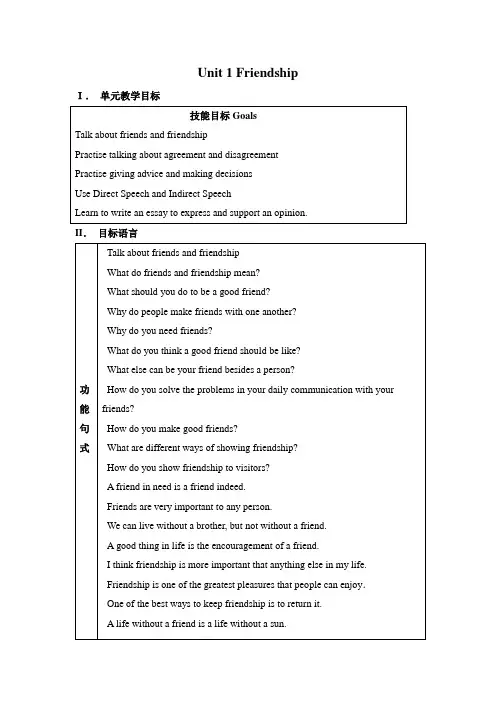
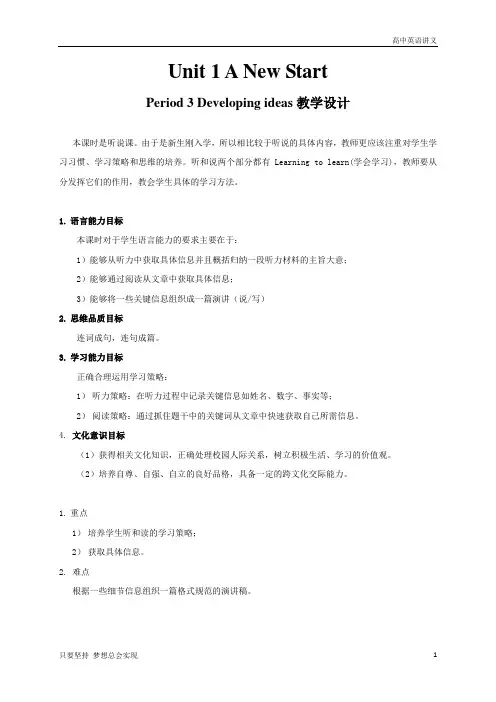
Teaching aims and demands
Goals:
1. Talk about friends and friendship
2. Discuss problems occurring in a friendship and suggest solutions
3. Practise talking about likes and dislikes
4. Learn to make apologies
5. Learn to use Direct Speech and Direct Speech
6. Learn to write an e-mail
Useful expressions:
1. Like and dislike
He / She likes / loves … He / She is fond of …
My interests / favourite hobbies are reading and singing.
He / She doesn’t like …
He / She doesn’t enjoy … He / She hates …
He / She thinks … is terrible / boring
2. Making apologies
You said that you would … Why did /didn’t you …?
You promised to … Why did /didn’t you …?
Please forgive me.
I’m very sorry. … It won’t happen again.
I’m sorry I forgot.
Useful phrases:
fond of hunt for in order to care about such as drop sb a line Grammar: Direct Speech and Direct Speech
Teaching plan I
I. Warming up
Step 1: Ask the Ss: Do you have any friends? What is your friend like?
And draw the picture below:
Step 2: Let the Ss speak relevant vocabulary as many as they can, for
example: kind, happy, strong, funny, etc.
Step 3: Ask the Ss to describe their friends with at least six
adjectives.
Step 4: Make sentence with the words(honest, brave, loyal, wise,
handsome, smart), using the model “Sb is…; Sb is…, because…”
II. Listening
Step 1: Draw a table on the picture:
Group one think
Peter is always___________________________________
Group two think
Peter is always___________________________________
Group three think
Peter is always___________________________________
Group four think
Peter is always___________________________________
Step 2: Tell the students that friends sometimes have problems and that
it is important to know how to solve the problems. The students will
hear three arguments between friends. And let the Ss to listen to the
tape for the first time and to write down the problem.
Step 3: Ask the Ss to discuss the problem in their groups, then let the
representative of each group to write down the result on the blackboard. Step 4: Analyze the results and comment on their answers.
Ps: the processes of Situation 2 and Situation 3 are the same with the
steps above.
III. Speaking
Step 1: Ask the Ss to listen to the tape to get the main idea of the
text.
Step 2: Tell the Ss to work in pairs. Ask them to complete the chart on
SB page 3.
Step 3: Use the answers to talk about who could be friends and what they
like or dislike. Ask each pair to decide who could be friends and give
reasons for their decisions.
Useful expressions:
I’m sure that…
I think that…
Perhaps…
Well, maybe not.
I’m not sure about that.
But what about…
IV. Homework
1. Finish doing the listening exercise on workbook.
2. Prepare for the reading text.
Teaching plan II for Reading
Pre-reading
Step 1. Explain the situation to the students, through brainstorming,
ask questions as many as possible according to the use of things listed
in the book. For example: What do you need if you want to make fire?
What do you use if you want to see your own face? Step 2: Tell the Ss to work in groups. Ask them to decide on three most
useful ones. Encourage the Ss to use the structure I think… because…
/I could use it to…/it could be used to…/…would be more important
than… because…
Step 3: Ask one student from each group to write their answers on the
blackboard. Compare answers from different groups and have a short
discussion.
Reading
Step 1: Tell the students to read the text silently without using a
dictionary. Mark the word or phrase if they can’t guess the meaning of
it.
Step 2: Ask them to look at the picture and ask one student to point to
the picture and retell the main idea of the text.
Step3: Ask the students to list words or phrases that they don’t know.
Explain important ones if necessary.
1. play 扮演(角色)
play the part/role of, act, act the part/role of, take the part of
2. crash (1) vt. & vi. (使)猛撞;(使)撞毁。例如:
Last night he was so drunk that he crashed his car into the iron
railings.
A plane crashed near the South pacific, killing 24 passengers on board.
(2) n. (汽车)撞车事故;(飞机)失事。例如:
We survives although others died in the air/plane crash.
3. desert v. 遗弃;抛弃;离弃。例如
He is so selfish that his friends have deserted him.
Many people hurriedly deserted the city before the war broke out.
deserted adj. 无人的;被抛弃的;被遗弃的。例如:
deserted island 荒岛;deserted street 空无一人的街道