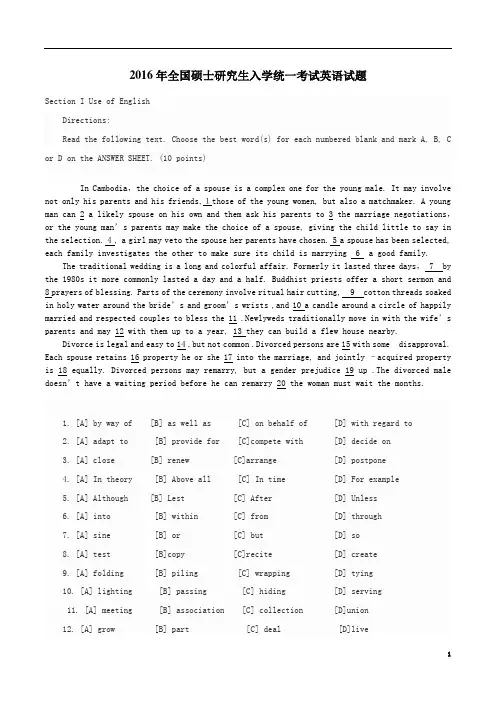
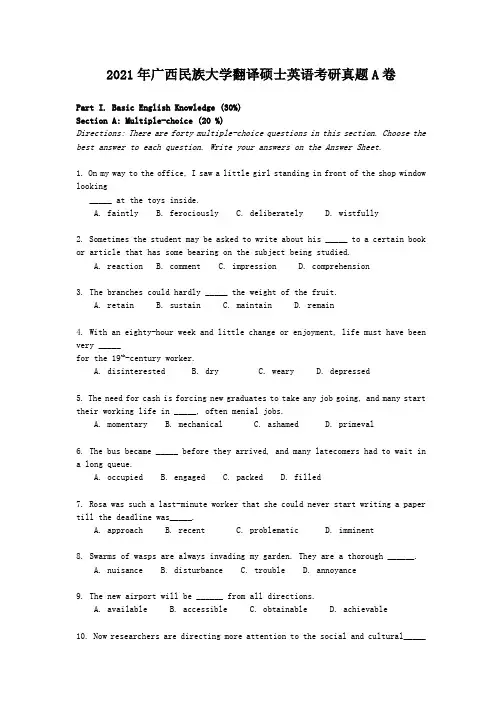
2021年广西民族大学翻译硕士英语考研真题A卷Part I. Basic English Knowledge (30%)Section A: Multiple-choice (20 %)Directions: There are forty multiple-choice questions in this section. Choose the best answer to each question. Write your answers on the Answer Sheet.1. On my way to the office, I saw a little girl standing in front of the shop window looking_____ at the toys inside.A. faintlyB. ferociouslyC. deliberatelyD. wistfully2. Sometimes the student may be asked to write about his _____ to a certain book or article that has some bearing on the subject being studied.A. reactionB. commentC. impressionD. comprehension3. The branches could hardly _____ the weight of the fruit.A. retainB. sustainC. maintainD. remain4. With an eighty-hour week and little change or enjoyment, life must have been very _____for the 19th-century worker.A. disinterestedB. dryC. wearyD. depressed5. The need for cash is forcing new graduates to take any job going, and many start their working life in _____, often menial jobs.A. momentaryB. mechanicalC. ashamedD. primeval6. The bus became _____ before they arrived, and many latecomers had to wait ina long queue.A. occupiedB. engagedC. packedD. filled7. Rosa was such a last-minute worker that she could never start writing a paper till the deadline was_____.A. approachB. recentC. problematicD. imminent8. Swarms of wasps are always invading my garden. They are a thorough ______.A. nuisanceB. disturbanceC. troubleD. annoyance9. The new airport will be ______ from all directions.A. availableB. accessibleC. obtainableD. achievable10. Now researchers are directing more attention to the social and cultural_____that propelled university graduates into careers in management.A. implicationB. impulseC. atmosphereD. imminence11. The police have offered a large ____ for information leading to the robber’s arrest.A. awardB. compensationC. prizeD. reward12. For years she suffered from the _____ that her husband might come back to her.A. visionB. ideaC. imaginationD. illusion13. There has been a _____ lack of communication between the union and the management.A. regretfulB. regrettableC. regrettingD. regretted14. Care should be taken to decrease the length of time that one is _____ loud continuous noise.A. subjected toB. filled withC. associated withD. attached to15. My mother can’t get _____ because she has rheumatism.A. aboutB. onC. throughD. in16. The novel contains some marvelously revealing _____ of rural life in the 19th century.A. glancesB. glimpsesC. glaresD. gleams17. The party’s reduced vote was _____ of lack of support for its policies.A. indicativeB. positiveC. revealingD. evident18. At three thousand feet, wide plains begin to appear, and there is never a moment when some distant mountain is not _____.A. on viewB. at a glanceC. on the sceneD. in sight19. Once a picture is proved to be a forgery, it becomes quite _____.A. invaluableB. pricelessC. unworthyD. worthless20. In the first few months of the war his army seemed ______, but soon it met its Waterloo.A. incredibleB. invisibleC. invidiousD. invincible21. _____ that they may eventually reduce the amount of labor needed on construction sites by 90 percent.A. So clever are the construction robotsB. So clever the construction robots areC. Such construction robots are cleverD. Such clever construction robots are22. He felt ______ during the interview. And he failed to get the job.A. anything but wellB. nothing but wellC. something but wellD. none but well23. It is not uncommon for there _____ problems of communication between the old and the young.A .being B. would be C. be D. to be24. _____, I’ll marry him all the same.A. Was he rich or poorB. Whether rich or poorC. Were he rich or poorD. Be he rich or poor25. Sorry to have kept you waiting. You must have thought ______.A. we were not comingB. we are not comingC. we didn’t comeD. we should not come26. That was not the first time he _____ us. I think it’s high time we _____ strong actions against him.A. betrayed, takeB. had betrayed, tookC. has betrayed, tookD. has betrayed, take27. ______, he is ready to accept suggestions from different sources.A. Instead of his contributionsB. For all his notable contributionsC. His making notable contributionsD. However his notable contributions28. I am pleased with what you have given me and _____ you have told me.A. thatB. all thatC. whichD. about whatever29. ______ earlier, I could have done something to help.A. If I was informedB. Was I informedC. Had I been informedD. If I should be informed30. _____,he never alters a decision.A. Come what mayB. What may comeC. May what comeD. May come whatever31. The Minister of Finance is believed of imposing new taxes to raise extra revenue.A. that he is thinkingB. to be thinkingC. that he is to thinkD. to think32. The heart is intelligent than the stomach, for they are both controlledby the brain.A. not soB. not muchC. no moreD. much more33. The membership card entitled him _____ certain privileges in the club.A. onB. inC. atD. to34. I have never been to London, but that is the city_____.A. where I like to visit mostB. I’d most like to visitC. which I like to visit mostlyD. where I’d like most to visit35. He was ______to tell the truth even to his closest friend.A. too much of a cowardB. too much the cowardC. a coward enoughD. enough of a coward36. ______ wool that is produced in _____ Scotland is used to make sweaters and other garments.A. / ... theB. / ... /C. The ... theD. The ... /37. _____ I like economics, I like sociology much better.A. As much asB. So muchC. How muchD. Much as38. You cannot be ______ careful in making the decision as it was such a critical case.A. tooB. quiteC. veryD. so39. _____ enough time and money, the researchers would have been able to discover more in this field.A. GivingB. To giveC. GivenD. Being given40. Barry had an advantage over his mother he could speak French.A. since thatB. in thatC. at thatD. so thatSection B: Proofreading and Error Correction (10 %)Directions: The following passage contains 10 errors. Each indicated line contains a maximum of ONE error. In each case, only ONE word is involved. You should proofread the passage and correct it. Please write your answers on the Answer Sheet.People once widely believed that intelligent life existed onMars. The 19th century discover of what appeared to be 41. geometric designs cut across the surface was taken as evidence.The lines were thought to have been system of canals that had 42. been built to irrigate the surface. This is now clear that 43. “canals〞—perhaps the most spectacular geologic features ofMars—are natural valleys which ancient rivers once flowed. 44.Other fragmented idea concerns the planet’s seasonal 45. changes in color. Once when attributed to the rapid spread of 46. some life-form, these shifts are now known to develop from themovement of fine dust in the atmosphere.By the close of the 20th century none of the manyexperiments were conducted by spacecraft had ever found 47. persuasive evidence of life. Furthermore, speculation continued 48. over the existence of some form of life, in either the presentand the past. In 1996 scientists discovered organic compounds 49. and minerals in a meteorite, consisted of Martian rock, 50. that collided with Earth around 11,000 BC. These compoundssuggest that Mars may have been inhabited by organisms morethan three billion years ago.Part II. Reading Comprehension (50 %)Section A (30 %)Directions: There are 3 passages in this section. Each passage is followed by some questions or unfinished statements. For each of them there are four choices marked A),B),C) and D).You should decide on the best choice and write your answerson the Answer Sheet.Passage OneQuestions 51 to 55 are based on the following passage.Department Store MagicFor most of the 20th century Smithson's was one of Britain's most successful department stores, but by the mid-1990s, it had become dull. Still profitable, thanks largely to a series of successful advertising campaigns, but decidedly boring. The famous were careful not to be seen there, and its sales staff didn't seem to have changed since the store opened in 1908. Worst of all, its customers were buying fewer and fewer of its own-brand products, the major part of its business, and showing a preference for more fashionable brands.But now all this has changed, thanks to Rowena Baker, who became Smithson'sfirst woman Chief Executive three years ago. Since then, while most major retailersin Britain have been losing money, Smithson's profits have been rising steadily. When Baker started, a lot of improvements had just been made to the building, without having any effect on sales, and she took the bold decision to invite one of Europe's most exciting interior designers to develop the fashion area, the heart of the store. This very quickly led to rising sales, even before the goods on display were changed.And as sales grew, so did profits.Baker had ambitious plans for the store from the start. ‘We're playing a big game, to prove we're up there with the leaders in our sector, and we have to make sure people get that message. Smithson's had fallen behind the competition. It provided a traditional service targeted at middle-aged, middle-income customers,who'd been shopping there for years, and the customer base was gradually contracting. Our idea is to sell such an exciting variety of goods that everyone will want to come in, whether they plan to spend a little or a lot.' Baker's vision for the storeis clear, but achieving it is far from simple. At first, many employees resisted her improvements because they just wouldn't be persuaded that there was anything wrong with the way they'd always done things, even if they accepted that the store had to overtake its competitors. It took many long meetings, involving the entire workforce, to win their support. It helped when they realized that Baker was a very different kind of manager from the ones they had known.Baker's staff policies contained more surprises. The uniform that had hardly changed since day one has now disappeared. Moreover, teenagers now get young shop assistants, and staffs in the sports departments are themselves sports fans in trainers. As Baker explains, ‘How can you sell jeans if you're wearing a black suit? Smithson's has a new identity, and this needs to be made clear to the customers.' She's also given every sales assistant responsibility for ensuring customer satisfaction, even if it means occasionally breaking company rules in the hope that this will help company profits.Rowena Baker is proving successful, but the City's big investors haven't been persuaded. According to retail analyst, John Matthews, ‘Money had already been invested in refurbishment of the store and in fact that led to the boost in sales. She took the credit, but hadn't done anything to achieve it. And in my view the company's shareholders are not convinced. The fact is that unless she opens several more stores pretty soon, Smithson's profits will start to fall because turnoverat the existing store will inevitably start to decline.'51. According to the writer, in the mid-1990s Smithson's department storeA. was making a loss.B. had a problem keeping staff.C. was unhappy with its advertising agency.D. mostly sold goods under the Smithson's name.52. According to the writer, Smithson's profits started rising three years ago because ofA. an improvement in the retailing sector.B. the previous work done on the store.C. Rowena Baker's choice of designer.D. a change in the products on sale.53. According to Rowena Baker, one problem which Smithson's faced when she joined was thatA. the number of people using the store was falling slowly.B. its competitors offered a more specialized range of products.C. the store's prices were set at the wrong level.D. customers were unhappy with the service provided.54. According to the writer, many staff opposed Baker's plans becauseA. they were unwilling to change their way of working.B. they disagreed with her goals for the store.C. they felt they were not consulted enough about the changes.D. they were unhappy with her style of management.55. Baker has changed staff policies because she believes thatA. the corporate image can be improved through staff uniforms.B. the previous rules were not fair to customers.C. customers should be able to identify with the staff serving them.D. employees should share in company profits.Passage TwoQuestions 56 to 60 are based on the following passage.The Affect of Electricity on CancerCan electricity cause cancer? In a society that literally runs on electric power, the very idea seems preposterous. But for more than a decade, a growing band of scientists and journalists has pointed to studies that seem to link exposure to electromagnetic fields with increased risk of leukemia and other malignancies. The implications are unsettling, to say the least, since everyone comes into contact with such fields, which are generated by everything electrical, from power lines and antennas to personal computers and micro-wave ovens. Because evidence on the subject is inconclusive and often contradictory, it has been hard to decide whether concern about the health effects of electricity is legitimate—or the worst kind of paranoia.Now the alarmists have gained some qualified support from the U.S. Environmental Protection Agency. In the executive summary of a new scientific review, released in draft form late last week, the EPA has put forward what amounts to the most serious government warning to date. The agency tentatively concludes that scientific evidence “suggests a causal link〞between extremely low-frequency electromagnetic fields—those having very long wave-lengths—and leukemia, lymphoma and brain cancer, While the report falls short of classifying ELF fields as probable carcinogens, it does identify the common 60-hertz magnetic field as “a possible, but not proven, cause of cancer in humans.〞The report is no reason to panic—or even to lost sleep. If there is a cancer risk, it is a small one. The evidence is still so controversial that the draft stirred a great deal of debate within the Bush Administration, and the EPA released it over strong objections from the Pentagon and the White House. But now no one can deny that the issue must be taken seriously and that much more research is needed.At the heart of the debate is a simple and well-understood physical phenomenon: When an electric current passes through a wire, it generates an electromagneticfield that exerts forces on surrounding objects, For many years, scientists dismissed any suggestion that such forces might be harmful, primarily because they are so extraordinarily weak. The ELF magnetic field generated by a video terminal measures only a few mill gauss, or about one-hundredth the strength of the earth’s own magnetic field, The electric fields surrounding a power line can be as high as 10 kilovolts per meter, but the corresponding field induced in human cells will be only about 1 mill volt per meter. This is far less than the electric fields that the cells themselves generate.How could such minuscule forces pose a health danger? The consensus used to be that they could not, and for decades scientists concentrated on more powerful kinds of radiation, like X-rays, that pack sufficient wallop to knock electrons out of the molecules that make up the human body. Such “ionizing〞 radiations have been clearly linked to increased cancer risks and there are regulations to control emissions.But epidemiological studies, which find statistical associations between sets of data, do not prove cause and effect. Though there is a body of laboratory work showing that exposure to ELF fields can have biological effects on animal tissues, a mechanism by which those effects could lead to cancerous growths has never been found.The Pentagon is for from persuaded. In a blistering 33-page critique of the EPA report, Air Force scientists charge its authors with having “biased the entire document〞 toward proving a link. “Our reviewers are convinced that there is no suggestion that (electromagnetic fields) present in the environment induce or promote cancer,〞 the Air Force concludes. “It is astonishing that the EPA would lend its imprimatur on this report.〞 Then Pentagon’s concern is understandable. There is hardly a unit of the modern military that does not depend on the heavy use of some kind of electronic equipment, from huge ground-based radar towers to the defense systems built into every warship and plane.56. The main idea of this passage isA. studies on the cause of cancer.B. controversial view-points in the cause of cancer.C. the relationship between electricity and cancer.D. different ideas about the effect of electricity on cancer.57. The view-point of the EPA isA. there is casual link between electricity and cancer.B. electricity really affects cancer.C. controversial.D. low frequency electromagnetic field is a possible cause of cancer.58. Why did the Pentagon and Whit House object to the release of the report? BecauseA. it may stir a great deal of debate among the Bush Administration.B. every unit of the modern military has depended on the heavy use of some kindof electronic equipment.C. the Pentagon’s concern was understandable.D. they had different arguments.59. It can be inferred from physical phenomenonA. the force of the electromagnetic field is too weak to be harmful.B. the force of the electromagnetic field is weaker than the electric fieldthat the cells generate.C. electromagnetic field may affect health.D. only more powerful radiation can knock electron out of human body.60. What do you think ordinary citizens may do after reading the different arguments?A. They are indifferent.B. They are worried very much.C. The may exercise prudent avoidance.D. They are shocked.Passage ThreeQuestions 61 to 65 are based on the following passage.Knowledge economyThere have long been markets in tin, cocoa, silver and the like. There used to be security in thinking that somewhere there was a product, something you could touch and see. Now there are new markets in abstractions, trade in ideas and knowledge. Everyone has knowledge but there used to be no way to trade it—except through jobs. That simple fact of economic life was the basis for white collar employment for centuries. The whole job culture grew up because there was no alternative way to sell knowledge, other than the worker or manager providing, for a fixed price, his or her knowledge to an employer to own or control. The quantity of knowledge provided has typically been measured in time.But today we stand at the threshold of a new era. The information economy has matured and become smarter. According to many business commentators, we are now living in a knowledge economy .There has always been a market for knowledge, of course. The publishing industry is based on it. But today the internet is making the distribution of knowledge ever easier. The days when the publisher decided what got published are over. Anyone with a PC and a modem can talk to the world. This is reducing the friction in the knowledge economy.Everyone has knowledge of whatever industry she or he is in. say you are a computer dealer, for example. Over the years you have compiled a list of the ten best lowest price places to buy wholesale computer equipment. Now you can sell your knowledge to newer, younger computer dealers who have no way to build up this knowledge without losing thousands of pounds finding it out the hard way. Until now, such knowledge remained securely locked in the recipient’s head, accumulated and then worthlessly withered away. This no longer needs to be the case. Such knowledge can be sold via websites.Knowledge has a distinct advantage in today’s marketplace. It’s a renewable resource. Better yet, it’s worth actually increases. “Knowledge is the only assetthat grows with use,〞 observes Stanford University Professor Paul Romer. But what exactly is knowledge and how can it be packaged to trade on an open market? “Knowledge is experiential information, intelligence applied thorough and gainedfrom experience,〞 say Joseph Pine and James Gilmore in their book The Experience Economy.The value of knowledge often depends on variables such as time and the credibility of the seller. Certain knowledge may have a very limited shelf life.In sights concerning how to set up an internet business in one country, might beworth a fortune on one day and nothing the next, depending on changes in government policy. Markets in knowledge will be significance for one thing. They representone of the most original uses of the web technology. In some corner of the globethere is a company wanting to source plastic widgets from Poland, and somewhereelse another company that wishes to set up a plastics factory there. It’s simplya case of connecting the two.Indicater is a good example of a knowledge trader. It is targeted at food service managers throughout the hospitality industry. “We started with the context rather than extracting money from suppliers,〞 explains founder Mike Day, “we offerfood service professionals interactive support to increase sales and profits. People don’t want another one-dimensional site full of advertising that doesn’t help them to do their job more effectively. It has to be customized offering real solutions to real problems.〞 The site’s features include access to online trainingand a tariff tracker to restaurants can check prices throughout the sector.61. What point is made in the first paragraph?A. Interest in commodity markets has decreased.B. Overall levels of expertise have improved.C. Opportunities to exploit your knowledge were limited in the past.D. External market forces have meant knowledge is underpriced.62. In the third paragraph, what does the writer say about knowledge?A. Acquiring knowledge can be expensive.B. The most valuable knowledge concerns IT.C. Trading knowledge raises issues of security.D. New businesses find it hard to trade in knowledge.63. What point is made about knowledge in the fourth paragraph?A. It provides specialist information.B. Its appeal lies in its exclusivity.C. it can generate new ideasD. Its value accumulates.64. Which application of knowledge does the writer regard as particularly useful?A. analyzing manufacturing trendsB. introducing compatible partiesC. interpreting time constraintsD. advising on legislation65. What key feature is provided by Indicater ?A. approaches that reflect the provider’s own experienceB. access to appropriately trained potential employeesC. advice which directly benefits the bottom lineD. advertising which is carefully targetedSection B: Cloze (20 %)Please fill in blanks 66 to 85 of the following passage. Write your answers on the Answer Sheet.Ancient Greek philosopher Aristotle viewed laughter as “a bodily exercise precious to health.〞 But __66__some claims to the contrary, laughing probably has little influence on physical fitness Laughter does __67__short-term changes in the function of the heart and its blood vessels, __68_ heart rate and oxygen consumption But because hard laughter is difficult to __69__, a good laugh is unlikely to have __70___ benefits the way, say, walking or jogging does.__71_, instead of straining muscles to build them, as exercise does, laughter apparently accomplishes the __72__, studies dating back to the 1930’s indicate that laughter__73___ muscles, decreasing muscle tone for up to 45 minutes after the laugh dies down.Such bodily reaction might conceivably help _ 74__the effects of psychological stress. Anyway, the act of laughing probably does produce other types of __75___ feedback, that improve an individual’s emotional state. __76___one classical theory of emotion, our feelings are partially rooted ___77___ physical reactions. It was argued at the end of the 19th century that humans do not cry __78__they are sad but they become sad when the tears begin to flow.Although sadness also ___79___ tears, evidence suggests that emotions can flow __80___ muscular responses. In an experiment published in 1988,social psychologist Fritz Strack of the University of würzburg in Germany asked volunteers to __81__ a pen either with their teeth-thereby creating an artificial smile – or with their lips, which would produce a(n)__82___ expression. Those forced to exercise their smiling muscles __83__ more exuberantly to funny cartons than did those whose mouths were contracted in a frown, __84__ that expressions may influence emotions rather than just the other way around __85__ , the physical act of laughter could improve mood.66. A. among B. except C. despite D. like67. A. reflect B. demand C. indicate D. produce68. A. stabilizing B. boosting C. impairing D. determining69. A. transmit B. sustain C. evaluate D. observe70. A. measurable B. manageable C. affordable D. renewable71. A. In turn B. In fact C. In addition D. In brief72. A. opposite B. impossible C. average D. expected73. A. hardens B. weakens C. tightens D. relaxes74. A. aggravate B. generate C. moderate D. enhance75. A. physical B. mental C. subconscious D. internal76. A. Except for B. According to C. Due to D. As for77. A. with B. on C. in D. at78. A. unless B. until C. if D. because79. A. exhausts B. follows C. precedes D. suppresses80. A. into B. from C. towards D. beyond81. A. fetch B. bite C. pick D. hold82. A. disappointed B. excited C. joyful D. indifferent83. A. adapted B. catered C. turned D. reacted84. A. suggesting B. requiring C. mentioning D. supposing85. A. Eventually B. Consequently C. Similarly D. ConverselyPart III. Writing (20 %)Directions: Write an essay of about 400 words on the following topic:Some people believe that success in life comes from taking risks or chances. Others believe that success results from careful planning. In your opinion, what does success come from? Use specific reasons and examples to support your answer.In the first part of your essay you should state clearly your main argument, and in the second part you should support your argument with appropriate details. In the last part you should bring what you have written to a natural conclusion or make a summary.You should supply an appropriate title for your essay.Marks will be awarded for content, organization, grammar and appropriateness. Failure to follow the above instructions may result in a loss of marks.。