
短语和从句
- 格式:ppt
- 大小:725.00 KB
- 文档页数:41

语法中的介词短语与副词从句的区别与用法在英语语法中,介词短语和副词从句是常见的两种语法结构。
它们在句子中起到了不同的作用和表达方式。
本文将对介词短语和副词从句的区别进行探讨,并详细介绍它们的用法。
一、介词短语1. 介词短语的组成和结构介词短语由介词和其后的名词短语组成,可以用来修饰名词、动词、形容词或副词。
介词短语提供了关于时间、地点、方式、原因等方面的信息。
2. 介词短语的作用和用法介词短语可以作为句子的状语、定语或补语来使用。
它们通常用来描述时间、地点、方式、原因等概念,起到补充说明的作用。
示例:- I went to the park with my friends.(我和我的朋友一起去了公园。
)- The book on the table is mine.(桌子上的书是我的。
)二、副词从句1. 副词从句的组成和结构副词从句是由连接词引导的一个包含主语和谓语的句子,它可以在复合句中充当副词的角色。
常见的副词引导词有when, where, how, why, if, whether等。
2. 副词从句的作用和用法副词从句可以作为句子的状语,修饰动词、形容词或副词,并提供有关时间、地点、原因、条件等方面的信息。
示例:- I will visit my grandparents when I have time.(我有时间的时候会去看望我的祖父母。
)- She asked me where I was going.(她问我要去哪里。
)三、介词短语与副词从句的区别1. 结构区别介词短语由介词和名词短语构成,整体上充当一个短语,在句子中作为一个整体来修饰其他成分。
而副词从句是一个包含主语和谓语的完整句子,能够独立成句,充当一个副词的角色。
2. 功能区别介词短语主要用来修饰名词、动词、形容词或副词,提供关于时间、地点、方式、原因等方面的信息。
而副词从句则是用来修饰动词、形容词或副词,并提供关于时间、地点、原因、条件等方面的信息。
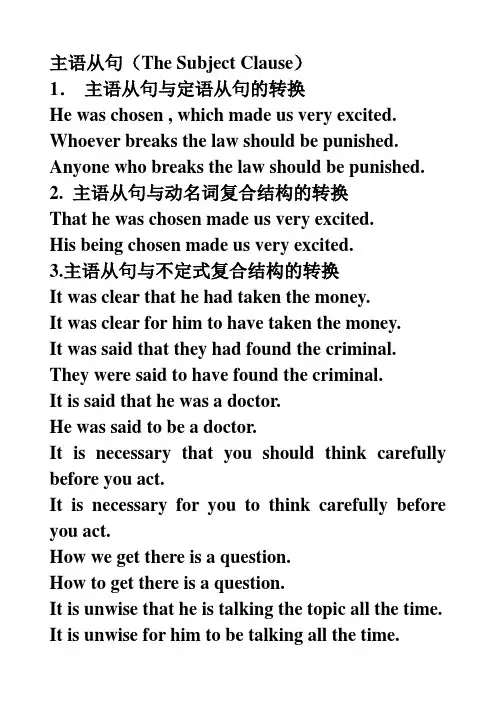
主语从句(The Subject Clause)1.主语从句与定语从句的转换He was chosen , which made us very excited. Whoever breaks the law should be punished. Anyone who breaks the law should be punished. 2. 主语从句与动名词复合结构的转换That he was chosen made us very excited.His being chosen made us very excited.3.主语从句与不定式复合结构的转换It was clear that he had taken the money.It was clear for him to have taken the money.It was said that they had found the criminal. They were said to have found the criminal.It is said that he was a doctor.He was said to be a doctor.It is necessary that you should think carefully before you act.It is necessary for you to think carefully before you act.How we get there is a question.How to get there is a question.It is unwise that he is talking the topic all the time. It is unwise for him to be talking all the time.It is said that the building had been destroyed in a fire two years ago.The building is said to have been destroyed in a fire two years ago.表语从句(The Predicative Clause)1表语从句与不定式The question is whether she can speak English. The question is whether to speak English there. His wish was to become a cashier.His wish was that he would become a cashier.The question is how we can help him.The question is how to help him.2. 表语从句与定语从句That is why you are always late for school.That is the reason why you are always late for school.同位语从句(The Appositive Clause)I have no idea when I will be back.I have no idea when to be back..宾语从句(The Object Clause)1.宾语从句与动名词He is sorry for what he has done.He is sorry for his having done.I don’t like that you are late.I don’t like your being late.He is very interested in what you are doing.He is very interested in your doing.2. 宾语从句与不定式The boy pretended that he was doing his homework when his mother came back.The boy pretended to be doing his homework when his mother came back.I wonder where I should go.I wonder where to go.The teacher told Mary that she should not be late for school again.The teacher told Mary not to be late for school again.I saw that he came and sat down.I saw him come and sit down.I heard her sing in her room last night.I heard that she sang in her room last night.3. 宾语从句与定语从句He told me what he had done .He told me all that he had done.I know why he studies so hard.I know the reason why he studies so hard.4. 宾语从句与分词I saw them playing basketball when I went past the playground.I saw that they were playing basketball when I went past the playground.5. 宾语从句与表语从句I suggest that you should go to school at once.My suggestion is that you should go to school at once.定语从句1.与不定式Do you have anything to say for yourself ?Do you have anything you want to say for yourself /Is there anything to do for you ?Is there anything I can do for you ?It is time for us to go home.It is high time that we went home.2.与分词The girl who is standing on the stage is my sister. The girl standing on the stage is my sister.This is the factory which was built in 1987.This is the factory built in 1987.3.与主语从句The reason why he didn’t turn up was not made clear.Why he didn’t turn up was not made clear.状语从句1.与不定式He visited London in order that he could see his parents.He visited London in order to see his parents.He was so fat that he couldn’t climb the tree.He was too young to climb the tree.We use a hammer so that we may knock in nails. We use a hammer to knock in nails.I was foolish because I expected him to write to me.I was foolish to have expected him to write to me.He was so lucky that he won the prize.He was lucky enough to win the prize.He was so near that I could not avoid him.He was too near for me to avoid him.2.与分词As he knew nothing about the matter , he kept quiet during the meeting.Knowing nothing about the matter, he kept quiet during the meeting.Because he didn’t know what to say, he kept quiet during the meeting.Not knowing what to say, he kept quiet during the meeting.After he had finished his work, he went out for a walk.Having finished his work, he went out for a walk. If weather permits, we’ll visit him.Weather permitting, we’ll visit him.3.与动名词We use a hammer so that we may knock in nails. We use a hammer for knocking in nails.The girl was praised because she often helpedothers.The girl was praised for often helping others.4.与介词短语They went out though it rained.They went out in spite of the rain.。
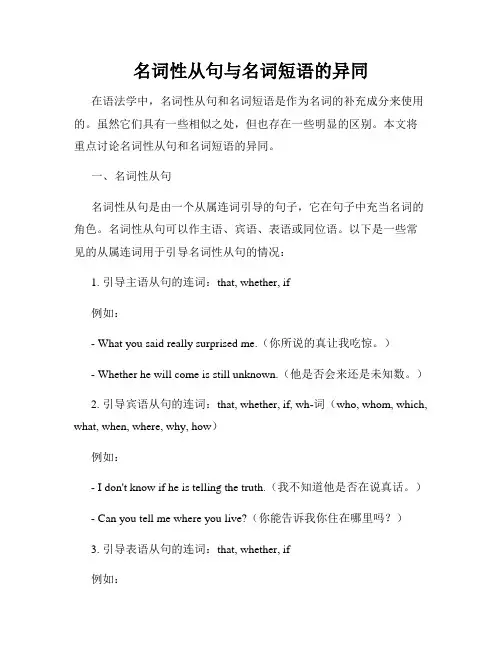
名词性从句与名词短语的异同在语法学中,名词性从句和名词短语是作为名词的补充成分来使用的。
虽然它们具有一些相似之处,但也存在一些明显的区别。
本文将重点讨论名词性从句和名词短语的异同。
一、名词性从句名词性从句是由一个从属连词引导的句子,它在句子中充当名词的角色。
名词性从句可以作主语、宾语、表语或同位语。
以下是一些常见的从属连词用于引导名词性从句的情况:1. 引导主语从句的连词:that, whether, if例如:- What you said really surprised me.(你所说的真让我吃惊。
)- Whether he will come is still unknown.(他是否会来还是未知数。
)2. 引导宾语从句的连词:that, whether, if, wh-词(who, whom, which, what, when, where, why, how)例如:- I don't know if he is telling the truth.(我不知道他是否在说真话。
)- Can you tell me where you live?(你能告诉我你住在哪里吗?)3. 引导表语从句的连词:that, whether, if例如:- His concern is whether it will rain tomorrow.(他所关心的是明天是否会下雨。
)4. 引导同位语从句的连词:that例如:- The fact that she passed the exam made us very happy.(她通过了考试这个事实让我们很高兴。
)名词性从句的特点:- 名词性从句本身就是一个完整的句子,有主语和谓语。
- 名词性从句可以包含陈述句、疑问句和感叹句等不同类型的句子。
二、名词短语名词短语是由名词或代词及其修饰成分构成的短语,用来充当名词的角色。
名词短语可以作主语、宾语、定语或表语等。
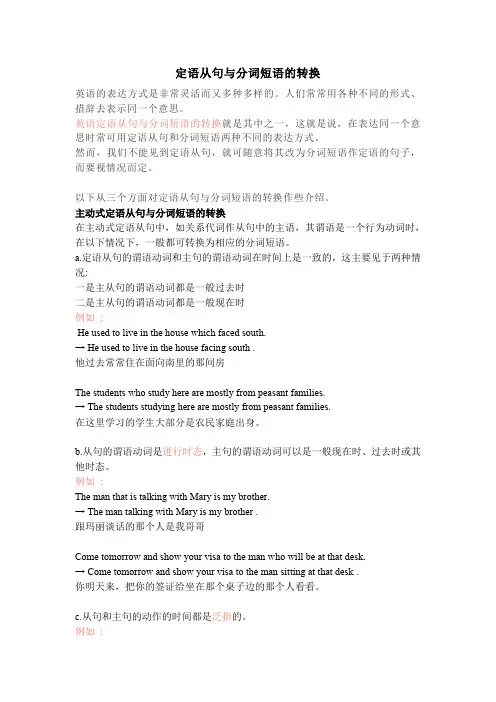
定语从句与分词短语的转换英语的表达方式是非常灵活而又多种多样的。
人们常常用各种不同的形式、措辞去表示同一个意思。
英语定语从句与分词短语的转换就是其中之一,这就是说,在表达同一个意思时常可用定语从句和分词短语两种不同的表达方式。
然而,我们不能见到定语从句,就可随意将其改为分词短语作定语的句子,而要视情况而定。
以下从三个方面对定语从句与分词短语的转换作些介绍。
主动式定语从句与分词短语的转换在主动式定语从句中,如关系代词作从句中的主语,其谓语是一个行为动词时,在以下情况下,一般都可转换为相应的分词短语。
a.定语从句的谓语动词和主句的谓语动词在时间上是一致的,这主要见于两种情况:一是主从句的谓语动词都是一般过去时二是主从句的谓语动词都是一般现在时例如:He used to live in the house which faced south.→ He used to live in the house facing south .他过去常常住在面向南里的那间房The students who study here are mostly from peasant families.→ The students studying here are mostly from peasant families.在这里学习的学生大部分是农民家庭出身。
b.从句的谓语动词是进行时态,主句的谓语动词可以是一般现在时、过去时或其他时态。
例如:The man that is talking with Mary is my brother.→ The man talkin g with Mary is my brother .跟玛丽谈话的那个人是我哥哥Come tomorrow and show your visa to the man who will be at that desk.→ Come tomorrow and show your visa to the man sitting at that desk .你明天来,把你的签证给坐在那个桌子边的那个人看看。