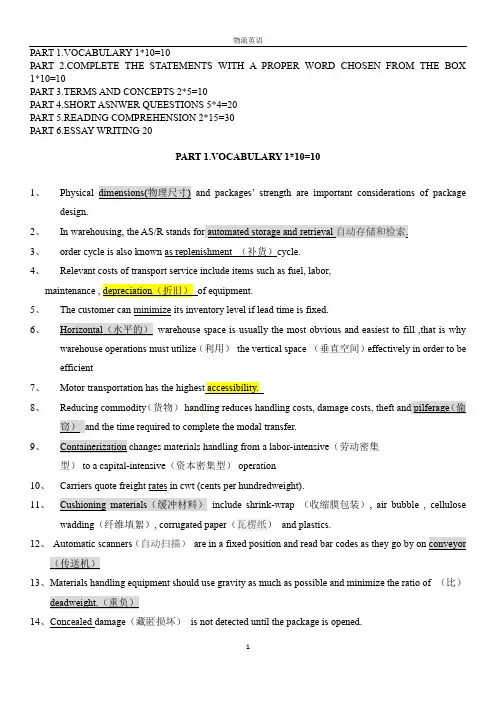
PART 1.VOCABULARY 1*10=10PART PLETE THE STATEMENTS WITH A PROPER WORD CHOSEN FROM THE BOX 1*10=10PART 3.TERMS AND CONCEPTS 2*5=10PART 4.SHORT ASNWER QUEESTIONS 5*4=20PART 5.READING COMPREHENSION 2*15=30PART 6.ESSAY WRITING 20PART 1.VOCABULARY 1*10=101、Physical and packages’ strength are important considerations of packagedesign.2、3、order cycle is also known as replenishment (补货)cycle.4、Relevant costs of transport service include items such as fuel, labor,5、The customer can minimize its inventory level if lead time is fixed.6、warehouse space is usually the most obvious and easiest to fill ,that is whywarehouse operations must utilize(利用)the vertical space (垂直空间)effectively in order to be efficient7、8、Reducing commodity(货物)9、(劳动密集型) to a capital-intensive(资本密集型) operation10、Carriers quote freight rates in cwt (cents per hundredweight).11、include shrink-wrap (收缩膜包装), air bubble , cellulosewadding(纤维填絮), corrugated paper(瓦楞纸)and plastics.12、Automatic scanners(自动扫描)13、Materials handling equipment should use gravity as much as possible and minimize the ratio of (比)14、Concealed damage(藏匿损坏)is not detected until the package is opened.15 、The trade-off logic studies the relationship between two conflicting practices or operations such aslarge quantity purchase price discount and high inventory levels.1.2.r eplenishment cycle.3.4.5.Warehousing can allow a firm into a large shipment, with significanttransportation savings.6.mixing for customer orders, protection7.8.customer service.9.process that plans, implements and controls the efficient,10.11.(传送带)12.the most obvious and easiest to warehouse13.14.Relevant costs of include items such as furl, labor, maintenance, ofequipment, and administrative costs.15.required to complete the modal transfer.\16.17.18.19.20.equipment and minimize the ratio21.22.23.24.and package’s strength are important considerations of package design.25.Practice of using external activities that have traditionally beenperformed within an organization itself26.a carrier27.28.The acquisition of goods or services29.A production strategy that strives to improve a business return on investmentinventory and associated carrying costs, also called the Toyota Production System30.The process of contracting a business function to someone else, involves the abusiness function-commonly one previously performed in-house to an external provider31.A flat transport structure that supports goods instorage efficiencies32.conditions in a set period of time (usually one hour)33.Value given up as a result of not taking certain action34.reduc e the likelihood of this due to the vendor’s lead time, which causeinterruptions to sales or deliveries35.specifying terms of delivery36.:37.38.A practice in logistics of unloading material from an incoming semi-trailer truck or railroad car andloading into outbound trucks, trailers, or rail cars, with little or no storage inbetween39.tons, or passengers40.:i nbound l ogistic41.in order to gain a tax deduction that will lower total tax liability42.by various modes43.may be common characteristics or common needs and desires:44.the requirement) tothe moment it is received by the customer1、a measure of uncertainty in carrier performance : the usual differences that occur between shipments byvarious modes :2、process of dividing the market according to similarities that exist among the various subgroups(亚组)3、The time from the moment the customer places an order (the moment you learn of the requirement) to the4、one to whom a carrier may lawfully make delivery in accordance with(与什么一致)his contract of5、a person or company that organizes shipments for individuals or other companies and may also act as a6、The process of contracting a business function to someone else, involves the contracting out of a business7、a production strategy that strives to improve a business return on investment by reducing in –process8. Practice of using external organizations to execute(执行)logistics activities that have traditionally been9.Economic principle that as the volume of production increases, the cost of producing each unit decreases, therefore, building a large factory will be more efficient than a small factory because the large factory will10. the acquisition(获得物)is an important aspect of customer service in logistics13.14. Warehousing can allow a firm shipment into a large shipment, with significant transportation savings.15. Order processing, billing and invoicing(开发票), product returns and claims handling are all typical exampleso ………), or out-of-stock (OOS) event is an event that causesinventorytobe exhausted. Reorderthe vendor's lead time, which cause interruptions to sales or deliveries.18. Adocumentissuedbyacarrier to a shipper, listing and acknowledging receipt of goods for transport and specifying terms of delivery bill of ladingPART 4.SHORT ASNWER QUEESTIONS 5*4=201、what are the components of JIT systems?Zero inventory zero defects(零缺陷)Short lead time small and frequent replenishment2、Give an example of both dependent demand(独立需求)and independent demand(非独立需求)Automobiles(汽车), tires(轮胎); Computer, keyboard3.state some inventory-related costs:Capital. Storage space Inventory service Inventory risks4、what are the three stock location criteria(标准)?Popularity Unit size(产品尺寸)Cube(立方)5、state 3 principles in warehouse designOne-story facility ,minimize aisle(通道)space ,efficient materials-handling equipment and so on6、state 3 principles of material handling.1)gravity principle;2)automation principle;3)space utilization principle;4)standardization principle.7、Which operations have a great impact on the warehouse layout and design(布局设计)? movement and storage(移动和仓储)8、state 4 dimensions of material handling(物料运输)Time Space Quantity Movement9、which 4 categories(分类)can freight carriers fall into ?Common Private Exempt(免税的)contract10、which factors affect the rates of transportation?Distance V olume or weight of the shipment Cost or value of the service11、3 forms of physical inventoriesRaw materials Work-in –process Finished goods1.State 4 dimensions of materials handling2.Which 4 categories can freight carriers fall into3.Which factors affect the rates of transportation4.What are the 3 forms of physical inventories5.State some inventory-related costs6.Give an example of both dependent demand and independent demand7.What are the 4 components of JIT systems / what are the 4 elements underpinning the JIT concept8.Which operations have a great impact on the warehouse layout and design9.What are the 3 stock location criteria10.List at least 3 principles in warehouse designReview for logistic English>>Topic 2: order management & Customer Service●learning points☐To have a working knowledge of order management and customer service in logistics;☐To describe how a company processes the incoming orders and the four elements of the order cycle;☐To discuss the major elements comprising logistics customer service;☐To explain how the customer service is measured.*Order Management( Page 23-24)How a firm handles incoming orders → the activities that take place in the period b/t the time a firm receives an order and the time a warehouse is notified to ship the goods to fill that order → an important component of a firm’s Management Information System (MIS).●Order Cycle☐Order placement(订单生成)– increasing use of Internet-facilitated ordering such as e-marketplace, extranets(外联网)and email while the use of EDI and phone/fax to place orders is declining☐Order processing (订单处理)– checking customer credit, transferring information to sales records, sending the order to the inventory and shipping area, preparing shipping documents☐Order preparation(订单准备)– preparing orders for shipment with the help of real-time information☐ Internet-based information system has made it possible for customers to track and trace shipments●Customer Service (Page 24-28)3 principal ways to define customer service:☐Customers service as an activity☐Customers service as performance measures☐Customers service as a philosophy(哲理)●Definition(Page 25)Customer service is a process of providing competitive advantage and adding benefits to the supply chain in order to maximize the total value to the ultimate (最终的)customer.●Dimensions of Customer Service (Page 26)1)Time, 及时性2)Dependability / reliability,可靠性3)Communication,沟通4)Convenience便利☐Time– order cycle time; lead time; replenishment time;☐Dependability / reliability – It is possible for customers to minimize the inventory level if lead time is fixed. There is no need for s afety stock to guard against stockouts resulting from fluctuating(波动的)lead time. unsafe delivery →inventory carrying costs, failing just-in-time (JIT) program; incorrect orders → potential lost sales or production;☐Communication –①transferring order information to the order-filling area (warehouse) ; ②picking the ordered items out of inventory;☐Convenience–palletize / pallets / palletization; market segmentation (细分市场)●How logistics customer service is measured( Page 29)☐Order entry订单录入☐Order documentation accuracy订单文件的准确性☐Transportation☐Inventory and product availability库存和产品的可得率☐Product damage☐Production / warehousing processing time生产/仓库的作业时间Give an example to illustrate the following statement:“The shorter and more consistent the order cycle is, the less inventory is needed by one’s customers.”Topic 3: Packaging & Material Handling●Learning points☐Role of packaging in logistics1.Definition of packaging2.Packaging materials3.Bar coding☐Objectives of material handling1.Guidelines and principles2.Materials-handling equipment●Role of Packaging☐ A concern to marketing, production and legal: sales tactic(策略), cost, transport and environmental rules/regulations☐Product information on the package: color codes, universal product codes, computer-readable tables, symbols and number codes☐Handling ease:1. physical dimensions (package size);2. package’s strength;3. package shape☐Protection: contamination(污染), water damage, temperature changes, pilferage, shocks and weight support / distribution in handling and transport☐Packaging designed to reduce tampering(篡改)●Definition of Packaging1)Consumer / interior packaging – marketing2)Industrial / exterior packaging – logistics●Packaging MaterialsCushioning materials(缓冲材料)(against shock, vibration(震动), surface damage):Shrink-wrap(收缩膜), air bubble cushioning(气泡), cellulose wadding(纤维填充物), corrugated paper (瓦楞纸材料), plastics (EPS, PU, PE, foam-in-place)●Bar Coding☐ A series of parallel(平行的)black and white bars, both of varying(不同的)widths, whose sequence (顺序)represents letters or numbers. A bar code carries important information such as a shipment’s origin, the product type, the place of manufacture and the price.☐Bar code scanners: automatic and handheld(自动和手动)☐Describe how bar code scanners work:Optical scanners(光学扫描仪)emit light beams(光束)and translate the reflections bouncing off (弹开)the black and white bars into electrical signals(电信号)which the scanner records as binary digits(二进制数字)of 1s and 0s.● 4 dimensions of materials handling——1Movement, time, quantity, space●Objectives of Material Handling(P42)1)Increase effective capacity of warehouse (focus on cubic / vertical space instead of floor/horizontalspace)2)Minimize aisle space (forklift trucks turning space)3)Reduce number of times product is handled4)Develop effective working conditions (safety concern)5)Reduce movements involving manual labor6)Improve logistics service (stock-keeping unit – SKU库存单位)7)Reduce cost●Principle of Materials Handling(Page 46)☐Optimize materials flow☐Gravity principle (utilize gravity wherever practical)☐Space utilization principle☐Automation principle (AGV)☐Standardization principle☐Deadweight principle (minimize ratio of deadweight to load)●Materials Handling Equipment☐Dock(码头)equipment:Forklifts(铲车), dock bumpers, (装卸台车挡)dock levelers(装卸跳板), dock seals, trailer restraint systems, pallets☐Other equipment:Conveyors: roller, wheel, belt, towline(拖链)Cranes(起重机): bridge, stacker, wagon(货车)AGVs, double-pallet jack☐Order-picking and storage equipmentPicker-to-part: bin shelving, modular storage drawers, flow racks, mobile storage systems, order-picking vehiclesPart-to-picker: carousels, miniload automated storage and retrieval systems●Expressions in Material Handling(Page 58)HANDLE WITH CARE NO HOOKS DO NOT TURN OVER DO NOT DROPSTAND ON END FRAGILE PERISHABLE LIQUID●Introduction of multiple equipmentsStandard Pull-chain mechanical Dock LevelerDock levelers are used to bridge the gap between the dock and the trailer and adjust for any height differences.The pull-chain mechanical dock leveler is the most common type used.Hydraulic(液压的)Dock Leveler(装卸平台升降板)A step up from the mechanical dock leveler, the hydraulic dock leveler uses an electric pump(抽水机)and hydraulic cylinder to engage/disengage the dock leveler.This works from a remote switch which is generally mounted on the wall next to the dock.Docks with high volume will benefit from this automation.(自动化)Truck Restraint: ICC Bar TypeThe most dangerous aspects of loading and unloading trailers(拖车)is when a driver starts to pull away from the dock while he is still being loaded.The ICC Bar type restraints automatically engage the rear guard(后卫部队)on the trailer when it backs into the dock.After the trailer is loaded/unloaded the restraint is disengaged via a control panelTruck Restraint: Automatic Wheel TypeAnother automated truck restraint system, the wheel type system engages in front of the rear wheels(后轮)of the trailer.Elevating(升降机构)DocksElevating docks are used where a raised dock is not available.They operate via an electric pump and a hydraulic lift cylinder.Dock SealsDock seals come in a variety of configurations(配置)and are used to prevent air, dirt, insects, birds, and rain/snow from entering the building while loading and unloading trucks.Truck Types 2- Narrow aisle reach truckOther Names of reach trucks are: Stand-up reach, Straddle reach , Double-deep reachReach trucks are designed for racking areas only and do not work for loading trucks or quickly moving loads over distancesTruck Types 2- Reach truckNarrow aisle truck designed specifically for racked pallet storage.Double-deep version (shown) loads pallets 2-deep in special double-deep racking.Gravity Skate Wheel ConveyorGravity flow skate wheel conveyor is a low cost option for conveying lightweight cartons or trays.Used extensively in shipping/receiving and assembly areas, skate wheel conveyors reduce manual material handling of lightweight items over short distances.Gravity Roller ConveyorApplication for gravity roller conveyor is similar to that of gravity skate wheel.Its cost is a little higher and it is more effective where heavier items are being handled.Automated Belt ConveyorAutomated belt conveyer has similar applications to gravity roller and skate wheel.Single units can be incorporated into gravity conveyor systems to create a simple low cost semi-automated system.Flexible ConveyorUsed extensively in shipping/receiving operations for package handling, flexible conveyor is usually anchored at one end to fixed gravity or automated conveyor allowing the other end to be expanded and flexed into trailers for loading and unloading.Unit Load ConveyorUnit Load Conveyor is a heavy duty version of roller conveyor used for handling pallet loads or larger trays.High Volume Trailer LoadingThis shows an application of conveyor in high volume trailer loading/unloading.Sortation SystemsSortation systems are the key to large elaborate conveyor systems.The variety of sortation systems is extensive as are their applications.Horizontal CarouselHorizontal Carousels are used in high-volume small-parts picking operations.Generally, an operator will run 2 to 4 carousels at a time avoiding the need for the operator to wait while one unit is turning.Vertical CarouselsVertical Carousels consist of a series of horizontal trays on a vertical carousel.Vertical carousels are most effective when floor space is at a minimum and there is ample overhead clearance.Automated Storage and Retrieval System (ASRS)A system of rows of rack, each row has a dedicated retrieval unit that moves vertically and horizontally along the rack picking and putting away loads.Towline (AGV=. 无人搬运车(Automatic Guided Vehicle)) systemTowline system is designed for movement of materials and products over paths.Topic 4: Transportation Mgmt●Learning points☐Importance☐Five basic modes☐ 3 Key factors of transport☐Single mode of transportation☐Inter-modal Services☐Classification of Carriers☐Bases for Rates☐Shipment Documentation (Domestic & Int’l)●Importance of Transportation☐40-50% of total logistics costs☐4-10% of the product-selling price● 5 Basic Modes of Transportation☐water, rail, truck, air and pipeline☐role of transportation agencies, shipper’s associations, brokers, freight forwarders● 3 Key Factors☐PriceRate: pickup at origin, delivery at destination, insurance, preparing for shipment, fuel, labor, maintenance, depreciation of equipment, administrative costs(行政费用)☐Transit time & variabilityAverage time it takes for a shipment to move from its point of origin to its destination;Variability — a measure of uncertainty in carrier performance☐Loss & DamageCarrier’s obligation(义务); delayed shipments;damaged goods → inconvenience; inventory level●●Inter-modal Transport Services☐Birdyback(鸟背运输), fishyback(鱼背运输), piggyback (背负式运输)services☐Problems with multi-modal service: carriers’ reluctance(勉强); transferability(可转移性)●Multi-modal Transport Services☐Containerization1.t are the advantages of using containers?2.Strengths in using containers: reducing handling costs, damage costs, theft and pilferage, time to transfer3.materials handling: labor-intensive → capital-intensive●Four categories of freight carriers----2☐Common Carrier公共承运人☐Contract Carrier合同承运人☐Exempt Carrier豁免承运人☐Private Carrier私营承运人●Common Carrier☐ A for-hire carrier that serves the general public at reasonable charges and without discrimination(区别)(填空词时考到该词)(railroads and pipelines)☐The most highly regulated●Contract Carrier☐Not serving the general public but serving one or a limited number of shippers with whom it is under specific contract;☐The contract: terms concerning the rates, liability, type of service and equipment;☐Rates: lower than those of common carriers☐Tailored / customized service; high service level●Exempt Carrier☐Carriers exempt from economic regulation regarding rates and services;☐Gaining the status by the commodity it hauls or by the nature of its operation;☐Examples: a motor carrier transporting agricultural products, newspapers, livestock(家畜), fish; a rail carrier is exempt when hauling fresh fruit;●Private Carrier☐Not for-hire, not subject to gov’t economic regulations;Core biz(n. 商业(等于business)) is not transportation;☐An inter-corporate hauling fee●Bases for Rates-Factors affecting the rates ( revenue per ton-mile)——3☐Cost and value of service;☐Distance;☐Volume or weight of the shipment●Cost and value of service☐What cost basis to use1.Fully allocated / average total costs2.Average variable costs3.Marginal / out-of-pocket (现款支付的)costs☐Service Pricing – Rates vary by transported productHigh-value commodities can sustain(维持)higher transportation charges (a small portion of the selling price)●Distance☐Tapering rate principle:Rate increase is not directly proportional to distance. The rate increases as distance increases, but not linearly.☐Terminal costs (cargo handling(货物装卸), clerical and billing) do not vary with distance. Carriers spread terminal costs over a greater mileage base.●Domestic Documentation☐Bill of Lading(B/L)提单☐Freight Bill运费清单☐Freight Claims货运索赔单☐FOB Terms of Sale FOB销售术语●Bill of Lading☐Certificate of title (产权证书)t o the goods☐Straight Bill of Lading (记名提单)Non negotiable(禁止转让的)instrument; consignee named☐Order Bill of Lading (指示提单)Negotiable instrument; the consignor retains security interest in the goods until the consignee pays the goods’ invoice value●Freight Bill (运费清单)☐Carrier’s invoice for the charges☐Listing the shipment, origin and destination, consignee, items, total weight, total charges, credit time period for payment;☐Prepayment is required if the carrier considers the commodity’s value is less than the freight charge.●Freight Claims (货运索赔单)☐ A document the shipper(发货人,托运人)files with the carrier to recoup(收回)monetary losses resulting from loss, damage or delay to the shipment or to recover overcharge payments☐Within 9 months of delivery☐Visible damage vs. concealed damage●FOB Terms of Sale (销售条款)☐①Who is to incur (招致)transportation charges; ②who is to control movement of the shipment;③where the title passes to the buyer☐FOB Delivered (目的地) – the seller☐FOB Origin (原产地) – the buyer●International Transportation☐Transportation DocumentsCarnet(通关卡)– known as duty-free import of goods passport , widely used internationally as a customs documents. indicating that the shipment has been sealed(封闭)at its origin and will not be opened until it reaches its final destination, passing in transit through intermediate customs points without inspection(检查)☐Universal airway billTopic 5: Inventory Mgmt●Learning points☐Inventory & Inventory Management☐Major Reasons for Carrying Inventory☐Major Types of Inventory-related Costs☐Approaches to Managing Inventory☐Distinctions among Various Approaches1.Two Forms of Demand2.Pull vs. Push3.System-wide(全系统)vs. Single-facility(单一系统)Solution☐Integrated(整合)Inventory Management: DRP, MRP and JIT●Inventory– or stock, in terms of supply chain management – is defined as the stored accumulation of material(材料)or components(部件)used in☐the inventory of partially produced products at various stages in the☐●☐Scale/Batching Economies & Cycle Stocks(规模经济和周转库存)acquisition, production and transportation; traditional long production runs/batches →cycle stock; concern about obsolescence(退化)of finished goods☐What is the trade-off logic?discount savings vs. inventory carrying costpurchase of raw materials & transportation rates●Why keep inventory?☐Uncertainty / Safety Stocks1.customer demand (hard to forecast)2.transportation3.supply shortage (stockouts)4.CPFR (Collaborative Planning, Forecast and Replenishment)☐In-Transit Stocks: modes of transport☐Work-in-Process Inventory: hours → days (auto and computer manufacturing)☐Seasonal Stocks (Page 93)1.Agriculture products – perishableCosts of holding items in storage1.Capital Cost(资本成本)– opportunity cost,hurdle rate(要求报酬率)(the minimum rate of return expected of new investments)2.Storage Space Cost – handling costs (in & out), rent, heating, lighting3.Inventory Service Cost – insurance & taxes4.Inventory Risk Cost – obsolescence and depreciation (fashion apparel, fruits &veges, computers &)☐ costs of replenishing inventory1.dollar amount per order, independent of order size.2.vary with the number of orders made.3.☐1.costs (info sys, tech, facilities) and variable costs (reviewing levels, orderpreparing and payment processing…)2.(流水作业线)☐ Associated with insufficient inventory.☐In-transit Inventory Carrying Cost●Two Forms of Demand——6☐Dependent——JIT & MRP1.Demand for items used to produce final products2.Tires stored at a Goodyear plant are an example of a dependent demand item☐Independent——DRP1.Demand for items used by external customers2.Cars, appliances, computers, and houses are examples of independent demand inventory●Economic Order Quantity (EOQ)☐EOQoptimal order quantity that will minimize total inventory costs☐Under what circumstances is EOQ to be applied?1.Demand (independent) is known with certainty and is constant over time2.No shortages are allowed3.Lead time for the receipt of orders is constant4.Order quantity is received all at once●Pull vs. Push☐Pull / Reactive approach (JIT)1.quick response to customer demand (independent);2.unable to coordinate (协调)the need for similar or identical items at parallel network facilities;3.one-way communication b/t need and supply;4.suitable in cases of uncertain order cycle or demand level☐Push / Proactive approach (MRP & DRP)1.anticipating future demand (dependent) and use of replenishment;2.adapting better to the coincident needs of parallel logistics network facilities;3.two-way communication b/t need and supply4.suitable for highly profitable segments, dependent demand, scale economies, supply uncertainties,source capacity limitations, seasonal supply buildups; organizations with greater logistics sophistication(复杂)●System-wide vs. Single-Facility Solution☐Single facility – individual warehouse; distribution center;☐Single-facility solution: JIT and EOQ-based approaches☐System-wide approaches: MRP and DRP●Just-in-Time Approach☐Designed to manage lead times and to eliminate waste; quick response with a high priority(优先级)on short and consistent lead times;☐Americanized version of the Kanban system(看板系统)developed by the Toyota Motor Company.Inventories should be available when a firm needs them – not any earlier, nor any later;☐Kanban: kan / production cards (生产卡片), ban / requisition cards (提料卡片), Andon / light system(指示灯系统)☐Four major elements underpinning the JIT concept——71.Zero inventories;2.Short lead times;3.Small, frequent replenishment quantities;4.Zero defects / high quality☐Evaluation of JIT1.Responsiveness and flexibility2.Efficient and dependable production and manufacturing processes3.Accuracy of forecasting to anticipate finished product demandmunications and information systems5.High-quality consistent transportation services●Materials Requirements Planning (物料需求计划)☐MRP starts by determining how many end products customers desire and when they need them.☐Goals of an MRP system1.to ensure the availability of materials, components and products for plannedproduction and for customer delivery;2.to maintain the lowest possible i nventorylevel;schedules and purchasing activities;Master Production Schedule(MPS):customer orders and demand forecasts2.Bill of Materials File (BMF)物料清单文件:exact amount of raw materials, components and subassemblies; when and how3.Inventory Status File(ISF)存活状态文件:safety stock needs, lead times, minimizing inventory4.MRP Program5.Outputs and Reports: ①quantities to order; ②need to reschedule or not; ③canceled need; ④system status☐Principle advantages1.Safety stock levels / minimal inventories2.Identify supply chain disruptions & take corrective actions3.Actual demand & forecasts of end-product needs4.Coordinate materials ordering5.Suitable for batch production / assembly☐Weaknessesputer intensive;2.increasing order and transport costs;3.not sensitive to short-term demand fluctuations;plex●Distribution Resource Planning(分销资源计划)☐DRP is usually used with an MRP system –DRP (in outbound logistics / inventories) vs. MRP (in inbound l ogistics / inventories)☐Key elements of DRP。