新视野大学英语视听说教程答案unit1~5(整理版)
- 格式:doc
- 大小:44.50 KB
- 文档页数:6
Uint1
Enjoy the colorful campus life!
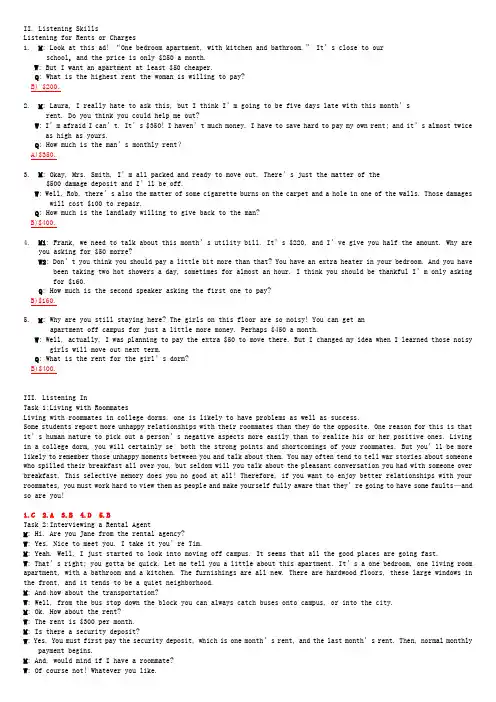
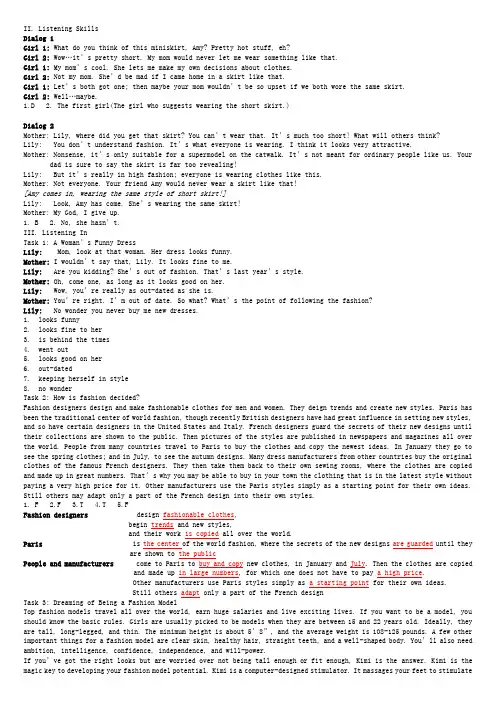
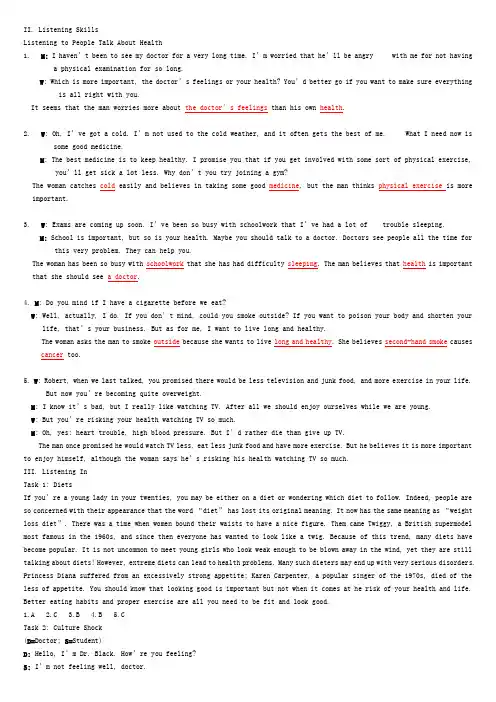
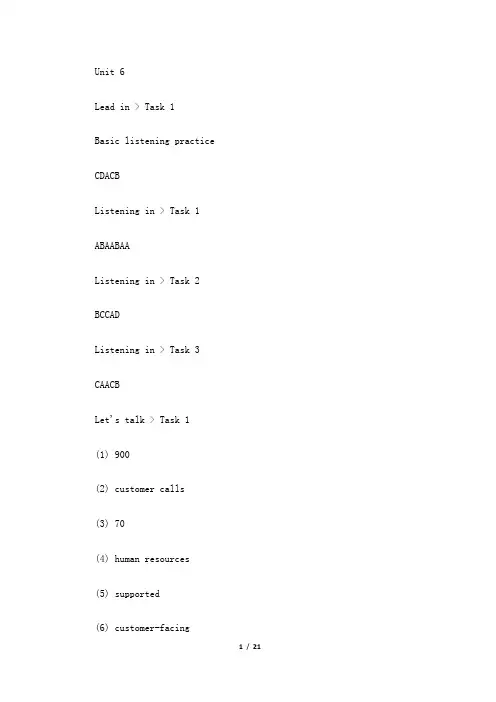
II. Basic Listening Practice
Keys: 1.C 2.D 3. B 4.D 5.A
III. Listening In
Task 1:On the first day
Keys:
(1)the first day
(2)changing
(3)really good
(4)hard workers
(5)went over her head
(6)explained
(7)notes
(8)Wednesday
(9)participation
(10)education
Task 2:How to select elective courses?
Keys:
(1)extra training
(2)chemistry
(3)accounting
(4)many fields of study
(5)better potential
(6)business degree
(7)challenging
(8)how to learn
(9)better understanding
(10)narrow-minded
Task3: How to get straight A's?
Keys:1.B 2.C 3. D 4.A 5.D
IV. Speaking Out
MODEL1
MODEL2
MODEL3
V. Let?ˉs Talk
Task 1:Maintaining the quality or increasing the intake?
Keys:
(1)quality
(2)young
(3)25
(4)difficult
(5)government (6)quality
(7)cut
(8)extra-cautious
(9)afford
(10)experience
(11)more
(12)blame
(13)budget
(14)puzzled
(15)service
Uint2
Our globe is in danger!
I.Lead in
Task 1:
sandstorm ; air pollution ; deforestation
water pollution ; melting polar ice cap ; light pollution
drought ; desertification ; littering
II. Basic Listening Practice
Keys: 1.B 2.D 3. A 4.A 5.C
III. Listening In
Task 1:We should have proper respect for nature!
Script:
Martha:Do you think most people in your culture respect nature?
Ed:I think so. Um... more now than before.
Martha:What do you think is the most serious environmental problem in the world today?
Ed: Today... I think damage to the ozone layer is a big problem, and another problem is pollution
in big cities and things like that.
Martha: How do you learn about environmental problems?
Ed: Um... through school. A lot of clubs promote environmental safety, and some TV programs,
too. They talk about environmental safety and stuff like that.
Martha: Do you think students should learn more about the environment at school?
Ed: I think so. So, as they grow older, they can be more aware of all the problems that are going
on, and also to prevent more problems from occurring.
Martha: If you could create a new law to help the environment, what would it be?
Ed: A new law for the environment? Um... I'd probably say that when people throw away their
cigarette butts, they have to throw them into the garbage bin, not just throw them everywhere
because it's just littering and I hate that. So they should be fined if they throw them on the floor or
on the ground.
Martha: That's a good idea. What do you personally do to help protect the environment?
Ed: I'm so against littering. I never litter. If I see somebody litter, I get really angry. So I always
throw my trash into the garbage bin.
Keys: (1)nature
(2)environmental problem
(3)pollution
(4)promote
(5)aware of
(6)from occurring
(7)law
(8)throw away
(9)fined
(10)trash
Uint 3
Culture makes me what I am
Task 1:On the first day
Collectivism Individualism Individualism Collectivism
II. Basic Listening Practice
Keys: 1.B 2.A 3. D 4.B 5.A
III. Listening In
Task 1:Competition in America
Keys:1.C 2.A 3. C 4.B 5.D
Task 2:How to select elective courses?
Keys:
(1)roots
(2)what
(3)moral
(4)diligence
(5)sin
(6)teachings
(7)centuries
(8)If it's worth doing at all, it's worth doing well
(9)In English a new word has been created to describe people who work compulsively
(10)Others hold that workaholics are valuable members of society because they are extremely
productive
Task3: Cross-cultural tips on doing business
Keys:1.D 2.A 3. D 4.A 5.C
V. Let?ˉs Talk
Task 1:International Slavery Museum
Keys:
1.
(1)transatlantic slave trade
(2)unknown lands
(3)dignity or payment
2. (1)rich
(2)cotton and sugar
3.
(1)all over the world
(2)family history
(3)changed
4.
200th anniversary
5.
(1)banned
(2)taking part in
(3)slavery
(4)freed
Uint4
Taste the sweets and bitters of family life
I.Lead in
Task 1:
Extended family;DINK family;Nuclear family;Single parent family
II. Basic Listening Practice
Keys: 1.C 2.A 3.B 4.C 5.D
III. Listening In
Task 1:Nuclear family living patterns
Script:
A nuclear family is typical in highly-industrialized societies.
Beginning in the early 20th century, the two-parent family known as the nuclear family was the
predominant American family type.
Generally children live with their parents until they go away to a college or university, or until
they find jobs and acquire an apartment or home of their own.
In the early mid-20th century, the father was typically the sole wage-earner, and the mother was
the children's principal caregiver.
Today, often both parents hold jobs. Dual-earner families are the predominant type for families
with children in the United States.