高中英语任务型读写题的解题思路及技巧
- 格式:docx
- 大小:27.83 KB
- 文档页数:2
高中英语任务型读写题的解题思路及技巧
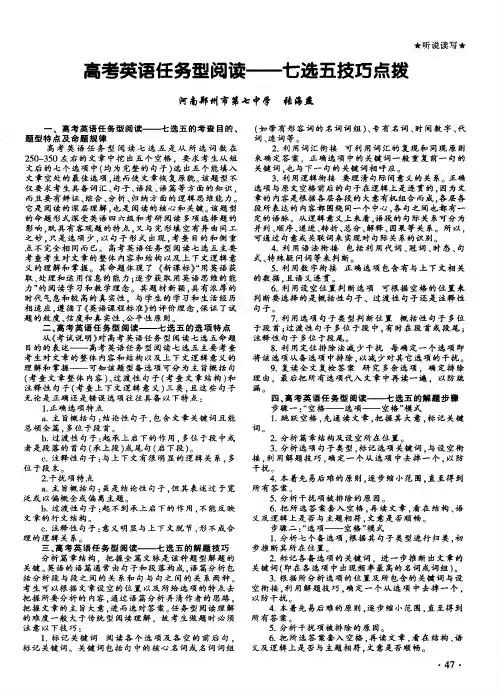
任务型阅读一般的解题思路可归纳为四步曲,即“审题”→“略读”→“边细读边解题”→“复核”。
“审题”,即看清题目及要求,做到有的放矢,心中有数。
“略读”,这里指的是快速阅读、掌握大意。在做题以前要快速扫视一下文章的大意,了解阅读材料的基本信息、语篇的文体类型,如记叙文、议论文还是说明文,作者的写作目的与态度等,为下一步完成任务作铺垫。
“边细读边解题”,指通过细读题目和文章中相关信息完成指定任务。
“复核”即检查核对初步完成的所要求的任务。通常做法是全部填完后,把文章看一遍,检查所填之词是否符合文章内容,答题是否符合规范,拼写是否正确以及大小写等。
在此过程中,注意以下解题技巧:
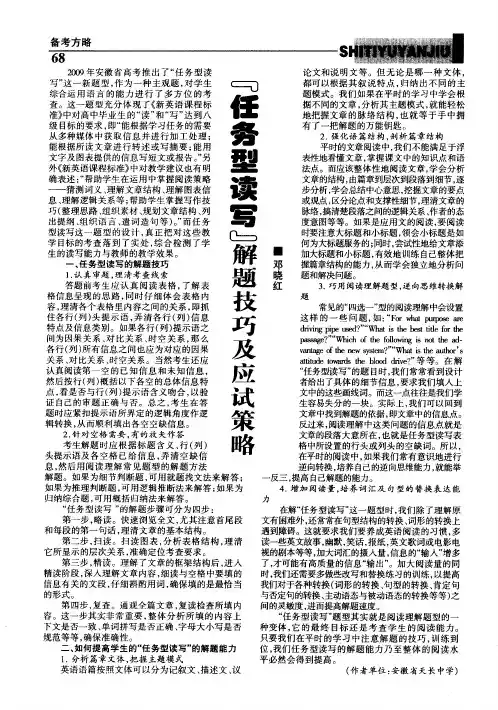
(一)分析表格,注意细节。注意表格前的小标题。它通常是段落和表格的主题句,有助于理解文章。理解表格设计,表格一般包括列标题和行标题,通过阅读这些标题和表格里的内容;可迅速了解表格的结构和表格的设计原理。同时也可缩小信息范围,确定考查内容。根据已填的内容来推断所填之词的形式,是单词或词组。
(二)掌握变通信息的技巧。
有许多答案是不能直接在文章中找到原句或原词的,这需要我们对文章进行加工或变通。这些变通大多与语法知识有关,也有些与短语和句型有关。
1.间接法---即基于原文某个词语的语法变形,如,主动与被动,谓语动词与非谓语动词,动词原形与动词第三人称单数形式,动词与名词,名词与形容词,形容词、副词的互换及比较级与最高级,名词单复数等。
2.意译法---即对原文中的某句话在保持意思不变的前提下,变换一种说法。这种变换有一定的难度,要求你吃透原句意思,然后进行转换或解释。答案的来 源往往有三个方面。
(1)根据关键词的导航,在文中捕捉原始信息。
(2)根据空格前后变化了的新语境,从语法和搭配的角度对原始信息进行加工。
(3)根据单元格本身的行文规律,遵循同一栏在表达上的一致性原则。如要是动词原型都是动词原型,或都是V-ing结构,从而确定信息最终的输出形式。
(4).同时要注意时态、语态、句式等,避免出现错误。
任务型阅读填空题解题技巧的实例分析,认真阅读下列短文,并根据所读内容在文章后图表中的空格里填入最恰当的词,每空一个词。
Traveling to all corners of the world gets easier and easier. We live in a global village, but this
doesn’t mean that we all behave in the same way.
How should we behave when you meet someone for the first time? An American shakes your hand
firmly while looking you straight in the eye. In many part of Asia, there is no physical contact (接触)at all. In Japan, you should bow, and the more respect you want to show, the deeper you should
bow. In Thailand, people greet each other by pressing both hands together at the chest. In both
countries, eye contact is avoided as a sign of respect. Many countries have rules about what you should and shouldn’t wear. In Muslim countries, you
shouldn’t reveal (显露)the body, especially women, who Should wear long blouses and skirts .In
Korea, you should take off your shoes when entering a house. Remember to place then neatly
together where you came in.
In Spain, lunch is often the biggest meal of the day, and can last two or three hours. For this reason
many people eat a light breakfast and a late dinner. In Mexico, lunch is the time to relax, and many
people prefer not to discuss business as they eat .In Britain, it’s not unusual to have a business
meeting over breakfast.
In most countries, an exchange of business cards is In most countries, an exchange of business
cards is necessary for all introductions. You should include your company name and your position.
If you are going to a country where your language is not widely spoken, you can get the back side
of your card printed in the local language. In China, you may present your card with the writing
facing the person you are giving it to.(如图)
76.确定标题,由文章的大意可知,文章主要讲述了各个国家的文化礼仪,而且在第一段最后一句中出现了Behavior 的动词形式behave一词,故应用Manners/Behavior.
77.语句概括。由shaking hands firmly; pressing both hands-----可知该礼仪是Greeting.
78.细节题。由第二段中In Japan, you should bow, and the more respect you want to show, the
deeper you should bow.而且和Shaking 和Pressing保持一致性, 故应填Bowing。
79.细节填空。由第三段第一行Many countries have rules about what you should and shouldn’t
wear. In Muslim countries, you shouldn’t reveal (显露)the body, especially women, who Should
wear long blouses and skirts. 故应填Muslin。
80.根据第三段最后一句.In Korea, you should take off your shoes when entering a house.
Remember to place then neatly together where you came in.
可以看出,这里应该填写一个表示地点方位的名词,根据生活常识,我们在进门时换鞋,故这个空格应填door/gate.
81. 细节填空.在第四段第三行In Mexico, lunch is the time to relax, and many people prefer not
to discuss business as they eat.可知此题的答案是lunch.
82.由第四段最后一句In Britain, it’s not unusual to have a business meeting over breakfast.可知,这个空格应填Britain或UK.
83.根据最后一段第一句In most countries, an exchange of business cards is necessary for all
introductions.,可知此题答案为introducing。原文给的是名词,题中根据句式,要填写其V-Iing形式,但是我们常见的句式,应该说学生很容易想到用V-Iing形式。
84.由文章的最后一句话In China, you may present your card with the writing facing the person
you are giving it to.可得知填with.但也许有点同学看不懂此句的结构和意思。
85.概括归纳题。由文章大意可知,要想到国外旅行,要了解该国的文化礼仪,故应填abroad或worldwide.