
虚拟语气
- 格式:ppt
- 大小:1.25 MB
- 文档页数:25


虚拟语气
一、If 引导的条件句中的虚拟语气
时间 从句谓语形式 主句谓语形式 例
将来 动词过去式(be用were)
should + 动词原形
were to + 动词原形 would / should / might /
could + 动词原形 If he were to/should/come here/he
came here, he would tell us about it. 如果他要来的话,他会通知我们一声。
现在 动词过去式
(be 用 were) would / should / might / could
+ 动词原形 If he were free, he would help us. 要是他有空的话,它会协助我们的。
过去 had +动词过去分词 would / should / might / could
have + 动词过去分词 If I had seen the film, I would have told
you about it. 我如果看过这场电影,我会把电影内容告诉你了。
▲
当虚拟条件句的谓语动词含有were, should, had时,if可省略,而将were, should, had等词置于句首。
例:Had he learnt about computers, we would have hired him to work here. 如果她懂一些电脑知识的话,我们会已经聘用他来这里工作了。
▲ if only 要是…就好了 If only I had got it. 要是我得到它了该多好啊。
▲ 在句中出现but for(if it were not for/ if it hadn’t been for), without, otherwise, or else 等时,后面的虚拟语气形式参照上面表格中主句谓语动词形式,视句子涵义而定。

If虚拟语气
一、 虚拟语气在条件句中的用法
If引导出的条件句中使用虚拟语气时,表示所说的话是非真实的,是一种假设。通常有三种情况,与现在事实相反;与过去的事实相反;与将来的事实相反。
1[/B]、[/B]if从句表示与想在的事实相反的假设时,从句的谓语动词用一般过去时([/B]be一般用[/B]were),主句用[/B]would/should/could/might+[/B]动词原形[/B][/B]
If we had enough money, we would buy a computer
If I were you,I would take her advice.
If places were a like,there would be little need for geographers.如果各个地方都一样,就不需要地理学家了。
Our life would be better if there were no examination.
2[/B]、[/B]if[/B]从句表示与过去事实相反的假设时,从句的谓语动词用过去完成时,主语用[/B]would/should/could/might+have+[/B]过去分词[/B][/B]
If I had worked harder at school,I would have got a better job.
If he had know your address yesterday,he would have telephoned you.
We might have arrived here eariler if we had taken a taxi.
If it had not been for you help, I would have failed again.
3[/B]、[/B]If[/B]从句表示与将来事实可能相反的假设时,从句的谓语动词用一般过去时,[/B]were to do[/B]或[/B]should+[/B]动词原形,主句用[/B]would/should/could/might+[/B]动词原形[/B][/B]
虚拟语气
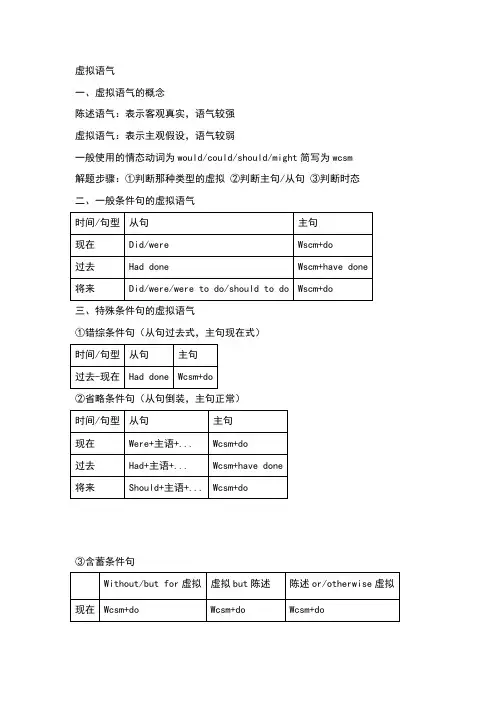
一、虚拟语气的概念
陈述语气:表示客观真实,语气较强
虚拟语气:表示主观假设,语气较弱
一般使用的情态动词为would/could/should/might简写为wcsm
解题步骤:①判断那种类型的虚拟 ②判断主句/从句 ③判断时态
二、一般条件句的虚拟语气
时间/句型 从句 主句
现在 Did/were Wscm+do
过去 Had done Wscm+have done
将来 Did/were/were to do/should to do Wscm+do
三、特殊条件句的虚拟语气
①错综条件句(从句过去式,主句现在式)
时间/句型 从句 主句
过去-现在 Had done Wcsm+do
②省略条件句(从句倒装,主句正常)
时间/句型 从句 主句
现在 Were+主语+... Wcsm+do
过去 Had+主语+... Wcsm+have done
将来 Should+主语+...
Wcsm+do
③含蓄条件句
Without/but for虚拟 虚拟but陈述 陈述or/otherwise虚拟
现在 Wcsm+do Wcsm+do Wcsm+do 过去 Wcsm+have done Wcsm+have done Wcsm+have done
without/but for的含蓄条件句一般翻译为:要是没有....
but的含蓄条件句一般翻译为:....但是....
or/otherwise的含蓄条件句一般翻译为:....否则.....
四、其他句型的虚拟语气
①时间型
时间/句型 As if/as though;wish Would rather;if only
现在 Did/were Did/were
过去 Had done Had done
将来 Wcm+do Did/were
②should型
类型 句型 翻译
名词从句 坚持/命令/要求/It‘s adj. that+(should) do .要是...就好了
(完整版)虚拟语⽓详解
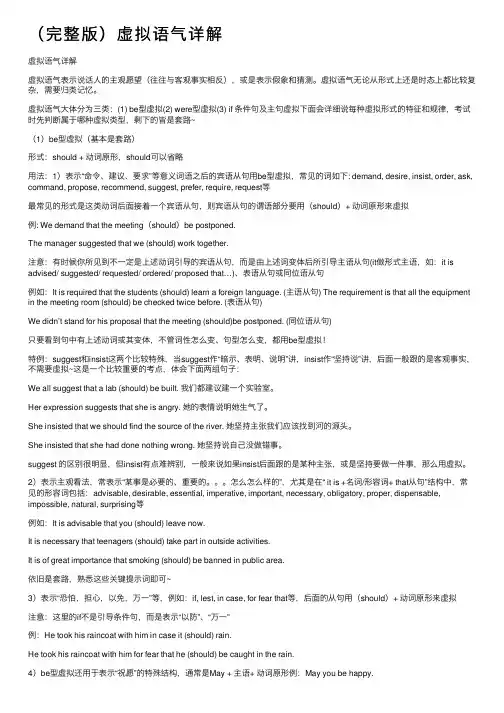
虚拟语⽓详解
虚拟语⽓表⽰说话⼈的主观愿望(往往与客观事实相反),或是表⽰假象和猜测。虚拟语⽓⽆论从形式上还是时态上都⽐较复杂,需要归类记忆。
虚拟语⽓⼤体分为三类:(1) be型虚拟(2) were型虚拟(3) if 条件句及主句虚拟下⾯会详细说每种虚拟形式的特征和规律,考试时先判断属于哪种虚拟类型,剩下的皆是套路~
(1)be型虚拟(基本是套路)
形式:should + 动词原形,should可以省略
⽤法:1)表⽰“命令、建议、要求”等意义词语之后的宾语从句⽤be型虚拟,常见的词如下: demand, desire, insist, order, ask,command, propose, recommend, suggest, prefer, require, request等
最常见的形式是这类动词后⾯接着⼀个宾语从句,则宾语从句的谓语部分要⽤(should)+ 动词原形来虚拟
例: We demand that the meeting(should)be postponed.The manager suggested that we (should) work together.
注意:有时候你所见到不⼀定是上述动词引导的宾语从句,⽽是由上述词变体后所引导主语从句(it做形式主语,如:it isadvised/ suggested/ requested/ ordered/ proposed that…)、表语从句或同位语从句
例如:It is required that the students (should) learn a foreign language. (主语从句) The requirement is that all the equipmentin the meeting room (should) be checked twice before. (表语从句)
We didn’t stand for his proposal that the meeting (should)be postponed. (同位语从句)