
初中英语人教版八年级上册Unit 1 Grammar(不定代词的用法)
- 格式:ppt
- 大小:240.00 KB
- 文档页数:19

八年级上册语法归纳总结(RJ)
Lesson1: Grammar Practice1
一、复合不定代词anything/something/everything/nothing的辨析
指物的复合不定代词
(1)指物的复合不定代词由some、any、no、every加上-thing构成。
如:something某物,anything任何事物,nothing没东西,everything每件事;一切
(2)指物的复合不定代词的用法。
这些复合不定代词只具有名词性质,用作单数,在句中可用作主语、宾语和表语。带some的一般用于肯定句,而带any的一般用于否定句和疑问句,注意:any在肯定句中意为“任何一个”;它们的用法同some、any的用法类似。
如:Everything begins to grow in spring. 春天万物开始生长了。
Something is wrong with my watch. 我的手表坏了。
I can’t see anything. 我什么也没看见。
(3)复合不定代词的特殊用法。
①用在表示“请求”、“建议”或希望得到对方肯定答复的疑问句中,some不用变为any。
如:Would you like something to drink? 你想喝点什么吗?
②复合不定代词被定语(形容词)所修饰时,定语必须放在它的后面。
如:There is something wrong with the radio. 收音机出了毛病。
二、复合不定代词someone /somebody/anyone/anybody/no one/nobody的辨析。
指人的复合不定代词
(1)指人的复合不定代词一般由some, any, no, every加上-body, -one构成。
如:somebody某人,anybody任何人,nobody没人,everybody每人
someone某人,anyone任何人, no one没人,everyone每人

Unit10 If you go to the party, you’ll have a great time!
Section A2 (Grammar Focus-3c)
一、教学目标:
1. 语言知识目标:
1) 学习掌握下列词汇:upset, taxi, advice
2)进行一步复习巩固学习Section A 部分所学的生词和词组。
3)掌握正确用含if条件状语从句的主从句。
4) 能够熟练运用所学的知识,用if来表达条件,用will来表达结果。
2. 情感态度价值观目标:
学习因果关系的表达和做出合理的建议。谈论自己的感受,同时使学生在英语交流中注意并观察他人的情感。由于本单元话题贴近学生生活,符合他们热爱休闲的心理,可以提高他们学习英语的兴趣,积极参与英语实践活动。
二、教学重难点
1. 教学重点:
1) 复习巩固Section A 部分所学的生词和词组,达到熟练运用的目标。
2) 能够熟练运用所学的知识,用if来表达条件,用will来表达结果。
2. 教学难点:
1) 掌握正确用含if条件状语从句的主从句。
2) 能够熟练运用所学的知识,用if来表达条件,用will来表达结果。
三、教学过程
Ⅰ. Warming- up and revision
1. Have a dictation of the new words learned in the last class.
2. Talking:
Let’s look at the pictures in 1a and let Ss make sentences with “if…will” .
e.g. If you go to the party with Karen and Anna, you’ll have a good time.
One by one, let some Ss make a sentences by themselves.

Unit 1 重点语法grammar复合不定代词和一般过去时-q八年级英语上册单元重难点易错题精练人教版
班级 姓名 学号 分数
Unit 1 Where did you go on vacation?
语法复合不定代词和一般过去时
(时间:60分钟,满分:100分)
一、单项选择(本大题共50小题,每小题1分,共50分)
1.—Life is the most important.
—I think so. ________ is more important than life.
A.Something B.Anything C.Nothing D.Everything
2.The school concert was so amazing that ________ left in the middle of it.
A.everybody B.anybody C.nobody D.somebody
3.Our school is going to have a sports meeting tomorrow. ________ is ready now.
A.Something B.Everything C.Anything D.Nothing
4.—Does _______ else want to come?
—No, no one wants to come.
A.anyone B.someone C.anything D.something
5.There is ________ wrong with my computer. It doesn’t work now.
A.something B.anything C.everything
6.—Hey, Bruce! _______ is waiting for you at the school gate.
Unit 1 Grammar导学案
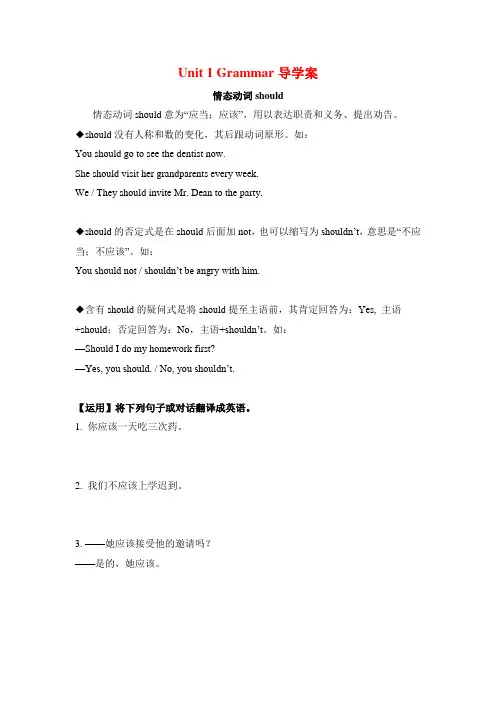
情态动词should
情态动词should意为“应当;应该”,用以表达职责和义务、提出劝告。
◆should没有人称和数的变化,其后跟动词原形。如:
You should go to see the dentist now.
She should visit her grandparents every week.
We / They should invite Mr. Dean to the party.
◆should的否定式是在should后面加not,也可以缩写为shouldn’t,意思是“不应当;不应该”。如:
You should not / shouldn’t be angry with him.
◆含有should的疑问式是将should提至主语前,其肯定回答为:Yes, 主语+should;否定回答为:No,主语+shouldn’t。如:
—Should I do my homework first?
—Yes, you should. / No, you shouldn’t.
【运用】将下列句子或对话翻译成英语。
1. 你应该一天吃三次药。
_____________________________________
2. 我们不应该上学迟到。
_____________________________________
3. ——她应该接受他的邀请吗?
——是的,她应该。
_____________________________________
答案
1. You should take the medicine three times a day.
2. We shouldn’t arrive late for school.
3. —Should she accept his invitation?
—Yes, she should.