一阶rc电路 英语
- 格式:doc
- 大小:16.50 KB
- 文档页数:1
一阶rc电路 英语
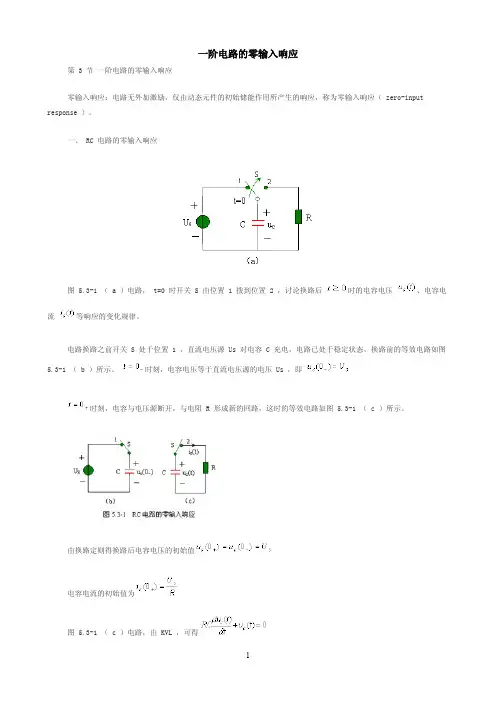
A first-order RC circuit is an electrical circuit that consists of a resistor
(R) and a capacitor (C) connected in series. The circuit is called "first-order"
because it only contains one energy storage element (the capacitor), which
determines the time constant of the circuit.
In a first-order RC circuit, the resistor limits the current flowing through
the circuit, while the capacitor stores electrical energy. When a voltage is applied
to the circuit, the capacitor begins to charge up, and the current through the circuit
increases over time. The rate at which the capacitor charges depends on the
resistance and capacitance of the circuit, as well as the applied voltage.
One important characteristic of a first-order RC circuit is its time constant,
which is defined as the product of the resistance and the capacitance. The time
constant determines how long it takes for the capacitor to charge or discharge to
a significant fraction of its final value. In a first-order RC circuit, the time
constant is typically on the order of milliseconds to seconds, depending on the
values of R and C.
First-order RC circuits are commonly used in electronics for a variety of
applications, including timing circuits, filters, and oscillators. They are also
used to model the behavior of electrical systems, such as the charging and
discharging of batteries or the response of a circuit to a sudden change in voltage.
In summary, a first-order RC circuit is a simple electrical circuit that consists
of a resistor and a capacitor connected in series. It has a time constant that
determines the rate at which the capacitor charges or discharges, and is commonly
used in electronics for timing, filtering, and oscillator applications.