
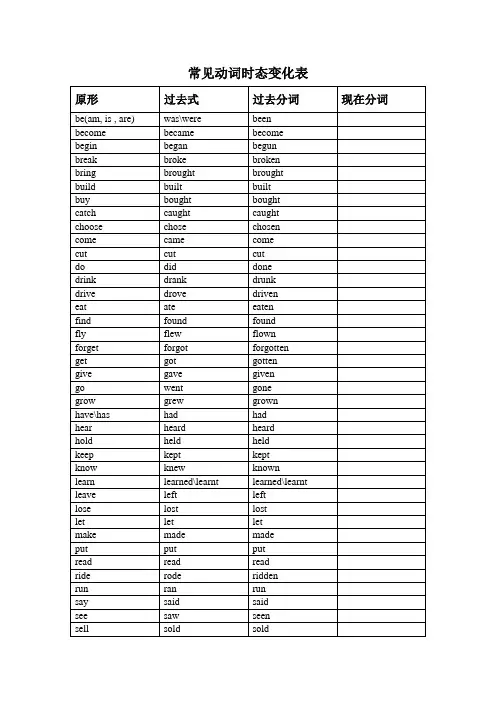
常见动词时态变化表
- 格式:doc
- 大小:63.00 KB
- 文档页数:2

动词一般时态变化形式英语中动词时态一共有16种,分为4类,分别是:一般时态、进行时态、完成时态和完成进行时态,每类又分4种,所以一共是16种。
今天给大家分享一般时态:一般现在时、一般过去时、一般将来时、一般过去将来时。
一. 一般现在时1. 一般现在时的基本用法1) 表示现在存在的习惯,经常发生的动作或存在的状态。
常与every day,twice a week,often,usually,always,seldom,sometimes 等时间状语连用。
如:She is our English teacher.她是我们的英语老师。
He takes a walk after supper every day.他每天晚饭后散步。
The children go to school at seven every morning.孩子们每天早晨七点上学。
2)表示主语的特征、性格、能力等。
如:He workshard. 他工作很努力。
即:他是一个勤劳的人。
Does she like sports? 她爱好运动吗?即:她是个运动爱好者吗?The children draw well. 这些孩子很会绘画。
表示能力3)表示客观事实或普遍真理。
如:The sun rises in the east. 太阳从东方升起。
Two plus two makes four. 二加二等于四。
Knowledge is power. 知识就是力量。
2. 一般现在时的其他用法1) 在时间、条件状语从句中表示将来的动作。
如:When they leave school, they will go to work in Tibet.他们毕业后将到西藏去工作。
If You see him,will you tell him to ring me?如果你见到他,叫他给我打个电话好吗?We'll visit the cotton mill if it is fine tomorrow.如果明天天晴,我们就去参观纺织厂。
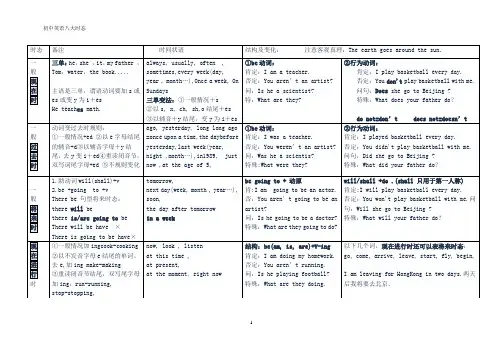


小学PEP英语四种时态总结一、一般现在时标志词:always(总是) usually(通常) often(经常) sometimes(有时) never(从不) every(每一)行为动词词型变化形式一般现在时动词只有第三人称后有词形变化,其他人称(第一人称:I, we;第二人称:you;第三人称复数:they、my friends)动词均用原形当主语是第三人称单数时,一般动词在一般现在时句子中的变化规律:1、多数在动词后加s play—plays like—likes ,2、以s,x,sh,ch,o结尾的动词加es wash–washes catch–catches do–does3、以辅音字母加y结尾,把y改i再加es fly—flies study—studies4、以元音字母加y结尾,直接加s buy – buys5、不规则变化have—has一般现在时基本用法功能1.表示事物或人物的特征、状态。
如:The sky is blue.天空是蓝色的。
2.表示经常性或习惯性的动作。
如:I get up at six every day.我每天六点起床。
3.表示客观现实。
如:The earth goes around the sun.地球绕着太阳转。
The earth is round.构成1. be动词:主语+be(am,is,are)+其它。
如:I am a boy.我是一个男孩。
2.行为动词:主语+行为动词(+其它)。
如:We study English.我们学习英语。
句型肯定句:A.be动词:主语+ be + 其它成分He is a worker.B.行为动词:主语+动词(注意人称变化) +其它成分We like the little cat.否定句:A.be动词:主语+ be + not +其它成分They are not students.B.行为动词:主语+助动词(do/does) + not +动词原形+其它成分We don’t like the little cat.一般疑问句:A.be动词:Am / Is /Are +主语+ 其它成分Are you a teacher? Yes, I am. / No, I am not.Are they students of your school.Yes they are / No they aren,t.B.行为动词:助动词(Do/Does)+主语+动词原形+ 其它成分Do you like it? Yes, I do. / No. I don’t .Does he(she) like it? Yes, he( she )does. / No, he ( she )doesn’t.特殊疑问句:疑问词+ 一般疑问句A.be动词:How many students are there in your school?B.行为动词:What do you usually do on Sunday?一般现在时动词be和have的变化形式1.动词Be 叫连系动词, 用法:第一人称单数用am,第三人称单数用is,其它人称用are。