
必修四《unit4-Body-language》说课稿
- 格式:pptx
- 大小:778.04 KB
- 文档页数:34

人教版高中英语必修四unit4Bodylanguage教案Teaching PlanModule4 Unit 4 Body languagePart1 .Analysis of the teaching materialSs have been learning how to communicate by speaking or writing, they are familiar with the words or voice, but sometimes body languages can express our feelings more directly. If we don’t notice them we may make misunderstanding. So it’s very important to learn the new lesson, lesson4 body language. Body language means the moving of eyes, head or hands while talking, even the distance between persons. In the new class, Ss are helped to learn the ways of body language and the expressions related to them. And by leaning the reading text, Ss are expected to learn the meanings of body language on different cultural background.1.Teaching aims1)K nowledge aims:To understand the meaning of body language.To memorize the new words, phrases and sentence patents.Ability aims:To be able to describe body language with the words learnt.Can recognize the differences under the same body language.2)E motion aims:To arouse the Ss’ interest in body language.To cultivate the Ss’ love for body language.2.Teaching difficult and important points1)The new words, phrases and sentences:2) The ability to describe and recognize body language.3.Teaching aidsa teaching planA multi-media systempptPart2. Teaching and learning methods1.Task-based method,2.Audio-visual(直观) methodPart3. Teaching stepsStep1: GreetingsGreet the whole class as usual.Step2: lead-in (Individual Work)1)Lead Ss know the topic of the lesson (body language)2)Lead Ss know the objectives of the lesson.Step3:Warm-up (individual Work and pair work)1)Show Ss some picturesT: What can you infer from the pictures in Ex1 on P25?2)Games (group work and pair work)Show Ss pictures of different body language, ask them to guess in English together.Invite some Ss act out body language in front of the classroom, others try to guess in English.Ask student go through the expressions in Ex2.Step4:Pre-reading (group work)Have Ss listen to the tape to get the general idea of the text.(the misunderstanding caused by body language)Step5: listening (group work)Have Ss listen to the tape twice and under the body language and the related feels.Check the answers with the CStep6 reading (individual work and group work)1)H ave Ss read the text and do Ex1 of the Comprehending. Check up with the C.2)H ave Ss discuss the questions of Ex2 of the Comprehending.Homework1, Go through the question1-3 of Pre-reading on P25.2, Listen and read the text on P26 two times.3, complete other Exes about new words.。

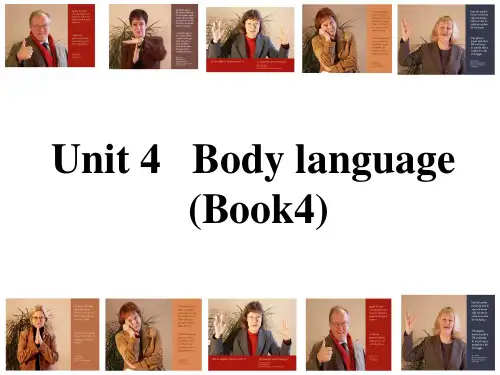
Unit 4 Body Language-Reading Communication: No Problem?Teacher: Cai QiulianCourse: EnglishTextbook: Senior English for China (Book 4), by Liu DaoyiTime Allotment: 1 period (40 minutes)Date: March 20, 2014Teaching aids: blackboard, Multi-media, Power Point, chalkI. Text Analysis (教材分析)This unit is about body language, and the text selected in the reading part demonstrates the difference and similarity of body language in many parts of the world. Through learning this passage, students are required to raise their awareness of using body language in different parts of the world. As body language is closely related to our daily life, it is easy to arouse students’ interest in learning this text. Reading skills and speaking training are designed around the text.II. Teaching Objectives (教学目标)By the end of the lesson, students will be able to:1. Language Skill Objective(语言技能目标):develop reading ability (skimming and scanning)as well as speaking ability.2. Cultural Knowledge Objective(文化学问目标): know about the cultural differences of using body language.3. Affective Objective(情感目标):increase students’ awareness of using body language correctly in different cultures.III.Teaching Focuses and Difficulties(教学重点和难点)1.Teaching Focuses(教学重点): the difference and similarity of body languagein many parts of the world.2.Teaching Difficulties(教学难点):develop students’ reading abilities ofskimming and scanning and ask the students to show their opinions with fluent English.IV. Teaching Procedures(教学步骤)It involves five parts:Step1. Lead-in(导入)Step2. Pre-reading(读前活动)Step3. While- reading(阅读)Step4. Post-reading(读后活动)Step5. Homework assignment(家庭作业)The first periodStep 1. Lead-in (引入)8’1. Show them some pictures (facial expressions and gesture expressions) of body language then guess what do they mean. 给他们展示不同的国家习俗不同表情和动作的图片,以此来激发学生爱好,引入肢体语言这个文章主题。
unit 4 Body language说课稿我今天说课的内容是新人教版高一英语必修4 unit 4 Body language的warming-up and speaking部分。
一、教材分析:本单元的中心话题是“肢体语言”,介绍了肢体语言在世界范围内的人们生活中所承担的不同角色及所起的重要作用,具体涉及什么是“体态语”,如何理解“体态语”,以及“体态语”的跨文化性等。
本单元的语言技能和语言知识也都是围绕“体态语”这一中心话题设计的,旨在通过单元教学,用听、说、读、写、做(表演)等多种形式,让学生正确认识和掌握“体态语”在交际中的作用和意义,使学生明确“体态语”在人类交际中的重要性,了解“体态语”在不同民族、不同文化交际中的多样性;使学生在今后的日常生活、学习、工作和交往中尽量减少或避免运用“体态语”时可能产生的误解,提高他们的“语言交际”能力和“非语言交际”能力。
其中重点介绍了肢体语言在不同的文化背景下的不同含义及世界通用的肢体语言。
本单元的绝大部分内容都围绕这一中心话题展开的。
本课内容主要以肢体语言为主,贴近学生实际生活,是学生每天都能看到接触到的知识内容,符合学生的学习需要,迎合学生好动、好说的心理,可充分调动学生手、口、脑以及全身的反应能力,给学生充分发挥的空间。
二、说教学目标:根据学生的知识基础,接受能力以及教材对学生的要求,我制定以下三点目标:1、知识目标:能理解、会用重点、难点词汇词组2、能力目标:能在教师创设的多种环节中熟练应用所学知识,培养学生动手、动脑、动口的综合能力。
进行“请求帮助”和“提供帮助”的日常英语的句型3、德育目标:Do in Rome asλ Rome does [as the Romans do].[谚]入国问禁, 入乡随俗。
Manners make theλ man. 礼貌造就人。
通过课堂活动意识到body language在跨文化交际中的重要作用三、说教学方法:根据教学内容的选择和学生实际情况,根据新颁布的《普通高中英语课程标准(实验稿)》所倡导的教学原则,确定本节课主要采用合作学习教学法(Cooperative Learning Approach)、直观教学法、交际教学法(Communicative Approach)、以及情感激励教学法(Affective Motivation)等教学方法。
