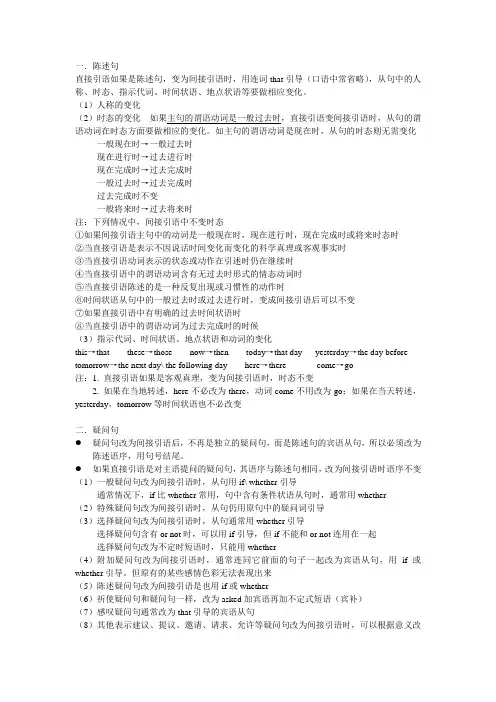
直接引语和间接引语知识点归纳
- 格式:doc
- 大小:55.50 KB
- 文档页数:5
直接引语和间接引语
引述或转述别人的话称为“引语”。直接引用别人的原话,两边用引号“ “标出,叫做直接引语;用自己的语言转述别人的话,不需要引号这叫做间接引语,实际上间接引语大都是宾语从句(其中由祈使句转换的间接引语除外,其转换后是不定式)。那么直接引语为陈述句、一般疑问句、特殊疑问句和祈使句,转换为间接引语时,句子的结构,人称、时态、时间状语和地点状语等都要有变化,如何变化呢?
1、人称的转变
1)直接引语中的第一人称,一般转换为第三人称,如:
He said,“I am very sorry.” ——>He said that he was very sorry.
2)直接引语中的第二人称,如果原话是针对转述人说的,转换为第一人称,如:
“You should be more careful next time,” my father told me.——>
My father told me that I should be more careful the next time.
3)直接引语中的第二人称,如果原话是针对第三人称说的,转换成第三人称。如:
She said to her son, “I'll check your homework tonight.” ——>
She said to her son that she would check his homework that night.
4)人称的转换包括人称代词、物主代词和名词性物主代词等,如:
He asked me, “Will you go to the station with me to meet a friend of mine this afternoon?” ——>
He asked me whether I would go to the station with him to meet a friend of his that afternoon.
总之,人称的转换不是固定的,具体情况,具体对待,要符合逻辑。
2、时态的转换
直接引语改为间接引语时,主句中的谓语动词如果是过去时,从句(即间接引语部分)的谓语动词在时态方面要作相应的变化,变成过去时范畴的各种时态(实际也是宾语从句的时态要求),变化如下:
“I am very glad to visit your school”, she said. ——>
She said she was very glad to visit our school.
Tom said, “We are listening to the pop music.” ——>
Tom said that they were listening to the pop music.
Mother asked, “Have you finished your homework before you watch TV?” ——>
Mother asked me whether I had finished my homework before I watched TV.
He asked the conductor, “Where shall I get off to change to a No. 3 bus?” ——>
He asked the conductor where he would get off to change to a No. 3 bus.
“Why did she refuse to go there?” the teacher asked. ——>
The teacher asked why she had refused to go there.
Mother asked me, “Had you finished your homework before you watched TV?” ——>
Mother asked me whether I had finished my homework before I watched TV.
Tom said, “We were having a football match this time yesterday.” ——>
Tom said that they were having a football match that time the day before.
He said,“I haven't heard from my parents these days.” ——>
He said that he hadn't heard from his parents those days.
3、直接引语变成间接引语时,从句时态无须改变的情况
1)当主句的谓语动词是一般现在时的时候,如:
He always says, “I am tired out.” ——>He always says that he is tired out.
2)当主句的谓语动词是将来时的时候,如:
He will say, “I’ll try my best to help you.” —>He will say that he will try his best to help me.
3)当直接引语部分带有具体的过去时间状语时,如:
He said, “I went to college in 1994.” ——>He told us that he went to college in 1994.
4)当直接引语中有以when, while引导的从句,表示过去的时间时,如:
He said,“When I was a child, I usually played football after school.” ——>
He said that when he was a child, he usually played football after school.
5)当直接引语是客观真理或自然现象时,如:
Our teacher said to us, “Light travels faster than sound.” ——>
Our teacher told us that light travels faster than sound.
6)当引语是谚语、格言时,如:
He said,“Practice makes perfect.” ——>He said that practice makes perfect.
7)当直接引语中有情态动词should, would, could, had better, would rather, might, must, ought to, used to, need
时,如:
The doctor said, “You'd better drink plenty of water.” ——>
The doctor said I'd better drink plenty of water.
He said, “She must be a teacher.”——> He said that she must be a teacher.
He said, “She ought to have arrived her office by now.”——>
He said that she ought to have arrived her office by then.
The teacher said, “You needn't hand in your compositions today.”——>
The teacher said we needn't/didn't need to/didn't have to hand in our compositions.
She asked, “Must I take the medicine?”——> She asked if she had to take the medicine.
〔注〕:此处用had to代替must更好
Teacher: You may have the ball game this afternoon. Student : What did the teacher say, Monitor?
Monitor: He said we might have the ball game this afternoon.
4、时间状语、地点状语及某些对比性的指示代词和动词变化
直接引语 间接引语
指示代词 this/these that/those
时间状语 now then
today that day
tonight that night
this week (month…) that week (month…)
yesterday the day before
last week (month…) the week (month…)before
two weeks (month)ago two weeks (months)before
tomorrow the next day
next week (month…) the next week (month…)
地点状语 here there
动词 come go
bring take
He said, “I met Mr. Smith this morning.”他说“我今天早晨见到史密斯了。”
→He said that he had met Mr. Smith that morning. 他说他那天早晨见到史密斯了。
He said, “We went to the cinema yesterday.” 他说:“我们昨天去电影院了。”
→He said they had gone to the cinema the day before. 他说前一天他们去电影院了。
Lily said, “I will come back next month.” 莉莉说:“我下个月回来。”
→Lily said that she would go back the next month. 莉莉说她下一个月就回去。
He said, “It is nine o'clock now.”他说:“现在九点了。”
→He said that it was nine o'clock then.他说那时九点了。
He said, “I haven't seen her today.”他说:“今天我没见到她。”
→He said that he hadn't seen her that day .他说那天他没有见到她。
She said, “I went there yesterday.”她说:“昨天我去了那儿。”
→She said that she had gone there the day before.她说前一天她去了那儿。
She said, “I'll go there tomorrow.”她说:“明天我将去那儿。”
→She said that she would go there the next day.她说第二天她将去那儿。
He said, “My sister was here three days ago.”他说:“三天前我妹妹在这儿。”