
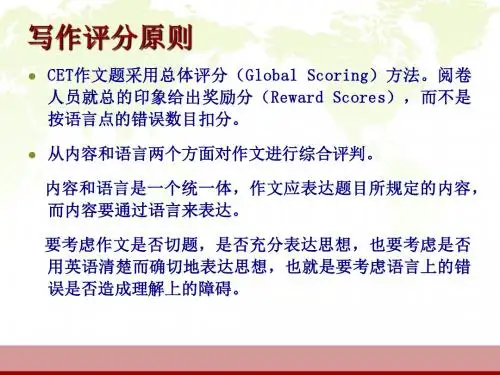
1作文评分原则
- 格式:ppt
- 大小:691.50 KB
- 文档页数:10

英语一作文评分标准细则In assessing English composition, evaluators typically adhere to a set of criteria to fairly gauge the quality of a piece of writing. Below are detailed guidelines outlining the standards commonly used for grading English essays:1. Content and Ideas:Clarity of Thesis/Argument: The essay should present a clear and coherent main idea or argument that addresses the prompt effectively.Relevance: All content should be directly related to the topic or prompt given.Depth of Analysis: The depth of analysis and insight into the topic demonstrates the writer's understanding and critical thinking skills.Supporting Evidence: Arguments should be supportedby relevant and convincing evidence, which may include examples, anecdotes, statistics, or expert opinions.Originality: Original thoughts and perspectives contribute to a more engaging and compelling essay.2. Organization:Logical Structure: The essay should have a well-organized structure with a clear introduction, body paragraphs, and conclusion.Transitions: Smooth transitions between paragraphs and ideas help maintain coherence and flow throughout the essay.Paragraph Development: Each paragraph should focus on a single main idea and provide sufficient explanation and support for that idea.3. Language Use:Grammar and Mechanics: Proper grammar, punctuation, and spelling are essential for clarity and readability.Vocabulary: A varied and appropriate vocabulary enhances the quality of writing, allowing for precise expression of ideas.Sentence Structure: Varied sentence structures contribute to the fluency and sophistication of the writing.Conventions of Academic Writing: Awareness of and adherence to conventions such as formal tone, academic style, and citation guidelines.4. Voice and Style:Engagement: An engaging writing style captivates the reader's attention and maintains interest throughout the essay.Tone: The tone should be appropriate for theaudience and purpose of the essay, whether it be formal,informal, persuasive, or analytical.Voice: The writer's unique voice and perspective should shine through the writing, adding authenticity and depth to the essay.5. Response to Prompt:Adherence to Prompt: The essay should directly address all aspects of the prompt or question provided.Depth of Response: A thorough and comprehensive response demonstrates a strong understanding of the prompt and its implications.6. Overall Impression:Coherence and Cohesion: The essay should be unified and coherent, with all parts working together to convey the writer's message effectively.Creativity and Originality: Innovative ideas,creative approaches, and unique perspectives contribute to a memorable and impactful essay.By carefully considering these criteria, evaluators can provide constructive feedback and assign fair and accurate scores to English compositions, allowing writers to understand their strengths and areas for improvement.。

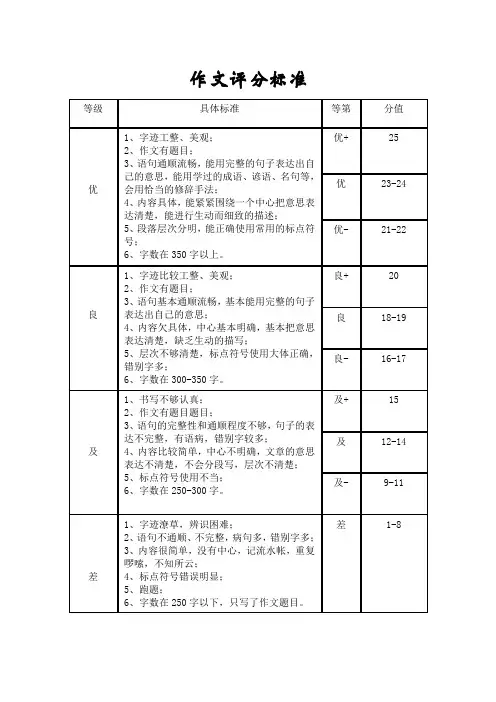
语文作文评分标准作文评分标准。
一、内容。
1. 主题鲜明,立意深刻,符合题意;2. 观点明确,论证充分,论据有力;3. 逻辑清晰,层次分明,结构合理,内容充实;4. 内容新颖,有独特见解,富有创意。
二、语言。
1. 用词准确,表达清晰,语言得体,用词恰当;2. 句式多样,语法规范,语言流畅,表达得体;3. 修辞恰当,形象生动,语言生动有趣;4. 字迹工整,书写规范,格式整齐。
三、思想感情。
1. 立意新颖,思想深刻,观点独特;2. 情感真挚,感情真实,语言真诚;3. 思想内容积极向上,富有感染力;4. 有一定的文学情操,富有人文关怀。
四、综合评价。
1. 总体印象好,思想内容丰富,语言表达得体;2. 立意深刻,论证充分,逻辑清晰,结构合理;3. 用词准确,句式多样,修辞恰当,字迹工整;4. 思想感情真挚,具有一定的文学情操。
高质量仿写。
作文题目,我的家乡。
我的家乡位于中国的一个小城市,这里风景优美,人文气息浓厚,是一个令人向往的地方。
家乡的美丽景色、丰富的历史文化和淳朴的民风都让我深深地爱上了这片土地。
首先,家乡的自然风光十分优美。
家乡四季分明,春天,万物复苏,桃花、梨花竞相开放,山上的杜鹃花也是一片绚丽的景象;夏天,绿树成荫,小河清澈见底,湖水清澈见底,是避暑的好去处;秋天,稻田金黄一片,层林尽染,美不胜收;冬天,银装素裹,白雪皑皑,如同一幅水墨画。
这些美丽的景色让人流连忘返,让人心旷神怡。
其次,家乡的历史文化底蕴深厚。
家乡有着悠久的历史,文化底蕴深厚。
古老的城墙、古老的街道、古老的建筑,都是历史的见证。
家乡还有许多名胜古迹,如名山大川、古寺古庙、文物古迹等,这些都是家乡历史文化的瑰宝。
每到春节、中秋等传统节日,家乡都会举办各种文化活动,如舞龙舞狮、戏曲表演等,这些活动充满了浓厚的地方特色,让人感受到了家乡的历史文化的魅力。
最后,家乡的人文气息浓厚。
家乡的人民淳朴善良,热情好客。
每逢节假日,家家户户都会举办各种聚会活动,邀请亲朋好友共聚一堂,共度美好时光。
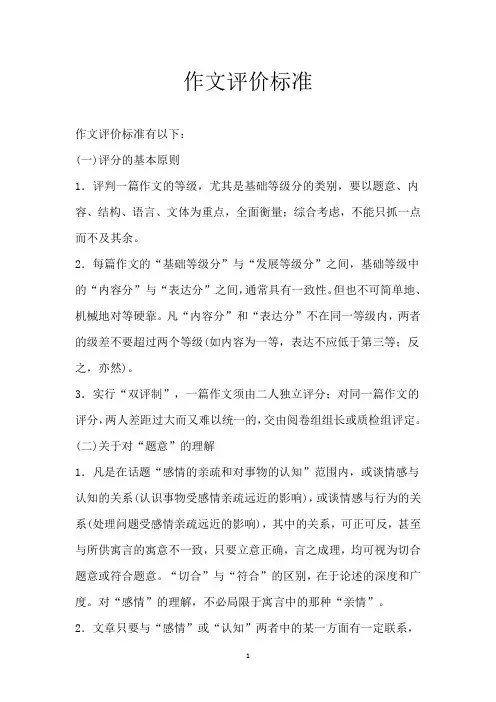
作文评价标准作文评价标准有以下:(一)评分的基本原则1.评判一篇作文的等级,尤其是基础等级分的类别,要以题意、内容、结构、语言、文体为重点,全面衡量;综合考虑,不能只抓一点而不及其余。
2.每篇作文的“基础等级分”与“发展等级分”之间,基础等级中的“内容分”与“表达分”之间,通常具有一致性。
但也不可简单地、机械地对等硬靠。
凡“内容分”和“表达分”不在同一等级内,两者的级差不要超过两个等级(如内容为一等,表达不应低于第三等;反之,亦然)。
3.实行“双评制”,一篇作文须由二人独立评分;对同一篇作文的评分,两人差距过大而又难以统一的,交由阅卷组组长或质检组评定。
(二)关于对“题意”的理解1.凡是在话题“感情的亲疏和对事物的认知”范围内,或谈情感与认知的关系(认识事物受感情亲疏远近的影响),或谈情感与行为的关系(处理问题受感情亲疏远近的影响),其中的关系,可正可反,甚至与所供寓言的寓意不一致,只要立意正确,言之成理,均可视为切合题意或符合题意。
“切合”与“符合”的区别,在于论述的深度和广度。
对“感情”的理解,不必局限于寓言中的那种“亲情”。
2.文章只要与“感情”或“认知”两者中的某一方面有一定联系,而未论及两者的关系,可视为“基本符合题意”。
3.与所供寓言、所定话题、所设问题丝毫没有关系,另立话题,视为“偏离题意”。
4.题意不是判定基础等级分的惟一标准。
切合题意的作文,不一定就是内容上的一类文,还应考虑中心是否突出、感情是否真挚等因素。
(三)关于表达的把握1.文体可不限,但对考生自选的文体,应根据文体特点,评判的侧重点有所不同,对采用特殊文体(如诗歌、剧本等)所写的作文,判分应慎重。
2.表达若有可取之处,即使偏离题意的作文,也不宜轻率判为四等。
(四)关于“发展分”的评定1.12个评分点,不求面面俱到,要求作文有“亮点”,有“精彩”之处,根据“亮点”的大小、精彩的程度,如确能反映有扎实的写作基本功,即可给高分直至满分。