英语十六时态表格总结(很全面).docx
- 格式:docx
- 大小:120.97 KB
- 文档页数:10
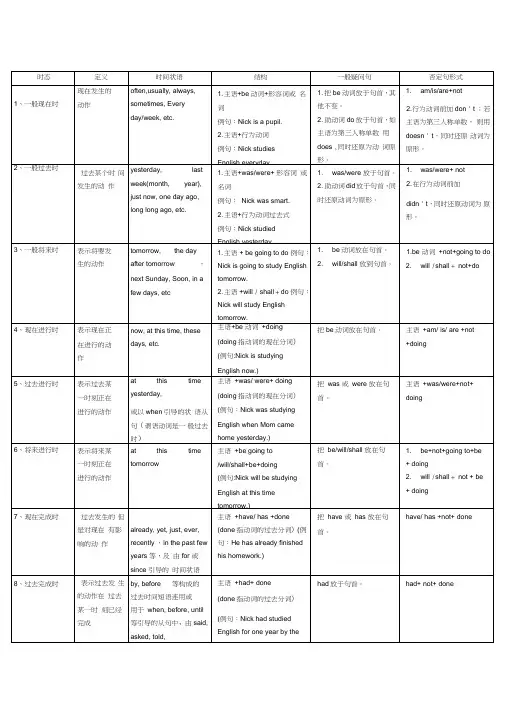
英语时态表——一般现在时、一般过去时时态常连用的词主要用法结构名称例句陈述句: I am an office worker.1 be 动词用am/is/are 表示,之后接名词,形容词或介词。
often;usually;every ;一般 2 行为动词用 V sometimes;现在原形或 V-s/es , always;never;时引导疑问句和否定句,用 do once/twice/a或 don’t;第三week/month/year;人称时用 does on或 doesn’t,有Sundays/Mondays/.;does 出现动词用原形;第三人称陈述句 V 后加s 或 es.1 . be 动词用过yesterday;去式 was 或the day beforewere 表示。
yesterday;一般last过去2 行为动词用week/month/year/.;时。
ago;V-ed ,陈述句, a moment ago;疑问句和否定just now;句借助于 did, 有on/in+过去的时间 ;did 出现动词用原形。
一般现在时表示没有时限的持久存在的习惯性的动作或状态,或现阶段反复发生的动作或状态在过去时间里所发生的动作或存在的状态。
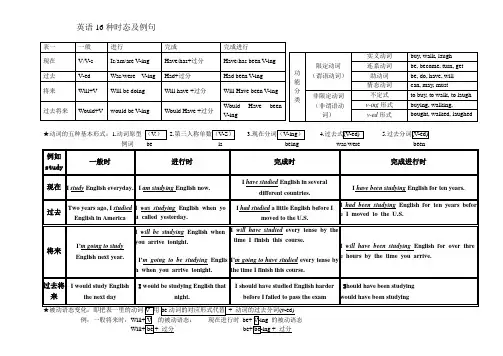
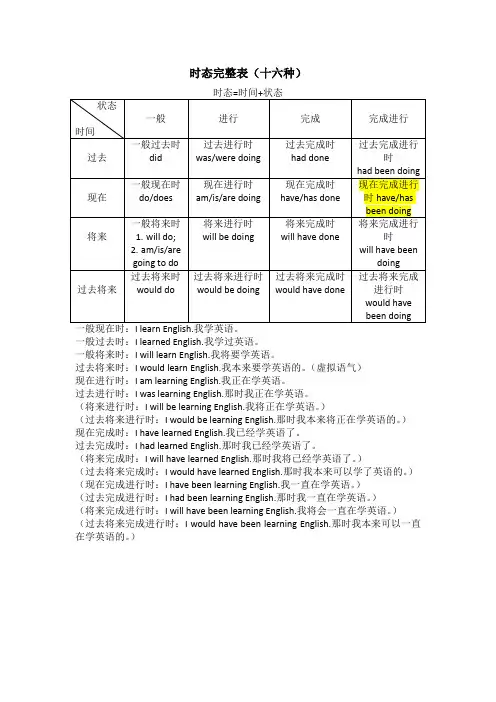
He is so lazy.They are at home now.否定句:I am not Tim.She is not very beautiful.They are not in the office.一般疑问句: Are you an officeassistant? Is shebeautiful?陈述句: I work in Shanghai.He works at home.Davy never watches TV at home.否定句 : I don’t like the food in KFC.Davy doesn’ t like the food in KFC either.一般疑问句 :Do you want a cup of coffee? Does she live nearthesubway station?陈述句: I was a big boss.He was beautiful.We were in Beijing last year.否定句 : I was not at home at that moment.We were not at work yesterday. 一般疑问句 : Were you a teacher?Was she in the office last week?陈述句: I worked in Sunmoon.We studied English there. He lived inHongKong.否定句 : I didn’t work here.They didn ’ t see me. She liked English a lot. 一般疑问句 : Did you go to America?Did he work in Sunmoon?英语时态表——一般将来时、过去将来时时态常连用的词主要用法结构名称tomorrow,一般the day aftertomorrow;即将发生动将来soon;作或状态。
时 1 任何人称 +will+V原形 .nextweek/month/year/...;the例句陈述句: I will fly to KongKong tomorrow. He will go with us.We will arrive in Shanghai next week.否定句 :I will never believe you again. He will not come tonight.We will not buy a car next year.一般疑问句 :Will you go there by train? Will he come tomorrow?week/month/year/...after next;2 is/am/are+going on/in + 将来的时间;to+V 原形,表示计划in+ 一段时间; .打算做什么事情。
过去was/were going to +V在过去将会原形将来多用在宾语从句中时发生的动作。
任何人称 +would +V原形英语时态表——现在进行时、过去进行时Will they live a five-star hotel?陈述句: I ’m going to go to Kongkong by air. 否定句 :We are not going to buy a house here. 一般疑问句 :Are they going to change their jobs? 特殊疑问句 :How are you going to tell him?陈述句: I was going to buy a computer.They told me that they were not going to goabroad.否定句 :I was not going to buy a computer.He said he would come in in Shanghai.I said I would buy you a car one day.时态结构常连用的词名称now ;现在at present;进行is/am/are+V-ing at the moment;时Look!( 放在句首 );Listen! (放在句首);at that time;at this time过去yesterday;进行was/were+V-ingat+ 时间点时+yesterday/lastnight;at that moment;主要用法表示现在( 指说话人说话时) 正在发生的事情。
过去一段时间正在发生的动作。
例句陈述句: I ’m waiting for my boy friend.He is doing the housework at home now.We are enjoying ourselves.否定句 :He is not playing toys.一般疑问句 :Are you having dinner at home?Is Tim cooking in the kitchen?特殊疑问句 :What are you doing now?Where are they having a meal?陈述句: I was doing my homework at that time.We were having a party while he was sleeping.否定句 :He was not sleeping at 11 o’clocklastnight.一般疑问句 : Were you watching TV at that time?特殊疑问句 : What were you doing at thatmoment?英语时态表——现在完成时、过去完成时时态常连用的词主要用法结构名称例句现在完成have/has+ p.p 时(过去分词)already ; just ; before;用来表示之yet( 否定句中 ) ; ever ;前已发生或never; once/twice/完成的动作for+ 一段时间;或状态,其结since +时间点;果的确和现since+一段时间 +ago;在有联系。
动by+ 现在时间;作或状态发so far; up to now; till生在过去但now; until now;它的影响现recently/lately;在还存在;也陈述句: I have already told Davy. Davy has knownthismatter.He has lived here for nearly 10 years.否定句 :I haven ’t finished my homework..Tim hasn’ t come yet.We haven’ t heardany news about him一般疑问句 : Has he worked here since he came here?特殊疑问句 : How long have you worked inthiscompany?during/over/in可表示持续thepast/last .到现在的动作或状态。
简单的说,就是动作已经发生对现在造成明显的影响。
1. have/has always been+名词/形容词/介词:总是或一直是什么样子。
He has always been a good father. I have always been busy.They have always been in America.特别注意:2. have/has gone to:去了。
He has gone to Beijing.They have gone to the cinema.过去过去的过去:动作发生在had + p.p (过 by+ 过去的时间;完成表“过去某动作或时间以过去的过去。
去分词)时前”的时间状语。
3. have/has been to:表示去过或到过。
I have been to Canada. Have you been to Hongkong? Where have you been? I have never been here.陈述句: He said he had told Davy.They told us they had finished the work.He left the office after he had called Davy.否定句 :She hadn ’t had dinner before she went out. 一般疑问句 :Had she learnt English before she movedhere?特殊疑问句 :how many English words had he learnt by theend of last year?英语时态表——英语时态举例!Simple Present Simple Past一般现在时一般过去时句子结构 : 主语 +V-ed 句子结构 : 主语 +VTwo years ago, I studied English inI study English everyday.America.我每天都学习英语.两年前 ,我在美国学英语.Simple Future一般将来时句子结构 : 主语 +will+V.If you are having problems, I will help you study English.如果你在学习英语当中 ,遇到问题 ,我将帮助你 .句子结构 : 主语 +be going to+VI ’m going to study English nextyear.我明年将开始学习英语.Past Continuous Future Continuous Present Continuous过去进行时将来进行时现在进行时句子结构 :主语 +will be+doing句子结构 :主语 +was/were+doing句子结构 : 主语 +be+doingI was studying English whenI am studying English now.you called yeaterday.我正在学习英语.你昨天给我打电话的时候,我正在学习英语 .Present Perfect Past Perfect现在完成时过去完成时I will be studying English when youarrive tonight.明晚你来的时候,我会正在学习英语.句子结构 : 主语 +be goingto+be+doingI ’m going to be studying Englishwhen you arrive tonight.同上 .Future Perfect将来完成时句子结构 : 主语 +will+havedoneevery tense bythe time I finish this course.句子结构 : 主语 +have/has doneI have studied English in severaldifferent countries.在一些国家 ,我已经学习了英语.Present Perfect Continuous现在完成进行时句子结构 : 主语+have/has been句子结构 : 主语 +had donea little Englishbefore I moved to the U.S.在我搬去美国之前, 我已经学习了一点英语 .Past Perfect Continuous过去完成进行时I had studiedI will have studied句子结构 : 主语 +hadbeen doing在我完成这个课程的时候,我已经能完成英语时态的学习了 .句子结构 :主语 +be going to+havedoneI ’m going to have studied everytense by the time I finish thiscourse.同上 .Future Perfect Continuous将来完成进行时句子结构 : 主语 +will have beendoingdoing I had been studying English for I will have been studying Englishten years before I moved to the for over three hours by the time youI have been studying English for U.S.arrive.ten years.在我搬去美国之前 , 我已经学习了十年的明晚你来的时候 ,我已经学习英语 3 个小时我已经学习英语有十年的时间了.英语了 .了 .句子结构 :主语 +be going to havebeen doingI ’m going to have beenstudyingEnglish for over three hours by thetime you arrive同上 .英语时态表——详细讲解 - 一般现在时通常以动词原形表示。