
一般过去时(课件)人教PEP版英语六年级下册
- 格式:pptx
- 大小:3.10 MB
- 文档页数:49


一般过去时 过去进行时
单选题。(10*10=100)
1. I worked in a travel agency now. Before that I in a shop.
A. work
B. worked
C. working
The police me on my way home last night.
A. stop
B. stoped
C. stopped
What you at 10 o’clock last night?
A. did, do
B. were, doing
C. did, doing
I home when I met Dave.
A. walked
B. was walked
C. was walking
Ann was watching television when the phone .
A. rang
B. rings
C. was ringing
Tom his hand when he the dinner.
A. burnt, was cooking
B. burnt, cooked
C. was burning, cooked
I saw you in the park yesterday. You on the grass and reading a
book.
A. sat
B. was sitting
C. were sitting
I was working in the garden, I hurt my back.
A. When
B. While
C. What 2.
3.
4.
5.
6.
7.
8.
9. I was sleeping in the classroom my teacher came in.
A. when
B. who
C. while
10. When Karen , we dinner.
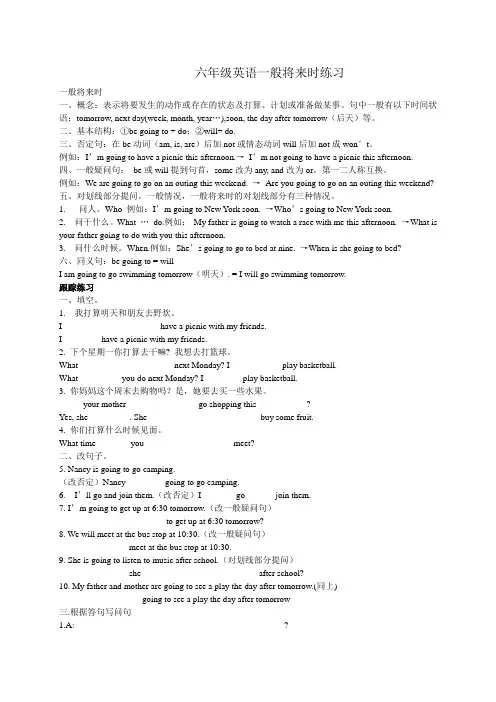
六年级英语一般将来时练习
一般将来时
一、概念:表示将要发生的动作或存在的状态及打算、计划或准备做某事。句中一般有以下时间状语:tomorrow, next day(week, month, year…),soon, the day after tomorrow(后天)等。
二、基本结构:①be going to + do;②will+ do.
三、否定句:在be动词(am, is, are)后加not或情态动词will后加not成won’t。
例如:I’m going to have a picnic this afternoon.→ I’m not going to have a picnic this afternoon.
四、一般疑问句: be或will提到句首,some改为any, and改为or,第一二人称互换。
例如:We are going to go on an outing this weekend. → Are you going to go on an outing this weekend?
五、对划线部分提问。一般情况,一般将来时的对划线部分有三种情况。
1. 问人。Who 例如:I’m going to New York soon. →Who’s going to New York soon.
2. 问干什么。What … do.例如: My father is going to watch a race with me this afternoon. →What is
your father going to do with you this afternoon.
3. 问什么时候。When.例如:She’s going to go to bed at nine. →When is she going to bed?
六、同义句:be going to = will
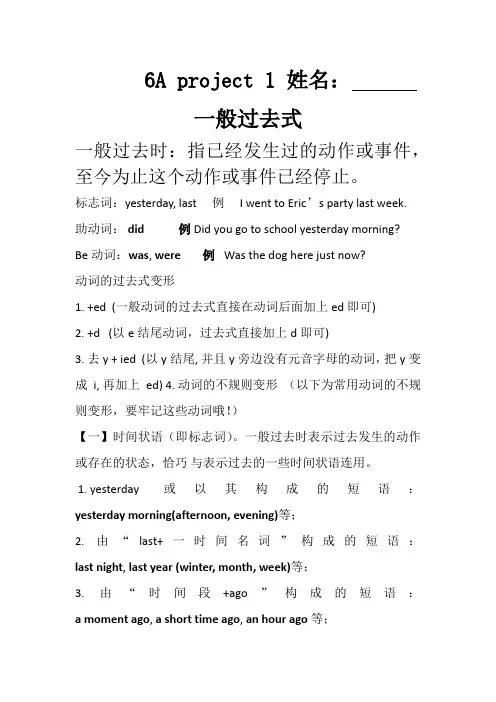
6A project 1 姓名:
一般过去式
一般过去时:指已经发生过的动作或事件,至今为止这个动作或事件已经停止。
标志词:yesterday, last 例 I went to Eric’s party last week.
助动词: did 例 Did you go to school yesterday morning?
Be动词:was, were 例 Was the dog here just now?
动词的过去式变形
1. +ed (一般动词的过去式直接在动词后面加上ed 即可)
2. +d (以e结尾动词,过去式直接加上d即可)
3. 去y + ied (以y结尾, 并且y旁边没有元音字母的动词,把y变成i, 再加上ed) 4. 动词的不规则变形 (以下为常用动词的不规则变形,要牢记这些动词哦!)
【一】时间状语(即标志词)。一般过去时表示过去发生的动作或存在的状态,恰巧 与表示过去的一些时间状语连用。
1. yesterday或以其构成的短语:yesterday morning(afternoon, evening)等;
2. 由“last+一时间名词”构成的短语:last night, last year (winter, month, week)等;
3. 由“时间段+ago”构成的短语:a moment ago, a short time ago, an hour ago等; 4. 其它:just now等
(含有实义动词的一般过去时态)
(1)一般过去时的肯定陈述句:
主语 + 动词过去式 + 宾语或表语。
He worked in Shanghai ten years ago.
(2)一般过去时的否定句:
a.主语 + didn’t + 动词原形 + 宾语。 (did + not =didn't)

一般过去时专项训练(二)
一、单项选择。
1. —____ he ____ a good rest? —No, he didn’t.
A. Do; had B. Did; have C. Did; had D. Was; had
2. —Where is the morning paper? —I ____ ____ it for you at once.
A. get B.am getting C.to get D.will get
3. He ____ very upset this week, he ____ better next week.
A. will be; is B. is; is C.will be; will be D.is; will be
4. —Shall I buy a cup of tea for you? —____
A. No, you won’t. B. No, you aren’t.
C. No, please don’t. D. No, please.
5. As soon as he ____, he ____ to his family.
A. arrived; writes B. arrived; wrote
C. arrived; written D. arrives; write
6. Mr. Black was late because he ____ his way.
A. losted B. lose C. loses D. lost
7. Will you please say it again? I ____ quite ____ you.