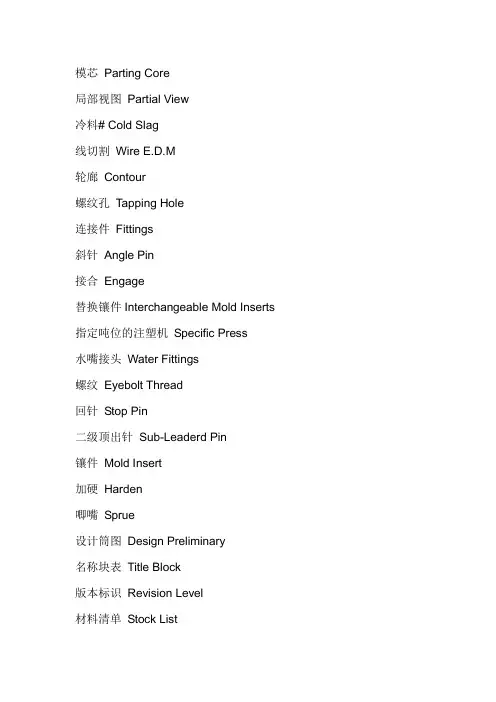
塑胶模具英文术语
- 格式:doc
- 大小:28.50 KB
- 文档页数:4
塑胶模具英文术语
1. "Cavity and Core in Plastic Mould. Y'all know, in a plastic
mould, the cavity is like the negative space that gives the outer
shape of the product, just like a mould for a chocolate bar. The
core, on the other hand, forms the inner part. For example, if we're
making a plastic cup, the cavity creates the outside look of the cup,
and the core shapes the inside so you can hold your drink. It's
super important to get these right!"
2. "Runner System. Oh my goodness! The runner system in a
plastic mould is like the highways for the molten plastic. It's the
channels that carry the plastic from the injection point to the
cavities. Imagine a water park, the runners are like the slides that
take the water (molten plastic in this case) to where it needs to go.
Let's say we're making small plastic toys, a well - designed runner
system ensures that the plastic gets evenly distributed to all the
cavities, making sure each toy comes out perfect."
3. "Gate in Plastic Moulding. Hey, you ever wondered how the
plastic gets into the cavity? That's where the gate comes in. It's like
the front door of a house for the plastic. If the gate is too small, it's like trying to squeeze a big elephant through a tiny mouse hole.
For instance, when making a large plastic panel, the right - sized
gate allows the plastic to flow smoothly into the cavity without
causing any defects."
4. "Ejection Mechanism. Well, this is a real lifesaver in plastic
moulds. It's like the gentle push that helps the finished plastic part
come out of the mould. It's like when you're trying to get a piece
of cake out of a pan, you need a little nudge. In a plastic mould for
a phone case, the ejection mechanism makes sure the case pops
out cleanly without getting stuck or damaged."
5. "Draft Angle. Oh, the draft angle! It's so crucial. Think of it as
the slope on a hill that helps things slide down easily. In a plastic
mould, it allows the part to be removed from the mould without
any hassle. For example, if we're making a conical - shaped plastic
container, having the right draft angle means it can be easily
ejected from the mould, just like a sled going down a well - sloped
hill."
6. "Mould Base. Now, the mould base is like the foundation of a
building for a plastic mould. It holds everything together. If the mould base is weak, it's like building a house on sand. When
making a complex plastic part like a gearbox housing, a strong and
stable mould base is essential to ensure the accuracy of the mould
and the quality of the final product."
7. "Cooling Channel. Oh boy, the cooling channel is like the air
- conditioner for the molten plastic. It cools down the plastic so it
can solidify quickly. Imagine baking a cake, if you don't let it cool
down properly, it'll be a mess. In plastic moulding, say for a plastic
bottle, the cooling channels ensure the plastic cools evenly and in
time, so the bottle has the right shape and strength."
8. "Parting Line. The parting line is a bit like the seam on a
piece of clothing. It's where the two halves of the mould meet. If
it's not well - defined or smooth, it's like having a crooked seam on
your favorite shirt. For example, when making a plastic figurine, a
clean parting line means the final product looks seamless and
professional."
9. "Insert Moulding. This is really cool! Insert moulding is like
adding special ingredients to a recipe. You put other components
(like metal inserts) into the mould and then the plastic surrounds them. It's like making a chocolate with a nut in the middle. If you're
making a tool handle with a metal core for extra strength, insert
moulding is the way to go."
10. "Shrinkage in Plastic Moulding. Shrinkage can be a bit of a
headache. It's like when you wash a wool sweater and it gets
smaller. In plastic moulding, different plastics shrink at different
rates when they cool. When making a large plastic tray,
understanding the shrinkage of the plastic used is key. Otherwise,
the tray might end up warped or not the right size.
In conclusion, understanding these plastic mould English terms
is not only important for those working directly in the plastic
moulding industry but also for anyone who wants to have a better
grasp of how plastic products are made. It's like learning a new
language that unlocks the secrets behind the everyday plastic
items we use."