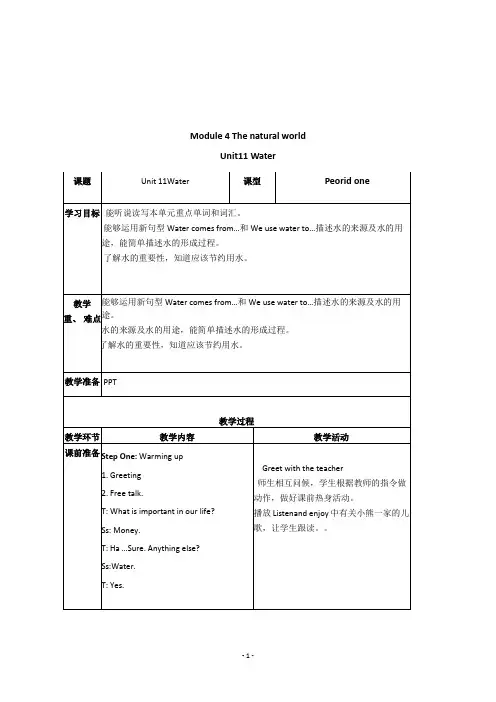
牛津沪教版英语五上Module 4 Unit 11 Water教案(公开课)
- 格式:doc
- 大小:31.50 KB
- 文档页数:4
Module 4
Unit 11 Water
教案
一、教学目标
1、本单元的主题是“水〞,教学中要充分利用“水〞这一话题,开展讨论,使学生了解水的重要性,提高学生节约用水的环保意识。
2、词汇方面是学习一些有关日常生活用品的英语表达:towel, soap, toothbrush, toothpaste„,学习介词with在句中的用法: wash with water 等等。
3、继续学习祈使句的英语表达法,学习用一般现在时描述日常进行的动作:I wash my hands
with water. I brush my teeth with toothpaste.
4、能认读字母Vv, Ww,掌握这两个字母在单词中的根本发音。
5.通过歌曲和游戏( A miming game ) 帮助学生进一步掌握祈使句和一般现在时的英语表达法。
二、重难点
1、围绕“水〞这一主题,让学生在学习过程中感知生活中处处离不开水,体会到水的重要性,并意识到必须从小事做起,养成节约用水的好习惯。在学习过程中提高学生环保意识。 2、能认读字母Vv, Ww,掌握这两个字母在单词中的根本发音。
3. 能够看图认读或拼读单词towel, soap, wash, dirty„,学习介词with在句中的用法: wash with
water „,初步了解turn on /off 与 open/close 的区别。
4、 能根据听到的口令做出正确的反响,并能让学生在特定的情景中运用祈使句表达一些简单的请 求与命令:Turn on the tap. Wash your towel„
5、 能用一般现在时描述日常进行的动作:I wash my hands with water. I brush my teeth with
toothpaste. This is the way I wash my face in the morning.
6、通过 “A miming game〞让学生听听、做做,在学习新知的同时,帮助学生归纳、整理以前所学的内容,将新、旧知识有机整合起来。
7、在歌曲的表演和改编过程中,在拓宽语言信息量的同时,培养学生的创新思维能力,开展学生的个性特长。
三、教学资源 现代技术支撑 录音机 电脑 实物投影机
四、教学过程
Step 1 Lead in
The first two natural elements —fire and electricity,and they have learned it in Grade 7.Can you
guess what it is? —It’s water.
Step 2 Warm up--- Revision
Review the use of water, using the sentence pattern: I/we use water to do„ I/we use water for
doing„
Step 3 Word study
Look for the new words Read aloud and try to find the new words.
Pairwork
Work in pairs to get the meaning of the new words Presentation The teacher will give
explanation of some key words and phrases, such as view, speed, impatient,pour into, speed down,
look round etc..
Practice
Some exercises about the new words The purpose is to input some phrases and words and let the
students master them..
小结与作业
背诵单词和句子
用英语向父母介绍水,用水,节约水。
第二课时
一、教学重点
词汇:grandparents,grandfather,grandmother,parent,uncle,aunt,cousin
二、教学栏目
Look and learn, Culture corner
三、教学目标 1. 帮助学生学习Look and learn中表示家庭成员的生词。
2. 通过Culture corner,帮助学生意识到英语国家对亲属的称谓特点。
3. 通过家谱的制作和介绍,帮助学生稳固词汇学习,结合句型I have ... This is my ...介绍家庭成员。
四、教学步骤
Pre-task preparations
1.利用多媒体播放一首有关家庭成员的儿歌,请学生欣赏。播放儿歌的同时,出示单词卡片aunt,uncle和cousin。
2.出示Look and learn中Jill的家谱,指着图片中的Jill的父母提问,帮助学生复习学过的
表示家庭成员的单词。
T: (point to Jill’s father in the picture) Who is he?
Ss: He is Jill’s father.
While-task procedures
1.出示Look and learn中Jill的家谱,指着图片中的其他家庭成员逐一介绍或自问自答,引
出生词grandfather,grandmother等。然后出示单词卡片,让学生跟读和拼读。
T: (point to Jill’s grandfather) Who is he? He’s Jill’s father’s father. He’ s Jill’ s grandfather (show
the flashcard for grandfather) Grandfather. G-R-A-N-D-F-A-T-H-E-R, grandfather.
Ss: Grandfather. G-R-A-N-D-F-A-T-H-E-R, grandfather.
然后,指着家谱图中的人物图片说单词,让学生快速反响。
T: (point to Jill’s aunt) Uncle?
Ss: No. Aunt. A-U-N-T, aunt.
2.在黑板上画出Jill的家谱图,请学生上来把单词卡片贴在适当的位置上,贴完之后让全班一起拼读单词。接着教师介绍Jill的家庭成员。
T: (point to the family tree) Jill has one uncle. His name’s John. He’ s Jill’s mother’s brother ...
然后要求学生扮演Jill,并用学过的句型I have ... His/Her name’s ...介绍Jill的家庭成员,帮助学生理解家庭成员之间的关系。
S1: I’m Jill. I have one cousin. His name’s Dan.最后,让学生看Culture corner,引导他们发 现中英文的区别:在英语中cousin既可以指“堂兄弟,表兄弟〞,也可以指“堂姐妹,表姐
妹〞,因此要注意根据实际情况选择代词he或she。让学生了解中外亲属称谓的差异:中国对亲属称谓划分较细,英语国家对亲属的称谓比拟笼统。
3.在黑板上画出你的家谱,边画边向学生介绍你的家庭成员,告诉学生你有几个叔叔、阿
姨、侄子、外甥等。
T: Look! I have three cousins.They are Jerry, Mark and Susan. I have two uncles. Who are they?
Ss: They’re ... and ...
接着请个别学生借助照片介绍自己的家庭成员。
S1: I’m ... This is my family. I have ... His/Her name’s ... He’s/She’s ...
4.出示一个大家庭的家谱,并给家谱中每位成员写上姓名,要求学生在小组内仿照之前学
的儿歌用chant形式做问答练习。
S1: Who is that? Who is that? Is he your uncle? Yes or no?
S2: (act as one family member) He’s Jack. He’s Jack.
Yes, he is. He’s my uncle Jack.
Post-task activities
1.小组活动。将学生分为四人一组。要求学生在纸上画出各自的家谱。在小组内交流各自
的家谱图,并互相介绍家庭成员。
S1: This is my family tree. I have two uncles. They’re ...
2.学生记录同组某个同学的家庭成员(主要是uncle,aunt,cousin)信息,向其他学生介绍。
S2: (show S1’s family tree) Look, this is (S1’s name)’s family tree. He/She has
uncle(s)/aunt(s)/cousin(s). His/Her name’s ...