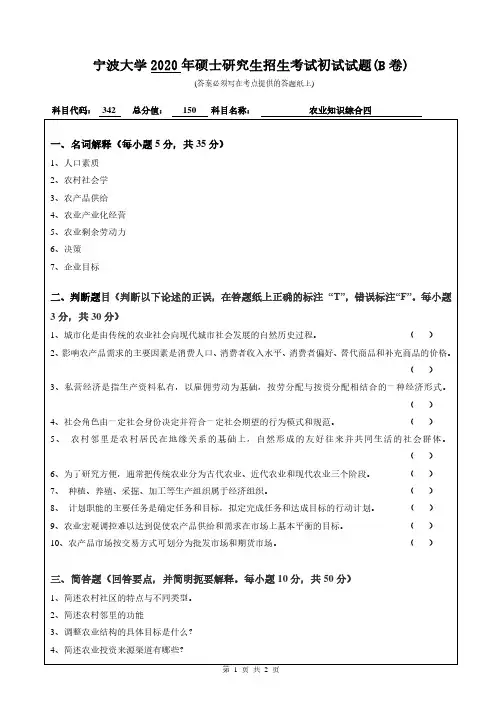
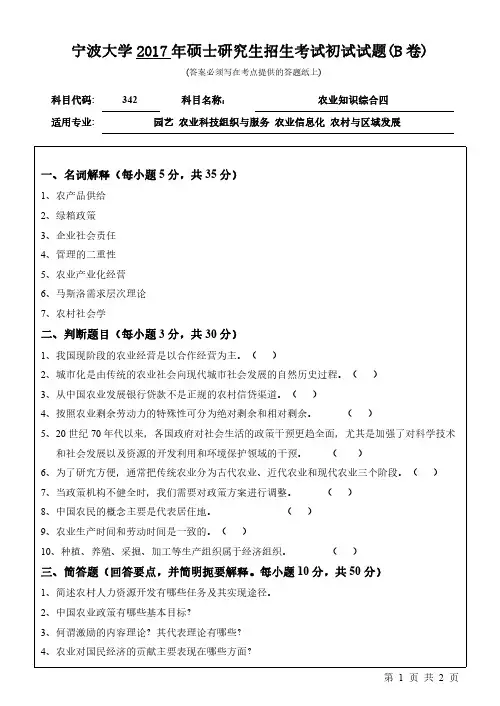
宁波大学2017年《342农业知识综合四》考研专业课真题试卷
- 格式:pdf
- 大小:1.92 MB
- 文档页数:2


2017年浙江宁波大学农业知识综合考研真题农业知识综合一一、营养生理(75 分)1、请解释“木桶效应”,该效应对生产实际有何指导意义?(10 分)2、分析影响维生素稳定性的主要因素有哪些?(15 分)3、渔用配合饲料与畜禽配合饲料的异同。
(15 分)4、详述蛋白质营养价值评定方法。
(10 分)5、写出能量代谢流程图。
(15 分)6、翻译(10 分)Lipid is one of the important nutrients for mollusks, especially at larval and juvenile stages, have also been demonstrated (Delaunay et al., 1991; Marty et al., 1992; Robinson, 1992; Mai et al., 1995). Lipid provides the source of energy, essential fatty acids (EFA) and other lipid classes like phospholipids and sterols and fat-soluble vitamins (Watanabe, 1982). Knowledge of the protein sparing effects of non-protein nutrients such as lipids or carbohydrates are necessary and should be used to reduce feed costs and limit ammonia production (Vergara et al., 1999). Meanwhile, excessive energy in diets can lead to decrease feed consumption (especially protein and other nutrients intake) and reduced growth (Ellis and Reich, 1991). Lipid in mollusk larvae have been used as an index for monitoring their physiological and nutritional status, and potential for successful metamorphosis (Gallager et al., 1986). However, information on the quantitative requirement of dietary lipid and its utilization in mollusk is mainly focus on the abalone. The optimal dietary lipid level of mollusk species, such as Haliotis discus hannai (皱纹盘鲍) (Uki et al., 1985; Mai et al., 1995), Haliotis tuberculata (L) (欧洲疣鲍)(Mai et al., 1995) had been demonstrated.二、动物繁殖学(75 分)1、名词解析(4 题,每题 5 分,共 20 分)(1)稚鱼(2)鱼种(3)担轮幼虫(4)面盘幼虫2、简答题(3 题,每题 10 分,共 30 分)(1)影响鱼类性腺发育的因素有哪些?(2)简述鱼类的卵巢分期及各期特点。