人教版一年级上册英语知识点汇总
- 格式:pdf
- 大小:134.35 KB
- 文档页数:5
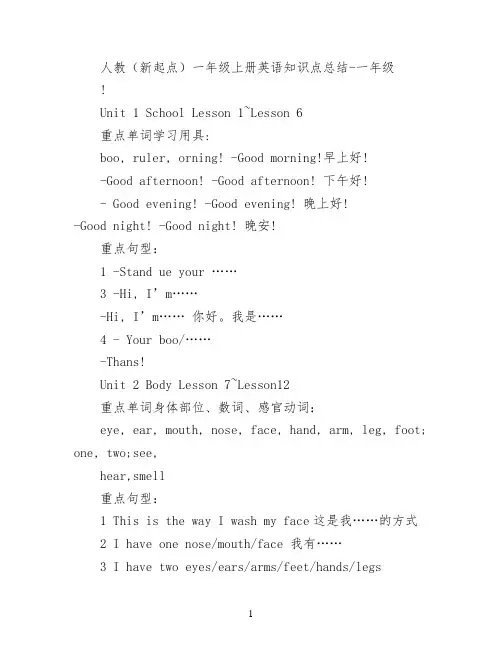
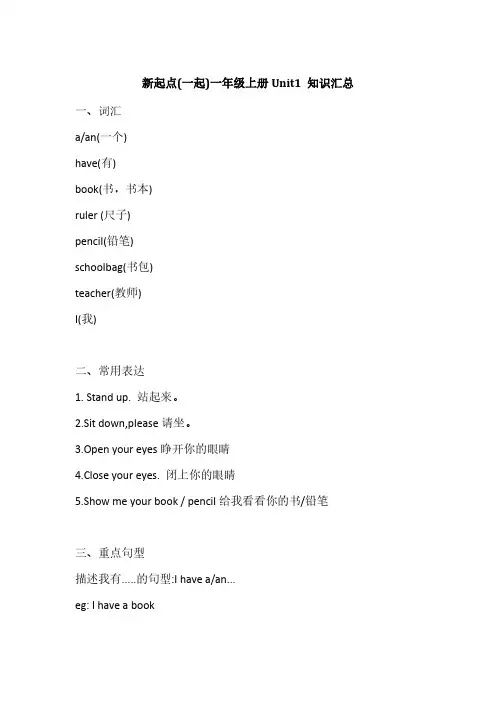
人教版一年级上册英语知识点汇总一、词汇积累1.学习用具•book(书)•ruler(尺子)•pencil(铅笔)•pencil case(铅笔盒)•eraser(橡皮)•backpack(背包)2.问候语•Hello/Hi(你好)•Good morning(早上好)•Good afternoon(下午好)•Good evening(晚上好)•Good night(晚安)3.身体部位•eye(眼睛)•ear(耳朵)•mouth(嘴巴)•nose(鼻子)•face(脸)•hand(手)•arm(手臂)•leg(腿)•foot(脚)4.数词•one(一)•two(二)•three(三)•four(四)•five(五)•six(六)•seven(七)•eight(八)•nine(九)•ten(十)5.动物•cat(猫)•bird(鸟)•rabbit(兔子)•dog(狗)•duck(鸭子)•monkey(猴子)•chicken(小鸡)•tiger(老虎)•panda(熊猫)•elephant(大象)•fish(鱼)•butterfly(蝴蝶)6.颜色•red(红色)•yellow(黄色)•purple(紫色)•brown(棕色)•orange(橙色)•white(白色)•green(绿色)•pink(粉色)•blue(蓝色)•black(黑色)7.水果•banana(香蕉)•apple(苹果)•peach(桃子)•melon(瓜)•pear(梨)•orange(橙子)•grape(葡萄)•strawberry(草莓)•pineapple(菠萝)8.其他常用词汇•here(这里)•there(那里)•call(呼叫)•give(给)•sorry(对不起)•big(大的)•small(小的)•old(老的)•sweet(甜的)•come(来)•along(一起)•eleven(十一)•want(想要)•help(帮助)•find(找到)•teacher(老师)•schoolbag(书包)•I have a/an(我有一个)二、句型掌握1.日常问候•Stand up, please.(请起立。)•Sit down, please.(请坐下。)•Hi, I’m…(你好,我是……)•Your book…(你的书……)•Thanks!(谢谢!)2.身体部位•This is the way I wash my face.(这是我洗脸的方式。)•I have one nose/mouth/face.(我有一个鼻子/嘴巴/脸。)•I have two eyes/ears/arms/feet/hands/legs.(我有两只眼睛/耳朵/手臂/脚/手/腿。)•My eyes can see.(我的眼睛能看见。)•My mouth can talk.(我的嘴巴能说话。)•My ears can hear.(我的耳朵能听见。)•My nose can smell.(我的鼻子能闻到。)•What’s this?(这是什么?)•It’s the head.(它是头。)•Touch your eyes/mouth/ears/arm…(摸你的眼睛/嘴巴/耳朵/手臂……)3.动物•Are you Joy?(你是Joy吗?)•No, I’m Lily. I’m a cat.(不,我是Lily。我是一只猫。)•What do you see?(你看见了什么?)•I see a panda/a bird/a monkey……(我看见了一只熊猫/一只鸟/一只猴子……)•Look at me!(看着我!)•What’s this?(这是什么?)•It’s a cat/a tiger/a bird……(它是一只猫/一只老虎/一只鸟……)•It has long ears/short legs/big eyes……(它有长耳朵/短腿/大眼睛……)•I like my……(我喜欢我的……)4.其他常用句型•Here is my hair/pencil/book/eraser/ruler……(这是我的头发/铅笔/书/橡皮/尺子……)•Look at my big eyes/small face(看我的大眼睛/小脸)•I see a rabbit/bird……(我看见了一只兔子/一只鸟……)Me too.(我也是。)•See/hear/call the bird.(看/听/呼叫那只鸟。)•Give me your tail please?(请给我你的尾巴。)•Sorry, it’s too long/short/big.(对不起,它太长了/太短了/太大了。)•Look, there it is.(看,它在那里。)•How old are you?(你多大了?)•I’m one/two/three/four/five/six/seven/eight/nine/ten.(我……岁了。)•One and one is two.(1+1=2)•Five and five is always ten.(5+5=10)•Let’s make ten!(让我们数到10!)•What’s your telephone number?(你的电话号码是多少?)•What’s your room number?(你的房间号是多少?)•Here are some chocolates for you.(给你们些巧克力。)•Thank you!(谢谢!)•What colour is it?(它是什么颜色?)•It’s pink/white……(它是粉色/白色……)•How many birds can you see?(你能看见多少只鸟儿?)•Three.(三只。)•What colour do you like?(你喜欢什么颜色?)•I like blue/red/pink……(我喜欢蓝色/红色/粉色……)•May I have two apples, please?(我可以要两个苹果吗?)•Here you are.(给你。)•Thank you.(谢谢。)•What do you draw here?(你在这里画了什么?)•One banana.(一个香蕉。)•A gift for you.(给你的礼物。)•Thank you.(谢谢。)•What is it?(这是什么?)•It’s a book.(它是一本书。)•Do you like…?(你喜欢……吗?)•Yes, I do./No, I don’t.(是的,我喜欢。/不,我不喜欢。)三、语法知识1.一般现在时•表示经常发生的动作或事情,常用“usually(通常)”、“often(常常)”、“every…(每……)”、“sometimes(有时)”、“always(总是)”等词。•基本结构:主语+动词原形或动词第三人称单数形式。•否定句:主语+don’t/doesn’t+动词原形。•一般疑问句:Do/Does+主语+动词原形?•特殊疑问句:What do/does+主语+动词原形?•动词第三人称单数形式:一般情况下加-s,如walk-walks;辅音字母+y结尾y去加-ies,如fly-flies;结尾是s, x, sh, ch加-es,如watch-watches;结尾是o加-es,如do-does, go-goes;特殊词have-has。2.现在进行时•表示正在发生的动作,常用“now(现在)”、“look(看)”、“listen(听)”等词。•基本形式:be+动词-ing。3.一般过去时•表示过去已经发生的事情,常用“last…(上一个……)”、“just now(刚才)”、“many years ago(许多年前)”、“yesterday(昨天)”等词。•be动词的过去式:am/is-was,are-were。•肯定句:主语+动词过去式。•否定句:主语+didn’t+动词原形。•一般疑问句:Did+主语+动词原形?