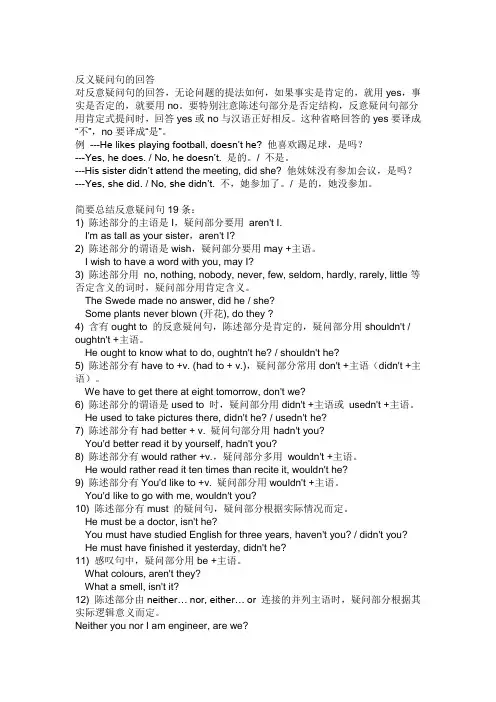
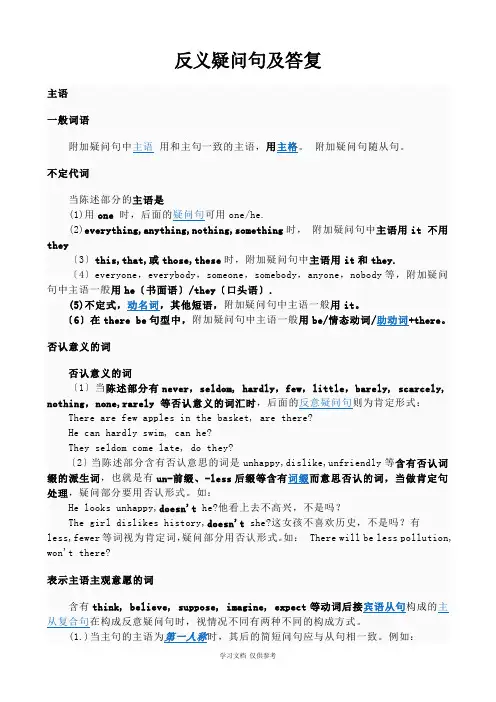
反义疑问句结构及回答
- 格式:doc
- 大小:16.28 KB
- 文档页数:9
反义疑问句结构及回答
英文回答:
Tag Questions.
Tag questions are short questions that are added to the
end of a statement to confirm or negate the speaker's
assumption about the statement. They are typically formed
by adding an auxiliary verb and a pronoun that agrees with
the subject of the statement. For example:
"You're going to the store, aren't you?"
"She doesn't like coffee, does she?"
Structure.
The structure of a tag question follows this pattern:
Statement + Auxiliary verb + Pronoun.
The auxiliary verb is chosen based on the tense and
polarity of the statement. For positive statements, the
auxiliary verb will be "do" or "does" in the present tense,
and "did" in the past tense. For negative statements, the
auxiliary verb will be "don't" or "doesn't" in the present
tense, and "didn't" in the past tense.
The pronoun should agree with the subject of the
statement. For example, if the subject of the statement is
"I," the pronoun will be "I."
Use.
Tag questions are used in a variety of situations,
including:
To confirm a speaker's assumption: "You're going to
the store, aren't you?"
To negate a speaker's assumption: "She doesn't like
coffee, does she?"
To express surprise or disbelief: "You're really going
to jump out of a plane, aren't you?"
To emphasize a point: "This is the best movie I've
ever seen, isn't it?"
Answers.
The answer to a tag question is typically either "yes"
or "no," depending on whether the tag question is
confirming or negating the statement.
If the tag question is confirming, the answer is
typically "yes." For example:
"You're going to the store, aren't you?" Yes, I am.
If the tag question is negating, the answer is
typically "no." For example:
"She doesn't like coffee, does she?" No, she doesn't.
Exceptions.
There are a few exceptions to the general rules for
forming tag questions. These exceptions include:
Statements with modal verbs: For statements with modal
verbs (such as "can," "could," "may," "might," etc.), the
auxiliary verb in the tag question is "will." For example:
"You can swim, can't you?"
Statements with "there is" or "there are": For
statements with "there is" or "there are," the auxiliary
verb in the tag question is "there." For example:
"There is a book on the table, isn't there?"
Statements with negative words: For statements with
negative words (such as "not," "never," "hardly," etc.),
the auxiliary verb in the tag question is positive. For example:
"I don't like to dance, do I?"
Intonation.
The intonation of a tag question can convey the
speaker's attitude towards the statement. For example, a
tag question with rising intonation can sound like a
request for confirmation, while a tag question with falling
intonation can sound like a statement of fact.
中文回答:
反义疑问句。
反义疑问句是指在陈述句的末尾附加一个简短的问题,以确认或否定说话者对陈述句的假设。它们通常通过添加一个助动词和一个与陈述句主语一致的代词来形成。例如:
“你去商店,是不是?”。
“她不喜欢咖啡,是吗?”。
结构。
反义疑问句的结构遵循以下模式:
陈述句 + 助动词 + 代词。
助动词的选择取决于陈述句的时态和极性。对于肯定陈述句,助动词将是现在时的“do”或“does”,过去时的“did”。对于否定陈述句,助动词将是现在时的“don't”或“doesn't”,过去时的“didn't”。
代词应与陈述句的主语一致。例如,如果陈述句的主语是“我”,则代词将是“我”。
用法。
反义疑问句用于各种场合,包括:
确认说话者的假设,“你去商店,是不是?”。
否定说话者的假设,“她不喜欢咖啡,是吗?”。
表达惊讶或怀疑,“你要跳飞机,真的吗?”。
强调一点,“这是我看过的最好的电影,不是吗?”。
回答。
反义疑问句的回答通常是“是”或“否”,这取决于反义疑问句是确认还是否定陈述句。
如果反义疑问句是确认,则回答通常是“是”。例如:
“你去商店,是不是?”是的,我是。
如果反义疑问句是否定,则回答通常是“否”。例如:
“她不喜欢咖啡,是吗?”不,她不喜欢。
例外。
反义疑问句的形成有一些例外。这些例外包括:
带情态动词的陈述句:对于带情态动词(如“can”、“could”、“may”、“might”等)的陈述句,反义疑问句中的助动词是“will”。例如:
“你会游泳,是不是?”。
带“there is”或“there are”的陈述句:对于带“there
is”或“there are”的陈述句,反义疑问句中的助动词是“there”。例如:
“桌上有本书,是不是?”。
带否定词的陈述句:对于带否定词(如“not”、“never”、“hardly”等)的陈述句,反义疑问句中的助动词是肯定的。例如:
“我不喜欢跳舞,是不是?”。
语调。
反义疑问句的语调可以传达说话者对陈述句的态度。例如,语