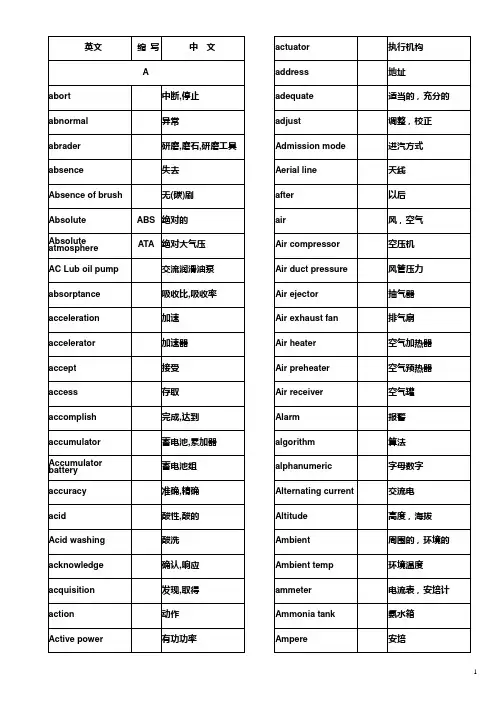
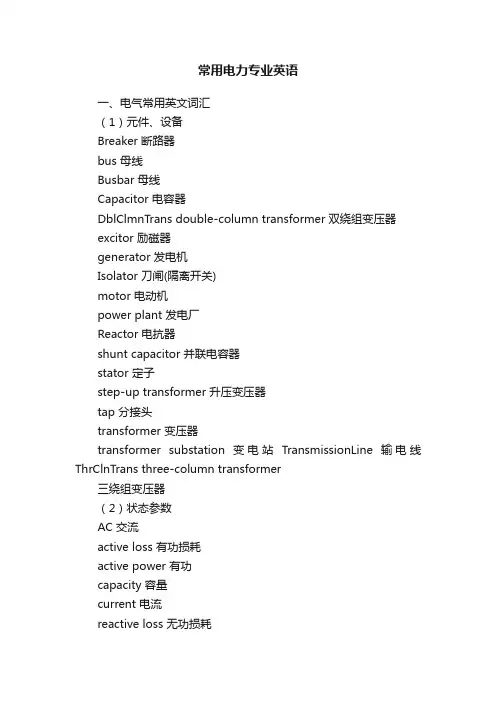
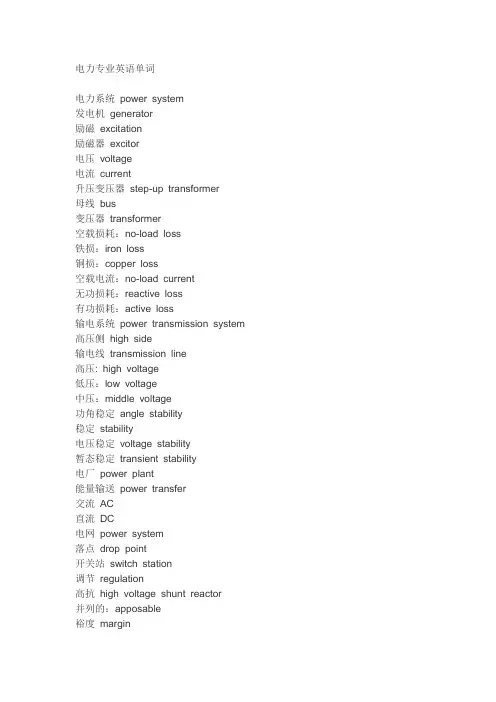
电力专业英语
- 格式:docx
- 大小:36.74 KB
- 文档页数:2
电力专业英语
The field of electrical engineering is vast, encompassing
everything from power generation to the intricate wiring of a
microchip. It's a world where the language of voltage and
current is as essential as any spoken tongue.
In the classroom, the language of electricity is taught
through a specialized lexicon that includes terms like
"ohms," "watts," and "amperes." Understanding these terms is
crucial for anyone looking to excel in the field.
As we delve deeper into the subject, we encounter more
complex concepts such as "alternating current" and "direct
current," each with its own set of rules and applications.
The mastery of these principles is key to designing efficient
electrical systems.
Professionals in the industry must also be adept at
reading and interpreting schematics, which are the blueprints
of electrical systems. These diagrams use a unique set of
symbols to represent different components.
Safety is paramount in this industry, and the language of
electrical safety includes phrases like "lockout/tagout" and
"grounding," which are essential for preventing accidents in
the workplace.
Innovation in the electrical sector is driven by the development of new technologies and materials. Terms like
"semiconductor" and "superconductor" are at the forefront of
this cutting-edge research.
Finally, the language of sustainability is becoming
increasingly important, with terms like "renewable energy"
and "smart grid" shaping the future of electrical engineering
and its impact on the environment.
In conclusion, the language of electrical engineering is
as diverse as the field itself, offering a rich vocabulary
for those who wish to explore its depths and contribute to
its ongoing evolution.