
高中英语语法代词PPT课件
- 格式:ppt
- 大小:1.12 MB
- 文档页数:107
代 词
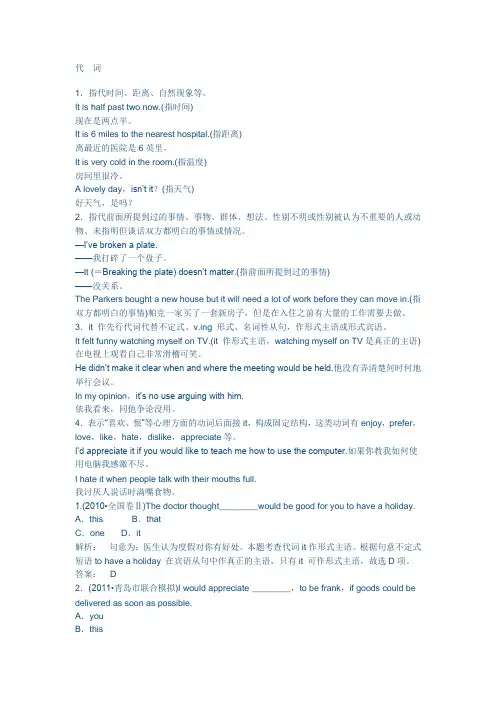
1.指代时间、距离、自然现象等。
It is half past two now.(指时间)
现在是两点半。
It is 6 miles to the nearest hospital.(指距离)
离最近的医院是6英里。
It is very cold in the room.(指温度)
房间里很冷。
A lovely day,isn’t it?(指天气)
好天气,是吗?
2.指代前面所提到过的事情、事物、群体、想法、性别不明或性别被认为不重要的人或动物、未指明但谈话双方都明白的事情或情况。
—I’ve broken a plate.
——我打碎了一个盘子。
—It (=Breaking the plate) doesn’t matter.(指前面所提到过的事情)
——没关系。
The Parkers bought a new house but it will need a lot of work before they can move in.(指双方都明白的事情)帕克一家买了一套新房子,但是在入住之前有大量的工作需要去做。
3.it 作先行代词代替不定式、v.ing 形式、名词性从句,作形式主语或形式宾语。
It felt funny watching myself on TV.(it 作形式主语,watching myself on TV是真正的主语)
在电视上观看自己非常滑稽可笑。
He didn’t make it clear when and where the meeting would be held.他没有弄清楚何时何地举行会议。
In my opinion,it’s no use arguing with him.
依我看来,同他争论没用。
4.表示“喜欢、恨”等心理方面的动词后面接it,构成固定结构,这类动词有enjoy,prefer,love,like,hate,dislike,appreciate等。
高中英语语法知识——代词
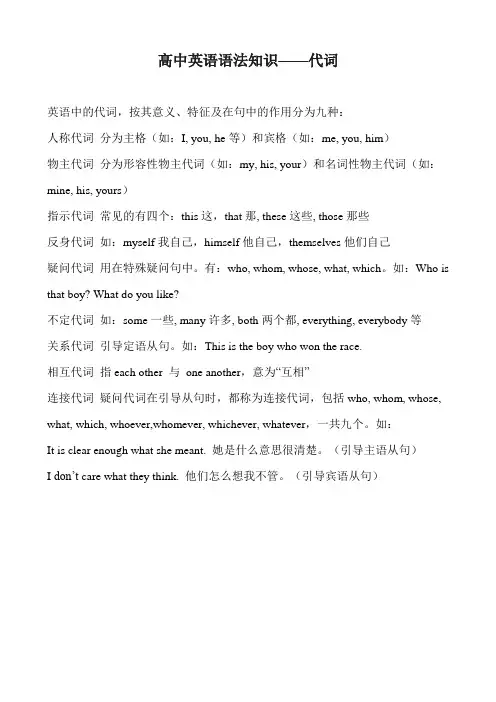
英语中的代词,按其意义、特征及在句中的作用分为九种:
人称代词 分为主格(如:I, you, he等)和宾格(如:me, you, him)
物主代词 分为形容性物主代词(如:my, his, your)和名词性物主代词(如:mine, his, yours)
指示代词 常见的有四个:this这,that那, these这些, those那些
反身代词 如:myself我自己,himself他自己,themselves他们自己
疑问代词 用在特殊疑问句中。有:who, whom, whose, what, which。如:Who is
that boy? What do you like?
不定代词 如:some一些, many许多, both两个都, everything, everybody等
关系代词 引导定语从句。如:This is the boy who won the race.
相互代词 指each other 与 one another,意为“互相”
连接代词 疑问代词在引导从句时,都称为连接代词,包括who, whom, whose,
what, which, whoever,whomever, whichever, whatever,一共九个。如:
It is clear enough what she meant. 她是什么意思很清楚。(引导主语从句)
I don’t care what they think. 他们怎么想我不管。(引导宾语从句) 第1讲
人称代词
第2讲 指示代词
人称代词分为主格和宾格。
考点1. 代词作同位语
如果代词和名词指代相同时,常用主格或宾格作同位语,不用物主代词。改错:Our Chinese people are friendly. 把our改为we, 因为我们本身就是中国人。
考点2. 用人称代词宾格代替主格的情况

1 第三讲代词
代词主要分为以下几类:人称代词、物主代词、反身代词、相互代词,指示代词, 疑问代词, 不定代词。大多数代词具有名词和形容词的作用。
1、人称代词
(1)在比较级的句子中than、as后用主格、宾格都可以。如:He is taller than me(I).但在下列句中有区别。(2)两个以上的人称代词并列,其次序排列原则:
在并列主语中,“I”总是放在最后,排列顺序为:二 三 一(人称)。宾格me也一样。
You ,she and I will be in charge of the case.
Mr.Zhang asked Li Hua and me to help him.
(3)she可以代表国家、船只、大地、月亮等。
The “Titanic”was the largest, wasn’t she?
(4) it 指代baby
Look at that baby. It's lovely.
(5) It 作形式主语
It is wrong to build a chemical factory here.
2.物主代词
(1)one’s own…=...of one’s own句式的转换。 do sth. on one's own= do sth
by oneself
(2)某些固定结构中常用定冠词代替物主代词。
如: take sb. by the arm
3.反身代词
(1)反身代词的语法功能:宾语、表语、主语或宾语的同位语。 2 (2)反身代词和某些动词连有,构成固定短语。
enjoy oneself, feel oneself, make oneself at home, make oneself understood
adapt oneself to seat oneself devote oneself to sth
4.指示代词(this, that , these, those, such, )

1 代词(一)
Part 1 人称代词
人称代词是表示"我"、"你"、"他"、"她"、"它"、"我们"、"你们"、"他们"的词。是表示自身或人称的代词。
1 人称代词有人称、数和格的变化,见下表:
单数 复数
主格 I you he she it we you they
宾格 me you him her it us you them
中文 我 你 他 她 它 我们 你们 他/她/它们
2人称代词的用法
(1) 人称代词在句中可以用作主语(用主格)和宾语(用宾格):
He loves her, but she hates him.
(2) 人称代词用于as, than之后时,可用宾格:
“Who is it?” “It’s me.”
He gets up earlier than me.
He speaks English as well as her.
但是,若than, as后的人称代词后跟由动词,则必须用主格:He gets up earlier than I do.
(3)单独使用的人称代词通常用宾格:me too.
3 人称代词的排列顺序
人称代词的排列顺序为:
(1) 单数人称代词通常按“二三一”排列,即you, he and I:
You, he and I are all middle school students.
(2) 复数人称代词通常按“一二三”排列,即we, you and they:
We, you and they will all go there.
(3) 但若用于承担责任或错误等场合,则可把第一人称I置于其他人称代词之前:
I and Tom are to blame.
Part 2 物主代词
表示所有关系的代词叫做物主代词。
1 物主代词可分为形容词性物主代词和名词性物主代词两种。列表如下: