冠词与介词的用法讲解及练习
- 格式:doc
- 大小:93.00 KB
- 文档页数:5
冠词与介词的用法讲解
一、冠词分类及其用法
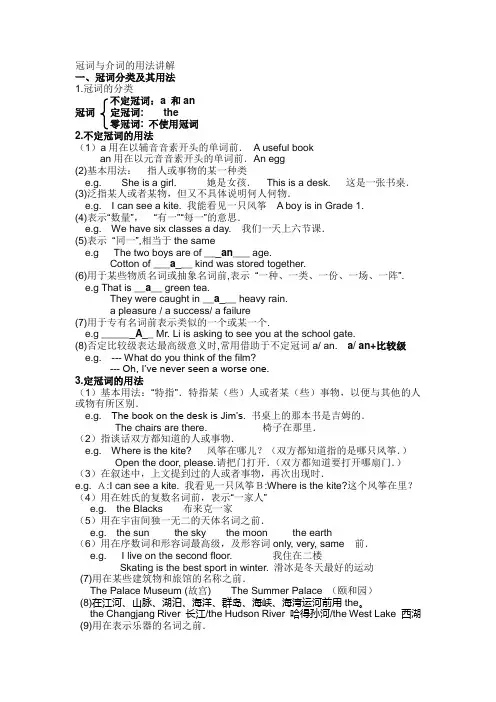
1.冠词的分类
不定冠词:a 和an
冠词 定冠词: the
零冠词: 不使用冠词
2.不定冠词的用法
(1)a用在以辅音音素开头的单词前. A useful book
an用在以元音音素开头的单词前.An egg
(2)基本用法: 指人或事物的某一种类
e.g. She is a girl. 她是女孩. This is a desk. 这是一张书桌.
(3)泛指某人或者某物,但又不具体说明何人何物.
e.g. I can see a kite. 我能看见一只风筝 A boy is in Grade 1.
(4)表示“数量”, “有一”“每一”的意思.
e.g. We have six classes a day. 我们一天上六节课.
(5)表示 “同一”,相当于the same
e.g The two boys are of ___an___ age.
Cotton of ___a___ kind was stored together.
(6)用于某些物质名词或抽象名词前,表示 “一种、一类、一份、一场、一阵”.
e.g That is __a__ green tea.
They were caught in __a___ heavy rain.
a pleasure / a success/ a failure
(7)用于专有名词前表示类似的一个或某一个.
e.g ______A__ Mr. Li is asking to see you at the school gate.
(8)否定比较级表达最高级意义时,常用借助于不定冠词a/ an. a/ an+比较级
e.g. --- What do you think of the film?
--- Oh, I’ve never seen a worse one.
3.定冠词的用法
(1)基本用法:“特指”.特指某(些)人或者某(些)事物,以便与其他的人或物有所区别.
e.g. The book on the desk is Jim’s. 书桌上的那本书是吉姆的.
The chairs are there. 椅子在那里.
(2)指谈话双方都知道的人或事物.
e.g. Where is the kite? 风筝在哪儿?(双方都知道指的是哪只风筝.)
Open the door, please.请把门打开.(双方都知道要打开哪扇门.)
(3)在叙述中,上文提到过的人或者事物,再次出现时.
e.g. A:I can see a kite. 我看见一只风筝B:Where is the kite?这个风筝在里?
(4)用在姓氏的复数名词前,表示“一家人”
e.g. the Blacks 布来克一家
(5)用在宇宙间独一无二的天体名词之前.
e.g. the sun the sky the moon the earth
(6)用在序数词和形容词最高级,及形容词only, very, same 前.
e.g. I live on the second floor. 我住在二楼
Skating is the best sport in winter. 滑冰是冬天最好的运动
(7)用在某些建筑物和旅馆的名称之前.
The Palace Museum (故宫) The Summer Palace (颐和园)
(8)在江河、山脉、湖泊、海洋、群岛、海峡、海湾运河前用the。
the Changjang River 长江/the Hudson River 哈得孙河/the West Lake 西湖
(9)用在表示乐器的名词之前. e.g. play the violin play the piano
(10)用在一些习惯用语中
e.g. in the day
in the morning / afternoon/ evening
the day before tomorrow/ yesterday
the next morning / week/ month/ year
in the sky/ water/ field/ country
4.零冠词的用法
(1)名词前有了物主代词、指示代词、不定代词和“S”所有格时。
e.g. Our books those apples Jim’s pen
(2)复数名词在表示一类人或者事物时。
e.g. They are teachers. 他们是老师。
(3)在专有名词前 e.g. China England
(4)在星期、月份、带day的节日前
e.g. on Sunday in August on Children’s Day /woman’s day 请区别:in the spring of 1945 (特指,加the )
(5)三餐前不加冠词,但特指须加,有时也可以加a 表示一顿。
e.g. have supper
What do you usually have for lunch?
We had a really good dinner.(特指)
(6)在一些固定搭配中
e.g. at night, go to school ,at table ,by bike,at work,go to bed
at school,at home, watch TV,play football/ basketball
(7)表示独一无二的职位、职务的名词用作表语、同位语或补足语时,常见名词有president, chairman, mayor, head, boss, secretary, leader, monitor等。
e.g. He was made monitor yesterday.
(8)表示交通工具的名词与by连用.
当bike,car,taxi,bus,train,foot,ship等与介词by连用,表示一种交通手段是,不用the。
e.g.Did you come back by plane or by train?
注意:还有by water,by land,by sea,by air,on foot,On horse back
等。但take a bus,on the bike, in a boat等需加冠词。
(9)两个名词同指一个人或事物时,后面的名词前不用冠词.
e.g The teacher and writer has come to the meeting.
(10)表示颜色、语种、国家前不用冠词
* in purple紫色 * in red * in English /Chinese *in Britain
二、介词的用法
1.时间介词in/ at/ on
(1)介词in表示较长时间如:世纪、年代 、年份、月份、季节、上午/下午/晚上以及一些习惯用法。e.g. in 1999 /in Winter/in the morning
(2)介词at表示某一时间点如:钟点、年龄、中午/夜晚/子夜、就餐时间或其它的习惯用法。 e.g. at 2:30/at the age of 25/at midday/At dinner time
(3)介词on表示某一天或者特定的时间如:星期、某月某日、某年某月某日、含Day的节日、有修饰上午/下午/晚上以及一些习惯用法。
2.地点介词in /on /at
In [表示地点、场所、位置等]在…里面;在…内部;在…上:例句: in the room
on 在…表面上,在…之上:例句: a glass on the desk
at [表示存在或出现的地点、场所、位置、空间]在(某地),在…里;在…上;
在…旁,接近…,靠近(某处):例句: at home 在家 at the office 在办公室 over 在……的正上方,垂直上方,不接触表面
above 在……上方,不强调是否垂直
练习:
1.Look! There is a bridge __the river.
A. on B. over C. above
2.Can you see the egg ___ the plate?
A. on B. at C. over
3.We live ___ a small bookstore.
A. on B. over C. above
5.The sun rose ___the horizon(地平线).
A. on B. above C. over
注意: on 接触平面 over 在平面的正上方 above 在上方
under 在……正下方(是on, over的反义词)
below 在……下方,不强调垂直,是above的反义词
6. The temperature will fall__ zero at night.
A. below B. above C. over
7.They were playing chess __ the tree.
A. on B. above C. Under
注意:in front of 是在物体外部的前面
in the front of 是在物体内部的前面
e.g. There is a garden in front of the classroom. 教室前有个花园。
There is a desk in the front of the classroom. 教室前有张桌子。
3.运动介词
through 从内部穿过 across 横穿 up 向上 down 向下
over 越过 round 环绕 ,在……周围
4.方位介词 in/on/to
①.如果前者在后者的范围之内,则用in
e.g. Shanghai lies in the east of China.