
The Middle Ages
- 格式:ppt
- 大小:1.98 MB
- 文档页数:15

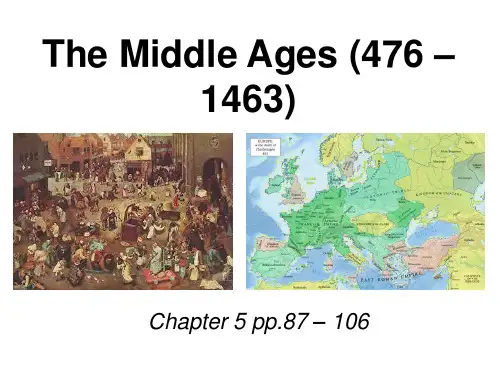

第三章中世纪文明The Middle Ages西欧中世纪:476年西罗马灭亡作为开端,至1453年奥斯曼土耳其攻占君士坦丁堡;另一说是1500年,吴于廑先生“海道大通”中世纪的欧洲文明,实质上是一种地域性的封建文明基督教构成了欧洲中世纪精神文化的核心封建西欧的历史分早、晚两个时期:1.封建文明形成与发展时期(5-14世纪)2.封建文明趋向没落、资本主义工业文明萌芽时期(15-17世纪)第一节西欧封建文明的萌发一、欧亚大陆的民族大迁徒3-5世纪,游牧世界对农耕世界大冲击从东到西中国:北方民族南下,匈奴、鲜卑等建立五胡十六国,汉人统治范围压缩到长江以南,偏安东晋。
日耳曼各部落(Barbarian)灭亡了西罗马二、日耳曼人的入侵及其影响1.日耳曼人的入侵恺撒的《高卢战记》与塔西陀的《日耳曼尼亚志》所反映的日耳曼社会原始社会末期氏族部落军事民主制阶段先后建立起了国家组织汪达尔王国、苏维汇王国、西哥特王国、勃良第王国、东哥特王国、法兰克王国2. 民族大迁徒的后果和意义并非单纯的民族迁移或武力征服活动,而是影响了西欧人民此后的历史发展道路,改绘了当时西欧的政治地图,在深刻交融的基础上重组了民族格局日耳曼人的入侵造成混乱,对当时西罗马帝国的社会经济很大破坏野蛮与文明之间的对话与撞击。
古典时代的结束与中世纪的开始日耳曼人的特点:没有国家观念、行政管理机构法律简单,神裁法自然经济日耳曼征服者在各方面不同程度地受到罗马文明的影响,皈依罗马天主教,反映了当时蛮族罗马化的趋向。
日耳曼人建立的王国:东哥特王国、汪达尔王国、法兰克王国三、法兰克王国Kingdom of Franks1.墨洛温王朝(481-751年)496年克洛维正式皈依了基督教罗马教会,日耳曼因素与罗马人结合的起点2.查理·马特Charles Martel的采邑制改革宫相mayor of the palace采邑beneficium本意为“承担义务的封地”将土地以采邑的形式分封给参战的将士,条件是为中央政权服军役。

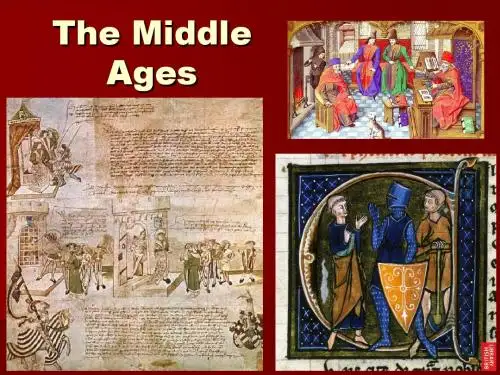
The Middle AgesKings and conflicts 500-1400The period from about 500 to 1400 in Europe is known as the Middle Age, or the medieval period. It began with the fall of the Roman empire and ended with the Renaissance, when a revival of art and learning swept through Europe.The medieval period was an age of wars and conquests. Some wars were fought to gain more territory while others were wars of religion, fought between people of differing faiths in an age when religion dominated most people’s lives. At this time China’s civilization was far in advance of the rest of the world. Africa and America saw the emergence of strong,well-organized empires based on trade, while the spread of Islam from Arabia across the Middle East and into North Africa and Spain brought a new way of life to a vast area.During the Middle Ages, ordinary people lived simply, as farmers in villages or as craftworkers in towns. Many built their own houses, made their own clothes and grew their own food. Poor people obeyed local landowners or lords, who in turn served a more powerful king or emperor. The rulers ordered castles and palaces, temples and cathedrals to be built. These huge stone buildings often took many years, even centuries, toconstruct.Few people travelled far from their homes. Those who did venture into foreign lands included merchants, soldiers and a few bold explorers who wrote accounts of their travels. Few people could read or write, and learning was passed down by word of mouth. In Europe, the monasteries were centres of learning, while in Asia the Chinese and Arabs led the way in science and technology, medicine and astronomy.。