
HMN-154_LCMS_25778_MedChemExpress
- 格式:pdf
- 大小:147.95 KB
- 文档页数:2


中国药理学通报ChOese PhopncologicO Bulletin2424Dec;36(12):1737〜43-1737•网络出版时间:2420-12-312:10网络出版地址/ttys://kps.cukh uemkcms/0e/il/34.1036.R.04201242.1317.234.htmlLncRNA GAS5通过miR-29/ADAMTSP途径抑制大鼠肺纤维化刘理静22,钱红5,王乐6,胡柯5,贺兼斌5,田玉梅2(1.湖南医药学院护理学院,湖南怀化411004;3,长沙民政职业技术学院医学院,湖南长沙410044;3.湖南医药学院医学院,4.湖南医药学院侗医药研究湖南省重点实验室,0.怀化市第一人民医院呼吸与危重症医学科,湖南怀化411004)Vol:14.C666/j.issn.1041-1278.2424.12.419文献标志码:A文章编号:1041-1978(2424)12-1737-47中国图书分类号:R-C36;R369.35;R349.9;R563.134.22摘要:目的探讨生长阻滞特异性转录本0(growth wrest-specifiv Uanscript0,GAS5)对肺纤维化的影响及分子机制。
方法采用生物信息学、荧光素酶报告基因分析GAS5、m/-21、ADAMTSN间的竞争性内源RNA(ceRNA)关系。
SD大鼠分为对照组、LV-GAS5组和LV-GAS5+mi/-71agomR组,经气管内注入博莱霉素A0建立肺纤维化模型后,分别给予尾静脉注射4.2mL的PBS、LV-GAS5、LV-GAS5+miR-21ag-omiy028,处死大鼠,收集血液,采用ELISA分析血清PICP 和PDINP水平,提取肺组织,HE染色和Masson染色观察病收稿日期:2929-97-29,修回日期:2929-97-07基金项目:湖南省自然科学基金资助项目(No2918JJ2077)作者简介:刘理静(1777-),男,硕士,副主任医师,研究方向:肺纤维化的防治,E-mail:wsfyz-709@;钱红(1777-)女,硕士,副教授,研究方向:肺纤维化的防治,共同第一作者,E-mail:Uae/2@;田玉梅(1777-),女,硕士,副教授,研究方向:肺纤维化的防治,通讯作者,E-mail:776256368@ 理改变,并用qRT-PCR检测GAS5、miRUl、ADAMTSN表达, Western blot检测ADAMTSU、Col I、Col川表达。

Notch信号转导通路在肝纤维化形成中的作用与分子机制陈方园1, 涂传涛2(1.复旦大学附属中山医院内科,上海 200032;2.复旦大学附属上海市公共卫生临床中心消化内科,上海 201508)摘要:慢性肝病及其并发症严重危害人类健康。
各种原因导致的慢性肝病可经过肝纤维化阶段最终进展至肝硬化,而肝纤维化甚至早期肝硬化是可逆转的。
因此,除强调针对肝病的基础病因防治外,临床中还迫切需要抗肝纤维化治疗。
然而,目前尚缺乏公认的行之有效的治疗药物。
因此,需要更深入地理解肝纤维化形成、进展和逆转的细胞分子机制,从而开发针对特异性靶点的药物,最终实现临床转化。
Notch信号转导通路在肝纤维化形成中的作用近年来倍受关注,其可能是抗肝纤维化治疗的新的潜在靶点,值得进一步探索。
本文就Notch信号转导通路在肝纤维化形成中的作用与分子机制进行综述。
关键词:肝纤维化;Notch信号转导通路;肝星状细胞;巨噬细胞;肝细胞;肝祖细胞The role and molecular mechanism of Notch signaling transduction pathway on liver fibrogenesisChen Fangyuan1, Tu Chuantao2(1.Department of Internal Medicine, Zhongshan Hospital, Fudan University,Shanghai 200032, China; 2.Department of Gastroenterology, Shanghai Public Health Clinical Center, FudanUniversity, Shanghai 201508, China)Abstract: Chronic liver disease and its complications endanger human health seriously. It is now clear thatchronic liver diseases of various causes eventually progress to cirrhosis through the stage of liver fibrosis.However, liver fibrosis and even early liver cirrhosis can be reversed. Therefore, beside the prevention andtreatment of the underlying causes of liver diseases, antifibrotic therapy is urgently needed. However, thereare currently no effective agents for liver fibrosis available. A greater understanding of molecular mechanismsregulating the liver fibrogenesis is needed for identification of novel targets for successful antifibrotic therapies.Recently, the role of Notch signaling transduction pathway in pathologic development of liver fibrosis hasreceived much attention, and current evidence suggests that the modulation of the Notch signaling transductionpathway may represent a new therapeutic target in liver fibrosis. This review highlights the recent advances inthe field indicating that Notch signaling transduction pathway is involved in the development of liver fibrosis.Key words: Liver fibrosis; Notch signaling transduction pathway; Hepatic stellate cell; Macrophage;Hepatocyte; Hepatic progenitor cells目前,慢性肝病仍是严重危害人类健康的重大疾病[1,2]。
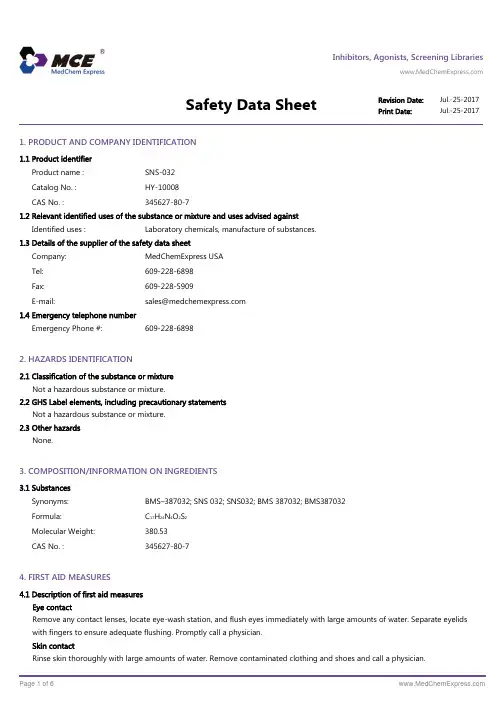
Inhibitors, Agonists, Screening LibrariesSafety Data Sheet Revision Date:Jul.-25-2017Print Date:Jul.-25-20171. PRODUCT AND COMPANY IDENTIFICATION1.1 Product identifierProduct name :SNS-032Catalog No. :HY-10008CAS No. :345627-80-71.2 Relevant identified uses of the substance or mixture and uses advised againstIdentified uses :Laboratory chemicals, manufacture of substances.1.3 Details of the supplier of the safety data sheetCompany:MedChemExpress USATel:609-228-6898Fax:609-228-5909E-mail:sales@1.4 Emergency telephone numberEmergency Phone #:609-228-68982. HAZARDS IDENTIFICATION2.1 Classification of the substance or mixtureNot a hazardous substance or mixture.2.2 GHS Label elements, including precautionary statementsNot a hazardous substance or mixture.2.3 Other hazardsNone.3. COMPOSITION/INFORMATION ON INGREDIENTS3.1 SubstancesSynonyms:BMS–387032; SNS 032; SNS032; BMS 387032; BMS387032Formula:C17H24N4O2S2Molecular Weight:380.53CAS No. :345627-80-74. FIRST AID MEASURES4.1 Description of first aid measuresEye contactRemove any contact lenses, locate eye-wash station, and flush eyes immediately with large amounts of water. Separate eyelids with fingers to ensure adequate flushing. Promptly call a physician.Skin contactRinse skin thoroughly with large amounts of water. Remove contaminated clothing and shoes and call a physician.InhalationImmediately relocate self or casualty to fresh air. If breathing is difficult, give cardiopulmonary resuscitation (CPR). Avoid mouth-to-mouth resuscitation.IngestionWash out mouth with water; Do NOT induce vomiting; call a physician.4.2 Most important symptoms and effects, both acute and delayedThe most important known symptoms and effects are described in the labelling (see section 2.2).4.3 Indication of any immediate medical attention and special treatment neededTreat symptomatically.5. FIRE FIGHTING MEASURES5.1 Extinguishing mediaSuitable extinguishing mediaUse water spray, dry chemical, foam, and carbon dioxide fire extinguisher.5.2 Special hazards arising from the substance or mixtureDuring combustion, may emit irritant fumes.5.3 Advice for firefightersWear self-contained breathing apparatus and protective clothing.6. ACCIDENTAL RELEASE MEASURES6.1 Personal precautions, protective equipment and emergency proceduresUse full personal protective equipment. Avoid breathing vapors, mist, dust or gas. Ensure adequate ventilation. Evacuate personnel to safe areas.Refer to protective measures listed in sections 8.6.2 Environmental precautionsTry to prevent further leakage or spillage. Keep the product away from drains or water courses.6.3 Methods and materials for containment and cleaning upAbsorb solutions with finely-powdered liquid-binding material (diatomite, universal binders); Decontaminate surfaces and equipment by scrubbing with alcohol; Dispose of contaminated material according to Section 13.7. HANDLING AND STORAGE7.1 Precautions for safe handlingAvoid inhalation, contact with eyes and skin. Avoid dust and aerosol formation. Use only in areas with appropriate exhaust ventilation.7.2 Conditions for safe storage, including any incompatibilitiesKeep container tightly sealed in cool, well-ventilated area. Keep away from direct sunlight and sources of ignition.Recommended storage temperature:Powder-20°C 3 years4°C 2 yearsIn solvent-80°C 6 months-20°C 1 monthShipping at room temperature if less than 2 weeks.7.3 Specific end use(s)No data available.8. EXPOSURE CONTROLS/PERSONAL PROTECTION8.1 Control parametersComponents with workplace control parametersThis product contains no substances with occupational exposure limit values.8.2 Exposure controlsEngineering controlsEnsure adequate ventilation. Provide accessible safety shower and eye wash station.Personal protective equipmentEye protection Safety goggles with side-shields.Hand protection Protective gloves.Skin and body protection Impervious clothing.Respiratory protection Suitable respirator.Environmental exposure controls Keep the product away from drains, water courses or the soil. Cleanspillages in a safe way as soon as possible.9. PHYSICAL AND CHEMICAL PROPERTIES9.1 Information on basic physical and chemical propertiesAppearance White to khaki (Solid)Odor No data availableOdor threshold No data availablepH No data availableMelting/freezing point No data availableBoiling point/range No data availableFlash point No data availableEvaporation rate No data availableFlammability (solid, gas)No data availableUpper/lower flammability or explosive limits No data availableVapor pressure No data availableVapor density No data availableRelative density No data availableWater Solubility No data availablePartition coefficient No data availableAuto-ignition temperature No data availableDecomposition temperature No data availableViscosity No data availableExplosive properties No data availableOxidizing properties No data available9.2 Other safety informationNo data available.10. STABILITY AND REACTIVITY10.1 ReactivityNo data available.10.2 Chemical stabilityStable under recommended storage conditions.10.3 Possibility of hazardous reactionsNo data available.10.4 Conditions to avoidNo data available.10.5 Incompatible materialsStrong acids/alkalis, strong oxidising/reducing agents.10.6 Hazardous decomposition productsUnder fire conditions, may decompose and emit toxic fumes.Other decomposition products - no data available.11.TOXICOLOGICAL INFORMATION11.1 Information on toxicological effectsAcute toxicityClassified based on available data. For more details, see section 2Skin corrosion/irritationClassified based on available data. For more details, see section 2Serious eye damage/irritationClassified based on available data. For more details, see section 2Respiratory or skin sensitizationClassified based on available data. For more details, see section 2Germ cell mutagenicityClassified based on available data. For more details, see section 2CarcinogenicityIARC: No component of this product present at a level equal to or greater than 0.1% is identified as probable, possible or confirmed human carcinogen by IARC.ACGIH: No component of this product present at a level equal to or greater than 0.1% is identified as a potential or confirmed carcinogen by ACGIH.NTP: No component of this product present at a level equal to or greater than 0.1% is identified as a anticipated or confirmed carcinogen by NTP.OSHA: No component of this product present at a level equal to or greater than 0.1% is identified as a potential or confirmed carcinogen by OSHA.Reproductive toxicityClassified based on available data. For more details, see section 2Specific target organ toxicity - single exposureClassified based on available data. For more details, see section 2Specific target organ toxicity - repeated exposureClassified based on available data. For more details, see section 2Aspiration hazardClassified based on available data. For more details, see section 2Additional informationRTECS No.: TM6071000This information is based on our current knowledge. However the chemical, physical, and toxicological properties have not been completely investigated.12. ECOLOGICAL INFORMATION12.1 ToxicityNo data available.12.2 Persistence and degradabilityNo data available.12.3 Bioaccumlative potentialNo data available.12.4 Mobility in soilNo data available.12.5 Results of PBT and vPvB assessmentPBT/vPvB assessment unavailable as chemical safety assessment not required or not conducted.12.6 Other adverse effectsNo data available.13. DISPOSAL CONSIDERATIONS13.1 Waste treatment methodsProductDispose substance in accordance with prevailing country, federal, state and local regulations.Contaminated packagingConduct recycling or disposal in accordance with prevailing country, federal, state and local regulations.14. TRANSPORT INFORMATIONDOT (US)This substance is considered to be non-hazardous for transport.IMDGThis substance is considered to be non-hazardous for transport.IATAThis substance is considered to be non-hazardous for transport.15. REGULATORY INFORMATIONSARA 302 Components:No chemicals in this material are subject to the reporting requirements of SARA Title III, Section 302.SARA 313 Components:This material does not contain any chemical components with known CAS numbers that exceed the threshold (De Minimis) reporting levels established by SARA Title III, Section 313.SARA 311/312 Hazards:No SARA Hazards.Massachusetts Right To Know Components:No components are subject to the Massachusetts Right to Know Act.Pennsylvania Right To Know Components:No components are subject to the Pennsylvania Right to Know Act.New Jersey Right To Know Components:No components are subject to the New Jersey Right to Know Act.California Prop. 65 Components:This product does not contain any chemicals known to State of California to cause cancer, birth defects, or anyother reproductive harm.16. OTHER INFORMATIONCopyright 2017 MedChemExpress. The above information is correct to the best of our present knowledge but does not purport to be all inclusive and should be used only as a guide. The product is for research use only and for experienced personnel. It must only be handled by suitably qualified experienced scientists in appropriately equipped and authorized facilities. The burden of safe use of this material rests entirely with the user. MedChemExpress disclaims all liability for any damage resulting from handling orfrom contact with this product.Caution: Product has not been fully validated for medical applications. For research use only.Tel: 609-228-6898 Fax: 609-228-5909 E-mail: tech@Address: 1 Deer Park Dr, Suite Q, Monmouth Junction, NJ 08852, USA。

尿嘧啶的荧光猝灭法测定与机理研究张敏;赵虎;张苗;岳宁宁;吕庆銮;王怀友【期刊名称】《分析测试学报》【年(卷),期】2008(27)8【摘要】研究了尿嘧啶猝灭伊文思蓝(Evans blue)的荧光猝灭机理,并根据尿嘧啶对伊文思蓝荧光的猝灭作用,建立了测定尿嘧啶的新方法.当用253 nm激发时,伊文思蓝的最大发射波长位于387 nm,线性回归方程为:c=11.85I0/IF-12.30,相关系数为0.999 0,线性范围为0.2 ~20 mg/L,检出限为0.14 mg/L,相对标准偏差(RSD)为3.6%.求得伊文思蓝与尿嘧啶的形成常数为K=4.88×103 L/mol,试验了pH、干扰离子、放置时间、核酸水解产物等对测定的影响.【总页数】4页(P859-861,865)【作者】张敏;赵虎;张苗;岳宁宁;吕庆銮;王怀友【作者单位】山东师范大学化学化工与材料科学学院,山东,济南,250014;山东师范大学化学化工与材料科学学院,山东,济南,250014;山东师范大学化学化工与材料科学学院,山东,济南,250014;山东师范大学化学化工与材料科学学院,山东,济南,250014;山东师范大学化学化工与材料科学学院,山东,济南,250014;山东师范大学化学化工与材料科学学院,山东,济南,250014【正文语种】中文【中图分类】O629.74【相关文献】1.核酸水解产物中腺嘌呤的荧光猝灭法测定及机理研究 [J], 张敏;赵虎;吕庆銮;岳宁宁;张苗;王怀友2.荧光猝灭法测定痕量镉—四碘合镉罗丹明S—聚乙烯醇荧光猝灭体系的研究 [J], 王钢;何应律3.基于荧光猝灭的黄连素光传感器的猝灭机理研究 [J], 王英4.碳量子点荧光猝灭法检测Hg^(2+)及其猝灭机理研究 [J], 丁玲;肖文;钱诗卉;周进;周尽晖;李世迁;唐欣伟5.荧光猝灭法测定次黄嘌呤及机理研究 [J], 张敏;岳宁宁;张苗;吕庆銮;王怀友因版权原因,仅展示原文概要,查看原文内容请购买。