(完整版)初中现在完成时练习题及答案(可编辑修改word版)
- 格式:docx
- 大小:19.30 KB
- 文档页数:7
现在完成时1.现在完成时的构成:现在完成时由助动词have\has + 过去分词构成,第三人称单数用has,其余用have。
I have been in Shenzhen for seven years.Lily hasn’t been to America before.2.现在完成时的用法:1)现在完成时通常表示在说话之前已经完成的动作或存在的状态。
说话人强调的是该动作或状态对现在的结果或影响。
My daughter has just gone out. 我女儿刚出去。
I’m sure we’ve met before. 我肯定我们以前见过面。
She has arrived. 她到了。
2)表示持续到现在的动作或状态, for…, since…,yet等。
如:I haven’t heard from her these days. 这些日子我没有收到她的信。
We haven’t seen you recently. 最近我们没有见到你。
They have been away for two years. 他们离开已经两年了。
She has been with us since Monday.3.常和现在完成时连用的时间状语:already, yet, before, lately, recently, once, twice, ever, never,since,for 等连用。
例如:She has already come. 她已经来了。
I haven’t read it yet. 我还没读过这个。
They have never been to Yan’an.他们从未去过延安。
I haven't seen him lately. 我近来没看到他。
She has been an independent girl since her father passed away.自从父亲去世后,这女孩就变得独立了。
Jack has been a doctor for 10 years.杰克做医生已经10 年了。
4.现在完成时的否定式和疑问句。
否定句:在have\has 后加not 结构:主语+has\have+not+过去分词+其他一般疑问句:Has\Have 提到主语前,其他照写。
结构:Have\Has+主语+过去分词+其他特殊疑问句:特殊疑问词+一般疑问句注意:肯定句中如有some\and,在否定句或者一般疑问句中要变成any\or,即some-any and-or5.部分不规则变化动词表6.注意:1.s ince 和for 的区别since 后接过去的某个时间点,如1993,last term, yesterday, the time I got there for 后接一段时间,表示“长达多久”,如ten years, a while, two days 等。
Exercise: 用since 和for 填空1.Jim has been in Ireland Monday.2.Jill has been in Ireland3.His aunt has lived in Australia three days.15 days.4.Mary is in her office. She has been there 7 o'clock.5.India has been an independent country 1974.6.The bus is late. They've been waiting 20 minutes.7.Nobody lives in those houses. They have been empty many years.8.Mike has been ill a long time. He has been in hospital October.2.表示短暂意义的动词如arrive, leave, borrow, buy, begin, start, die 等,在完成时当中不能和表示一段时间的状语连用,因为它们表示的动作不可能持续。
因此,不能说:He has come here for 2 weeks. ×The old man has died for 4 months. ×They have left only for 5 minutes. ×以上三句话可以改为:He has been here for 2 weeks.The old man has for 4 months.They have only for 5 minutes3.h ave (has) been(to\in)+地点和have (has) gone(to)+地点的区别:“曾到过某地” =“have (has) been”; 去过,现在已经回来了。
“已经去某地”= “have (has) gone”。
去了没有回来。
试比较:Where has he been? 他刚才到哪里去了?(已经回来了)Where has he gone? 他上哪儿去了?(人不在)They have been to Canada. 他们到过加拿大。
(现在已经不在加拿大)They have gone to Canada. 他们到加拿大去了。
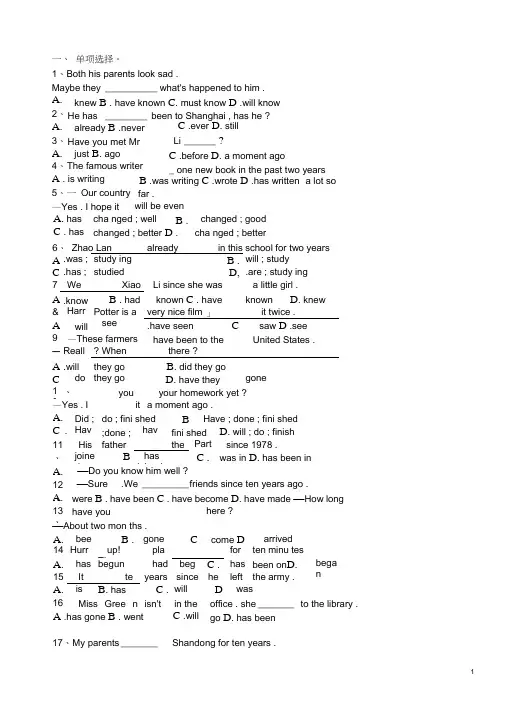
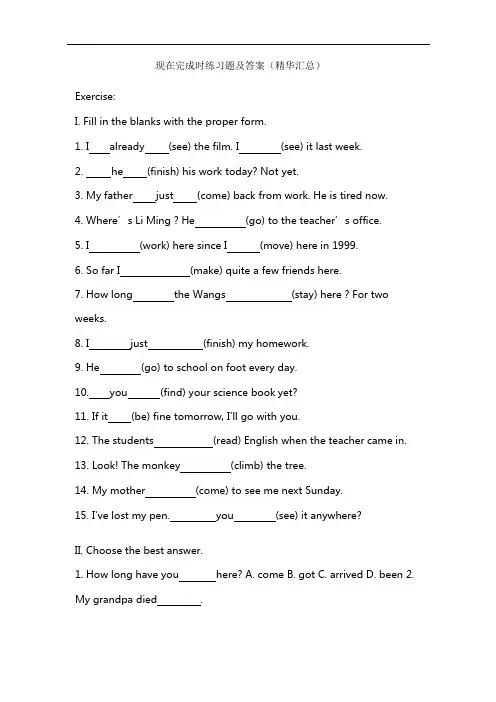
(可能在路上和已经到加拿大)随堂练习:一、用单词的适当形式填空1.S he’s(live) here ever since she was ten.2.Both of them (be) in Hongkong for ten days.3.Both of them (come) to Hongkong ten days ago.4.Half an hour (pass) since the train (leave).5.Mary (lose) her pen. you (see) it here and there?6.you (find) your watch yet?7.---Are you thirsty? ---No I just (have) some orange.8.We already (return) the book.9.they (build) a new school in the village?10.I (not finish) my homework . Can you help me?11.My father (read) the novel twice.12.I (buy) a book just now.13.I (lost ) my watch yesterday.二、单选题1.How long have you here?eB. gotC. arrivedD. been2.My grandpa died .A.at the age of my 2B. for 2 yearsC. when I was 2.D. my age was 6.3.Jane has to BeiJing. She will come back tomorrow.A.beenB. goneC. wentD. never been4.It is ten years I last saw her.A.afterB. sinceC. forD. that5.--Who will go to the station to meet Lorry?--I will. I her several times.A. metB. have metC. had metD. will meet6.--What a nice dress! How long you it?--Just 2 weeks.A. will, buyB. did, buyC. are, havingD. have, had7.--Do you know Lydia very well?--Yes, She and I friends since we were very young.A. have madeB. have becomeC. have beenD. have turned8.The Smiths in China for 8 years.A.has livedB. livedC. have beenD. live9.--Hello, this is Mr. Green speaking. Can I speak to Mr. Black?-- Sorry. He the Bainiao Park.A.has been toB. has gone toC. went toD. will go to10.-- you ever to the US?-- Yes, twice.A.Have, goneB. Have, been C, Do, go D. were, going三、将下列句子变成否定句,一般疑问句,并对划线部分提问。
1)I have been there for two days.否定句:一般疑问句:对划线部分提问:2)My father has lived here since 2000.否定句:一般疑问句:对划线部分提问:3)He left here yesterday.否定句:一般疑问句:对划线部分提问:4)They bought a book two hours ago.否定句:一般疑问句:对划线部分提问:四、用“never, ever, already, just, yet, for, since” to 填空1.I have seen him before, so I have no idea about him.2.Jack has finished his homework.3.Mr. Wang has taught in this school ten years.4.“Have you seen the film?” “No, I have seen it.”5.“Has the bus left?” “Yes, it has left.”五、用have(has) been 或have(has) gone 填空。
A: Where Li Fei ?B: He to Hainan Island.A: How long he there?B: He there for three days.A: When will he come back , do you know?B: I’m afraid he won’t come back recen tly.A: Could you tell me the way to Hainan Island?B: Sorry, I never there.A: How many times Li Fei to that place?B: He there only once.五、用have / has been to / in, have gone to 及go 的适当形式填空。