
M3U1 grammar 语言点讲解
- 格式:ppt
- 大小:627.00 KB
- 文档页数:6

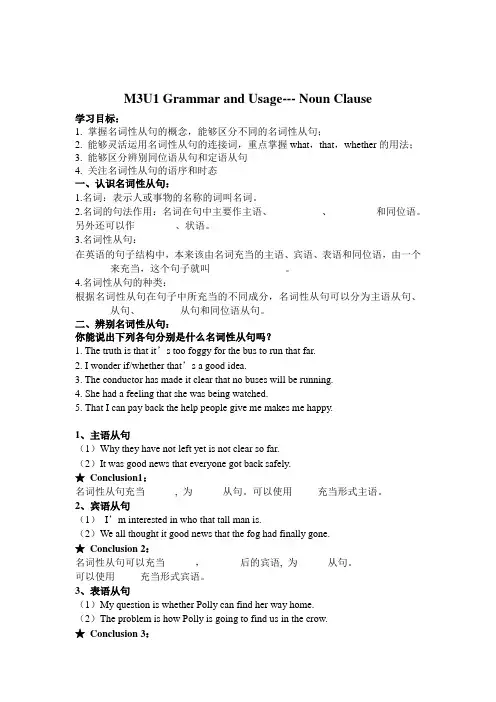
M3U1 Grammar and Usage--- Noun Clause学习目标:1. 掌握名词性从句的概念,能够区分不同的名词性从句;2. 能够灵活运用名词性从句的连接词,重点掌握what,that,whether的用法;3. 能够区分辨别同位语从句和定语从句4. 关注名词性从句的语序和时态一、认识名词性从句:1.名词:表示人或事物的名称的词叫名词。
2.名词的句法作用:名词在句中主要作主语、__________、_________和同位语。
另外还可以作________、状语。
3.名词性从句:在英语的句子结构中,本来该由名词充当的主语、宾语、表语和同位语,由一个_______来充当,这个句子就叫_______________。
4.名词性从句的种类:根据名词性从句在句子中所充当的不同成分,名词性从句可以分为主语从句、_______从句、________从句和同位语从句。
二、辨别名词性从句:你能说出下列各句分别是什么名词性从句吗?1. The truth is that it’s too foggy for the bus to run that far.2. I wonder if/whether that’s a good idea.3. The conductor has made it clear that no buses will be running.4. She had a feeling that she was being watched.5. That I can pay back the help people give me makes me happy.1、主语从句(1)Why they have not left yet is not clear so far.(2)It was good news that everyone got back safely.★Conclusion1:名词性从句充当______, 为______从句。
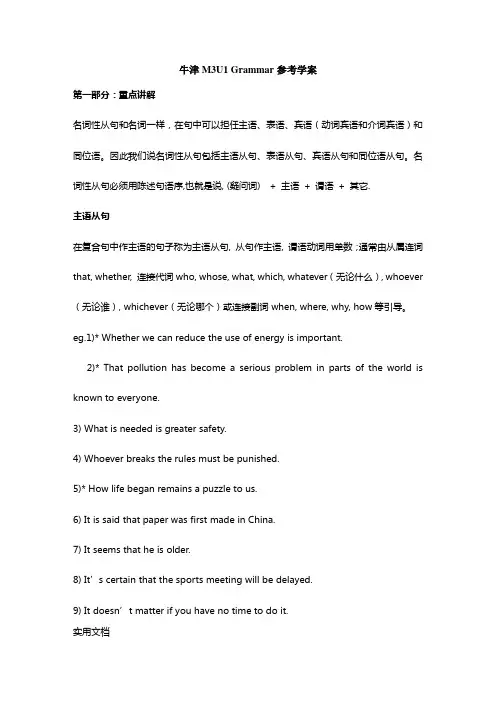
牛津M3U1Grammar参考学案第一部分:重点讲解名词性从句和名词一样,在句中可以担任主语、表语、宾语(动词宾语和介词宾语)和同位语。
因此我们说名词性从句包括主语从句、表语从句、宾语从句和同位语从句。
名词性从句必须用陈述句语序,也就是说, (疑问词) + 主语+ 谓语+ 其它.主语从句在复合句中作主语的句子称为主语从句, 从句作主语, 谓语动词用单数;通常由从属连词that, whether, 连接代词who, whose, what, which, whatever(无论什么), whoever (无论谁), whichever(无论哪个)或连接副词when, where, why, how等引导。
eg.1)* Whether we can reduce the use of energy is important.2)* That pollution has become a serious problem in parts of the world is known to everyone.3) What is needed is greater safety.4) Whoever breaks the rules must be punished.5)* How life began remains a puzzle to us.6) It is said that paper was first made in China.7) It seems that he is older.8) It’s certain that the sports meeting will be delayed.9) It doesn’t matter if you have no time to do it.实用文档注意:1. 陈述句必须以that 引导, 不能省略。
2. 主语从句只能用whether引导,不能用if引导。

高中英语M3U1知识点回顾Words & Expressions for Unit 1 Words: sense hold one’s fear(hold one’s hand)rest (on her arm) hear my heart beating lead sb. through sth.keep their hands in very hot wateras…as possible尽可能take the pain承受痛苦stay healthy保持健康experiment in做…...的实验;experiment on在......做实验experiment with用......做实验do / make / carry out / perform the experiment….. Phrases1. as well也,还2. not…until直到…才…3. make great achievements取得成就4. l ost one’s sense失明in sight看见out of sight看不见catch sight of看见lose sight of看不见at the sight of一看见5. be covered in被笼罩在…..中be covered with / by 覆盖着6. step out走出去step in/into走进step over横越, 跨过step up走近; [美]促进, 加紧make astep forward[backward]前进[后退]一步step aside走到一旁step by step逐步地, 循序渐进地7. the rest of 其余的,其余部分8. glance at匆匆看一下take / have a glance at9. set off (for) 出发set out (for)10. by the time到…为止11. wish for=look forward to期盼;盼望12. reach out伸出reach for取13. stare up at抬头凝视着14. (say sth.) in one ear15. watch out for留心注意keep a watch onwatch out 当心,小心look out (for); take care (of)be careful (of)16. get across越过,通过17. follow one’s advice听从某人的建议18. be related to与…有关19. be linked to与…有关;与…联系20. be in a position to do(处于状态)有办法/有可能做某事21. lie in在于22. find one’s way out找出…出路23. make sense讲得通,有意义24. have something to do with与…有关25. late on = later以后26. rather than而不是;宁愿27. turn down调小28. can’t help doing sth.情不自禁做某事29. warm up热身30. get close to逼近31. turn around四周环顾32. be frozen with由于…呆了33. sweat with fear吓出汗了34. all of a sudden = all at once =suddenly35. ring out36. in the distance在远处37. at the beginning ofAt the end ofIn the middle of38. set sail for启航39. be through经历Reading(P2-3)Read the text carefully and answer the following questions to help you understand the text further.1. What did Polly get to know from the weatherman?A. It was going to rain.B. There would be strong wind.C. There would be a thick fog in the afternoon.D. There would be no buses at the bus stop in the afternoon.2. Why did she walk quickly towards her usual bus stop?A. She wanted to get a seat on the bus as it was crowed.B. She wanted to know if there was a bus.C. She had something urgent (紧急的) to deal with.D. She felt she would get wet as it was going to rain.3. Who might the tall man in a dark coat be in your opinion?A. the old blind man.B. the bus conductor.C. a robber.( 强盗)D. one of his colleagues.4. Why did the man brush Polly’s face?A. He did it on purpose. (故意地)B. He was blind and he didn’t know there was someone in front of him.C. He wanted to ask her to go away.D. He wanted to help Polly go along the street.5. On sunny days, how can the blind like the old man get across the road?A. They can manage it without any help.B. The have a special road to take.C. Some workers are arranged specially (专门地) to help them.D. Many warm-hearted people would like to offer their help.Module 3 Unit 1Language points (P1-5)1.confuse vt. –to make someone feel that they can’t think clearly or don’t understand别告诉我这么多,-- 你把我弄糊涂了。
