2020北京东城区初三英语一模试题+答案
- 格式:docx
- 大小:273.20 KB
- 文档页数:13
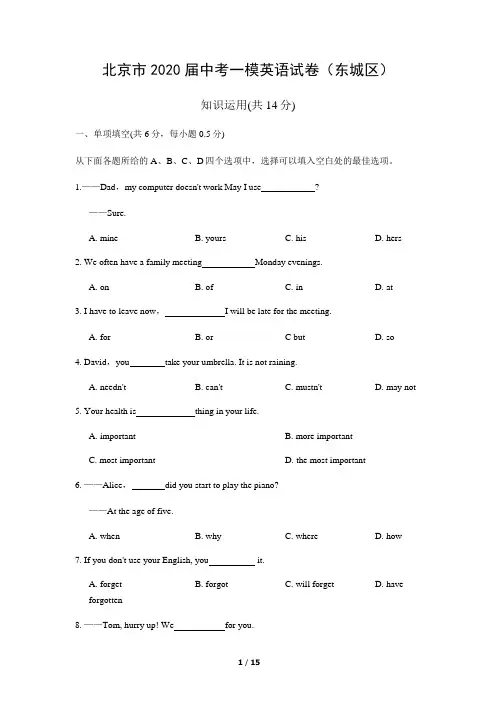
2020北京东城初三一模英语2020.5学校班级姓名教育ID号知识运用(共14分)一、单项填空(共6分,每小题0.5分)从下面各题所给的A、B、C、D四个选项中,选择可以填入空白处的最佳选项。
1.——Dad,my computer doesn't work May I use ?——Sure.A. mineB. yoursC. hisD. hers2. We often have a family meeting Monday evenings.A. onB. ofC. inD. at3. I have to leave now,I will be late for the meeting.A. forB. or C but D. so4. David,you take your umbrella. It is not raining.A. needn'tB. can'tC. mustn'tD. may not5. Your health is thing in your life.A. importantB. more importantC. most importantD. the most important6. ——Alice,did you start to play the piano?——At the age of five.A. whenB. whyC. whereD. how7. If you don't use your English, you it.A. forgetB. forgotC. will forgetD. have forgotten8. ——Tom, hurry up! We for you.——Just one minute.A. waitB. waitedC. are waitingD. have waited9. Mr. Johnson met an old friend when he down the street.A. walksB. is walkingC. will walkD. was walking10. Mike football since the fourth grade.A. playsB. has playedC. is playingD. will play11.Patients good care of when they stay in hospital.A. takeB. tookC. are takenD. were taken12——Can you tell me last summer vacation?——Sure. I went to Shanghai.A. where did you goB. where you wentC. where will you goD. where you will go二、完形填空(共8分,每小题1分》阅读下面的短文,掌握其大意,然后从短文后各题所给的A、B、C、D四个选项中,选择最佳选项。
Born to DrawJenna looked at the calendar and sighed(叹气).Even though she looked forward to the new term,she would miss spending her summer vacation 13 .It was so satisfying to see how her drawings could bring life to her storytelling!Unfortunately,Jenna's parents didn't understand how much she wanted to be a comic illustrator(插画家).When she talked about her dream job with her parents,she expected them to 14 her. Instead,they explained that drawing comics was a hobby, not a career(职业).Jenna couldn't stop thinking about that unpleasant conversation,so she turned to her elder brother, James. She wanted her brother to help her make their parents 15 that drawing comics is an art form and that it can even be a great career.But as she spoke,the look on her brother's face told her that he agreed with their parents. Jenna politely listened to her brother and then she walked back to her room 16 .At school a few weeks later,Miss Bridwell noticed that Jenna wasn't herself. Jenna told Miss Bridwell that she was 17 because her parents didn't back her choice of becoming a comic illustrator.Pointing to the bookshelf in the front of the room,Miss Bridwell began,“When I was probably about your age,my dad once said writing was not a career. I was just straightforward with my dad. I simply told him the truth. I explained that I enjoyed writing,and that I wanted to get better and to write. I guess my 18 came through,and he believed me.”Miss Bridwell's story 19 Jenna a lot,so she decided to discuss her ideas with her parents again. It didn't happen immediately,but in the end,they came to understand that Jenna's 20 of drawing comics was more important than whether it was the career they wanted for Jenna.13. A. drawing B. reading C. writing D. singing14. A. comfort B. support C. teach D. follow15.A. promise B. decide C. prove D. believe16. A. secretly B. hopefully C. cheerfully D. quietly17. A. regretful B. nervous C. upset D. frightened18. A. honesty B. patience C. pride D. carefulness19.A. reminded B. encouraged C. surprised D. interested20. A. love B. experience C. purpose D. memory阅读理解(共36分)三、阅读下列短文,根据短文内容,从短文后各题所给的A、B、C、D四个选项中.选择最佳选项。
(共26分,每小题2分}AHere are some books about space travel. Take a trip to the Moon and beyond with these encouraging reads.Balloon to the MoonLong before anyone haddesigned a rocket,theMontgolfier brothers weremaking hot air balloons. InOctober 1783,they became thefirst people to experiencecontrolled flight. Balloon to the Moon starts there and leads to Neil Armstrong's “small step" and beyond. Learn about all the progress of the space travel,then get ready for an unknown but exciting future.Extraordinary Life of Neil ArmstrongNeil Armstrong made historyin 1969 when he became thefirst person to set foot on theMoon. From his childhoodplaying with model planes tobecoming one of the mostfamous astronauts of all time,discover the wonderful story of Neil Armstrong's life in this book. It has lots of facts and pictures,and shows the key events in his life.To Space & BackSally Ride became the firstAmerican woman in space in1983. In this book,Sallyshares her personal experienceof traveling into space. Fromdiscussing the experience ofliving and working in space to explaining how astronauts train and adapt(适应)to their new environment, she talks about her journey through space. Counting on KatherineThis encouraging book tellsthe story of Katherine Johnsonwho has a gift for math Shehelped make the historic Apollo11 moon landing possible andmade sure that Apollo 13returned home safely when themission(任务) was in danger.21. Who first experienced controlled flight in October 1783?A. The Montgolfier brothers.B. Katherine Johnson.C. Neil Armstrong.D. Sally Ride.22. If a girl is interested in women astronauts' life in space,she will probably read .A. To Space & BackB. Balloon to the MoonC. Counting on KatherineD. The Extraordinary Life of Neil Armstrong23. What did Katherine Johnson do?A. She designed the first rocket.B. She recorded key events of space travel.C. She explained how astronauts trained for space travel.D. She helped make the Apollo 11 moon landing possible.BPeople can reduce, reuse,or recycle waste instead of throwing it away. Matt and Sam decided to do an experiment. They wanted to see exactly how much waste the three R's could save.First, they collected the rubbish from six classrooms at their school. Theydivided the rubbish into three groups:things that were reusable,such as a pencil or a marker that had been thrown awaythings that could be recycled,such as cans, glass, or paperthings that were truly wasteThen,Matt and Sam weighed each of the three groups. They learned that 84% of the total rubbish thrown away that day could be recycled or reused. They decided to do something about it.Matt and Sam presented the idea of starting a recycling programme to the school leaders. Then they worked with the Student Council. They prepared brochures(手册)to send home to tell the students and their families about recycling. They stated in the brochure that recycling helps to keep our planet healthy. The school bought colored containers(容器)for each classroom. Each room received a blue container for paper and a green container for glass and cans. They also received a red container for real rubbish.Within a short time,each classroom in the school was sorting recyclable materials from rubbish before it was thrown. Matt and Sam decided to weigh the rubbish one more time. They wanted to check the school's progress. They collected the rubbish from the red containers from the same six classrooms as before. They sorted the rubbish into three groups again and weighed each group. This time,they were pleased to find that the red containers were filled with 90% waste that should be thrown away. Only 10% of recyclable materials had been thrown into the red containers. Matt and Sam were pleased with their school's effort at reducing waste on our planet.24. By doing an experiment, Matt and Sam wanted to find out .A. what things could be reusedB. what recyclable materials could be savedC. how much waste the three R's could saveD. how much waste their school produced a day25. What did Matt and Sam do in the recycling programme?A. They made a speech on recycling.B. They wrote a report to the school leaders.C. They bought colored containers for each classroom.D. They helped students and their families know about recycling.26. Which word can best describe Matt and Sam?A. Responsible.B. Friendly.C. Independent.D. Confident.CWe see logos on signs, buildings, television,and even on the clothes we wear. Logos are used to stand for brands(品牌).There are logos such as the Nike "swoosh",the Apple logo and thecolorful rings of the Olympic Games. All of these logos are designed to attract ourattention. They also help us remember a product or service connected to the logo.However, research performed at the University of California,Los Angeles findsthat remembering the details of logos is very difficult. The researchers try toexplain this.Logos are typically designed to be simple and easy to recognize. Yet the frequent exposure(频繁接触)to these logos can actually make our brains overlook the details of logos. It would be challenging to try to remember every single thing that crosses our path. We take in so much information every day that the brain works to notice information that does not need to be stored. It allows the unimportant information to disappear gradually from our memory.The details of product logos are just the kind of information our brains tell us we do not need. This may be discouraging to logo designers and to companies that use these eye-catching logos. But there are still many business experts who believe in the importance of a recognizable logo.Even though the brain is likely to pay no attention to unnecessary details, it is also programmed for recognition. When we see logos over and over again,we become familiar(熟悉) with them. This repeated exposure leads our brains to remember the basic idea without all of the details. This general sense of memory has its own benefits. It can make us feel like we really know the product behind the logo. In fact, familiarity with a logo can even make people feel more comfortable about buying or using certain products.Logos are everywhere we look today. Those people who create logos need to know that people will only remember what they believe is important. A clever design may be interesting,but most people will forget the details.27. In the first paragraph,the writer mainly .A. introduces some famous brandsB. describes the design of some logosC. shows the popularity of famous brandsD. explains the purpose of designing logos28. The word "overlook" in Paragraph 2 probably means“”A. try to rememberB. see the importance ofC. take no notice ofD. fail to understand29. What can we learn from the passage?A. Business experts think the details of logos are unnecessary.B. Our brains can choose which logos to notice and remember.C. The repeated exposure to a logo can lead people to buy the product.D. People know more about the products behind logos with more details.30. Which of the following would be the best title for the passage?A. What Makes a Good Logo?B. What Can We See in a Logo?C. Why Is a Good Logo Important?D. Why Should Logos Be Recognizable?DThe students are quieting down in their seats. The teacher begins to give lessons. Then she asks a question for the class to answer, and the students all react in separate ways.Each student is special with different strengths and weaknesses. Because of this fact, different students learn differently. While some may learn by quickly answering the teacher's question,speaking up with ease and comfort,others may learn just as well by listening to their classmates and teacher speak. These students should not be punished for learning the way they do, but when teachers grade class participation(参与),that is exactly what they are doing.According to a survey carried out by Bonnie M. Miller, a professor at University of Massachusetts Boston,60% of her students believe that grading participation does not encourage them to participate more in class. They feel more comfortable expressing their thoughts if they know what they say will not be given a number later on.Some other students believe that when class participation is graded,teachers are awarding outgoing students while punishing shy ones. Grading class participation sends the message that shy students are not good students. It makes them feel like they should be outgoing, loud, and able to learn by talking,which makes them feel uncomfortable.In my experience with classes where class participation was graded,I felt difficult to do well. For example,instead of being able to fully focus on what my teacher and classmates said, my mind would race with the things that I could possibly share in the class discussion. Either I would be too slow in raising my hand,or feel too nervous to lift it at all. Imagining my falling grades,wishing that I could somehow be a more outgoing person, suddenly my thoughts would be interrupted by the sound of my classmates getting up to leave,and I would realize that I learned nearly nothing that class.What's more, by focusing on the students who talk the most in class,teachers fail to award students who may be good listeners-a skill that is as important as being able to talk in front of a group of people.Teachers can increase class participation by providing different ways of grading participation that are acceptable to different personalities and learning ways. For example, they can give students opportunities to write their ideas. Most importantly, teachers should create classrooms where students want to learn.31. According to the passage, in a class where participation is graded, .A. most students are likely to act activelyB. some students feel stressed to be who they areC. students are forced to listen to their classmatesD. students are encouraged to learn the way they prefer32. The writer talks about his own experience in Paragraph 5 to explain .A. why students care much about gradesB. why listening is as important as speaking upC. how grading participation influences learning processD. how students feel when preparing for speaking up in class33. What's the writer's main purpose in writing the passage?A. To remind teachers of the importance of grading properly in class.B. To tell students the effect their personalities have on learning.C. To encourage teachers to keep students active in class.D. To provide students with ways to participate in class.四、阅读短文,根据短文内容回答问题。