句子成分及结构
- 格式:doc
- 大小:55.50 KB
- 文档页数:4
句子成分及句子结构句子成分(members of a sentence)句子成分定义:构成句子的各个部分叫做句子的成分。
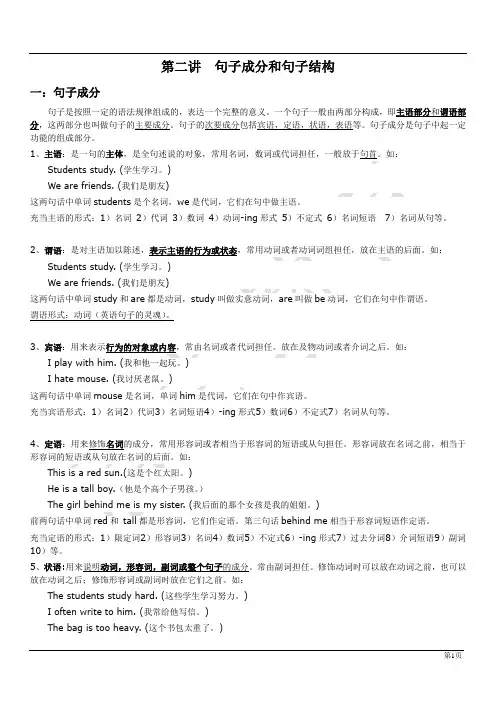
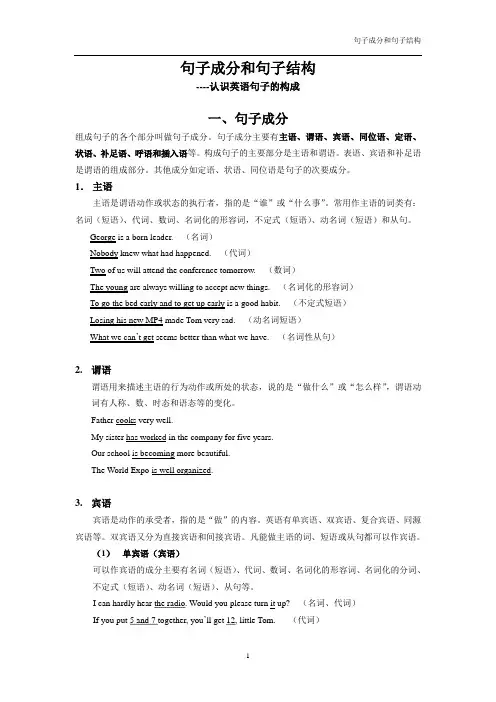
句子成分有主要成分和次要成分:主要成分有主语和谓语;次要成分有表语、宾语、定语、状语、补足语和同位语。
主语(subject):主要由名词、代词、数词、不定式、动名词、名词化得形容词和主语从句等充当。
1)During the 1990s, American country music has become more and more popular.2)We often speak English in class.3)One-third of the students in this class are girls.4)To swim in the river is a great pleasure.5)Smoking does harm to the health.6)The rich should help the poor.7)When we are going to have an English test has not been decided.8)It is necessary to master a foreign language.谓语(predicate verb):简单谓语:由一个动词或动词短语构成。
He practice running every morning.复合谓语:1)由情态动词或其他助动词加动词原形构成。
You may keep the book for two weeks. He has caught a bad cold.2)由系动词加表语构成。
We are students.表语(predicative):用以说明主语的身份、特征和状态,它一般位于系动词(be, become, get, look, grow, turn, seem等)之后。
一般由名词、代词、形容词、分词、数词、不定式、动名词、介词短语、副词和表语从句充当。
1)Our teacher of English is an American. 2) Is it yours?3)The weather has turned cold. 4)The speech is exciting.5) Three times seven is twenty one. 6)His job is to teach English.7) His hobby is playing football. 8)The machine must be out of order.9) Time is up. The class is over. 10) The truth is that he has never been abroad.宾语(object):宾语表示动作的对象或者承受者,一般位于及物动词和介词后面。
1)They went to see an exhibition yesterday.2)The heavy rain prevented me from coming to school on time.3)How many dictionaries do you have? I have five.4)They pretended not to see me.5)They helped the old with their housework yesterday.6)I enjoy listening to popular music.7)I think (that) he is fit for his office.宾语类型:1)双宾语(间接宾语+直接宾语)Lend me your dictionary, please.2)复合宾语(宾语+宾语补足语)They elected him their monitor.宾语补足语(complement):有些及物动词,除了有一个直接宾语以外,还要有一个宾语补足语,才能使句子的意义完整。
带有宾语补足语的一般句型为:某些及物动词(make, find, leave,deng)+宾语+宾补。
宾补可由名词、形容词、副词、不定式、分词、介词短语和从句充当。
1)His father named him Dongming.2)They painted their boat white.3)Let the fresh air in. 4) You mustn’t force him to lend his money to you.5)We found everything in the lab in good order. 6)We saw her entering the room7)We will soon make our city what your city is now.定语(attributive):修饰名词或代词的词、短语或从句(定语从)。
定语可由下列成分充当1)Guilin is a beautiful city. 2) China is a developing country; America is a developed country.3) There are thirty women teachers in our class.4) His rapid progress in English made us surprised.5) Our monitor is always the first to enter the classroom.6) The teaching plan for next term has been worked out.7) He is reading an article about how to learn English.状语(adverbial):修饰动词、形容词、副词或整个句子,说明动作或者状态特征的句子成分,叫状语。
1)Light travels most quickly. 2) He has lived in the city for ten years.3) He is proud to have passed the national college entrance examination.4) He is in the room making a model plane.5) Wait a minute. 6) Once you begin, you must continue.状语的种类;1)How about meeting again at six?(时间状语)2)Last night she didn’t go to the dance party because of the rain.(原因状语)3)I shall to there if it doesn’t rain.(条件状语)4)Mr. Smith lives on the third floor.(地点状语)5)She put the eggs into the basket with great care.(方式状语)6)She came in with a dictionary in her hand.(伴随状语)7)In order to catch up with the others, I must work harder.(目的状语)8)He was so tired that he fell asleep immediately.(结果状语)9)She works very hard though she is old.(让步状语)10)I am taller than he is.(比较状语)同位语(appositive)——一个名词对另一个名词或代词进行修饰、限定或说明。
Mr. Smith, our new teacher, is very kind to us.Yesterday I met Tom, a friend of my brother'sHe told me that his brother John is a world-famous doctorWe Chinese people are brave and hardworkingHe is interested in sports, especially ball games.五大句型Ⅰ)主语+不及物动词(S+V)Ⅱ) 主语+及物动词+宾语(S+V+O)Ⅲ) 主语+连系动词+表语(S+V+P)Ⅳ)主语+谓语+宾语+宾补(S+V+O+OC)Ⅴ)主语+及物动词+间接宾语+直接宾语Ⅰ)主语+不及物动词(S+V)(特征:句子的谓语动词都能表达完整的意思——不及物动词)Birds sing in the morning. She dances well. The cat disappeared.He walked home yesterday. Light travels much faster than sound.Ⅱ)主语+及物动词+宾语(S+V+O)(特征:谓语动词都具有实义,都是主语产生的动作,但不能表达完整的意思,必须跟有一个宾语,即动作的承受者,才能使意思完整。
这类动词叫做及物动词。
)I like popular music. She knows what to do next.I usually do my homework at home in the evening.She laugh at herHe understands English.They ate some apples. Jack likes Chinese food.I want to have a cup of tea. He said “Good morningⅢ)主语+连系动词+表语(S+V+P)(特征:句子谓语动词都不能表达一个完整的意思,必须加上一个表明主语身份或状态的表语构成复合谓语,才能表达完整的意思。
这类动词叫做连系动词。
系动词分两类:be, look, feel, smell等属一类,表示情况;get, grow, become, turn等属另一类,表示变化。
be 本身没有什么意义,只起连系主语和表语的作用。
其它系动词仍保持其部分词义。
)Eg: 1)This is an English-chinese Dictionary 2)The dinner smells good.3)He fells happy. 4)Everything looks different.5)He is tall and strong. 6)The book is interesting.7)The weather becomes warmer and warmer. 8)His face turned red.Ⅳ)主语+谓语+宾语+宾补(S+V+O+OC)(特征:动词虽然是及物动词,但是只跟一个宾语还不能表达完整的意思,必须加上一个补充成分来补足宾语,才能使意思完整。