order用法
- 格式:doc
- 大小:14.88 KB
- 文档页数:5
- 1 - order用法
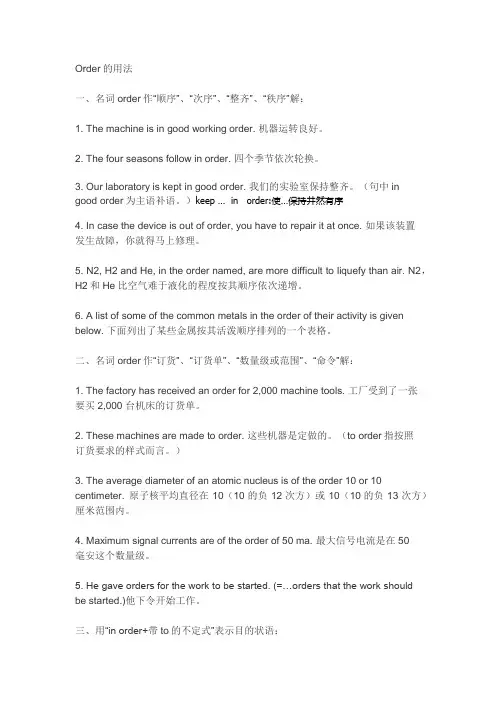
Order一词在英语中有多种不同的用法和含义。在本文中,我们将探讨order在不同情境下的用法和含义,以及如何正确地使用这个词。
一、作为动词
1. 点菜
Order作为动词,最常见的用法是“点菜”,即在餐馆或酒吧中点菜。例如:
- Can we order some appetizers, please?(我们可以点一些开胃菜吗?)
- I’d like to order a glass of red wine.(我想点一杯红酒。)
- We ordered a pizza to share.(我们点了一份披萨共享。)
2. 下订单
Order也可以表示“下订单”,比如在网上购物时。例如:
- I ordered a new pair of shoes from Amazon.(我在亚马逊上订购了一双新鞋。)
- Have you ordered the tickets for the concert yet?(你订购音乐会的门票了吗?)
- She ordered a custom-made dress for her wedding.(她为自己的婚礼订制了一件定制礼服。)
3. 命令 - 2 - Order还可以表示“命令”,通常用于正式场合或军事场合。例如:
- The general ordered his troops to attack at dawn.(将军命令他的部队在黎明时分发起攻击。)
- The judge ordered the defendant to pay a fine.(法官命令被告支付罚款。)
- The teacher ordered the students to be quiet.(老师命令学生保持安静。)
4. 整理
Order也可以表示“整理”或“安排”,通常用于家庭、办公室或其他组织中。例如:
- I need to order my closet before winter.(冬天来临之前我需要整理一下我的衣柜。)
- The boss ordered the files alphabetically.(老板命令将文件按字母顺序排列。)
- The event planner ordered the seating chart for the
wedding.(活动策划师为婚礼安排了座位表。)
二、作为名词
1. 命令
Order也可以作为名词,表示“命令”或“指示”。例如:
- The soldiers obeyed the orders of their commander.(士兵们服从了指挥官的命令。) - 3 - - The manager gave orders to his staff to prepare for the
meeting.(经理下令让他的员工为会议做准备。)
- I need to follow the doctor’s orders to recover from my
illness.(我需要遵循医生的指示来恢复健康。)
2. 顺序
Order也可以表示“顺序”或“次序”。例如:
- The alphabet is a sequence of letters in a specific order.(字母表是一系列按特定顺序排列的字母。)
- The speakers will give their presentations in
alphabetical order.(演讲者将按字母顺序进行演讲。)
- The books on the shelf are arranged in order by author’s last name.(书架上的书按作者姓氏顺序排列。)
3. 订单
Order还可以表示“订单”,即指已经下达但尚未完成的购买请求。例如:
- The company received a large order for its new product.(该公司收到了一份新产品的大订单。)
- The restaurant had to cancel our order because they ran
out of ingredients.(餐厅不得不取消我们的订单,因为他们的原料用完了。)
- I placed an order for a new laptop online.(我在网上订购了一台新笔记本电脑。) - 4 - 三、常见搭配
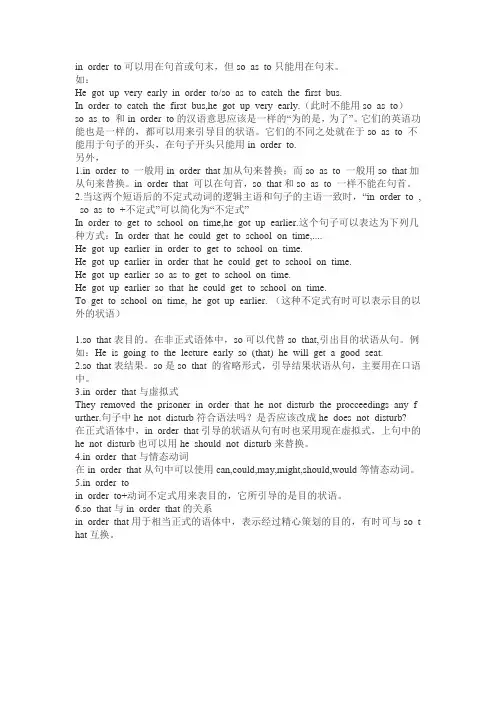
1. in order to
In order to是一个常见的短语,表示“为了”。例如:
- I’m studying hard in order to pass the exam.(我正在努力学习,为了通过考试。)
- We need to save money in order to buy a house.(我们需要节约开支,以便买房。)
- He started exercising regularly in order to improve his
health.(他开始定期锻炼,为了改善健康。)
2. out of order
Out of order是另一个常见搭配,表示“故障”的意思。例如:
- The elevator is out of order, so we’ll have to take the
stairs.(电梯出故障了,所以我们得走楼梯。)
- The printer is out of order, so we can’t print the
documents.(打印机出故障了,所以我们不能打印文件。)
- The ATM was out of order, so I had to go to a different
bank.(自动取款机出故障了,所以我得去别的银行。)
四、常见错误
1. order和ordain的混淆
有些人会将order和ordain混淆,认为它们是同义词。实际上,order通常表示“命令”、“点菜”或“整理”,而ordain则表示“任命”或“祝圣”。例如: - 5 - - The bishop ordained the new priest during the ceremony.(主教在仪式上任命了新神父。)
- The restaurant owner ordered the chef to prepare a special
dish for the VIP guest.(餐厅老板命令厨师为贵宾准备一道特别的菜肴。)
2. order和request的混淆
有些人会将order和request混淆,认为它们可以互换使用。实际上,order通常表示“命令”、“点菜”或“整理”,而request则表示“请求”或“要求”。例如:
- I requested a table by the window, but the restaurant was
fully booked.(我请求在窗户边的桌子,但是餐厅已经订满了。)
- The police officer ordered the suspect to put his hands
up.(警察命令嫌疑人举起手来。)
五、总结
Order是一个非常常见的词汇,有多种含义和用法。在使用order时,需要根据上下文和语境来确定其正确的含义和用法。同时,需要避免常见的错误,比如将order和ordain或request混淆。通过正确地使用order,我们可以更好地表达自己的意思,避免语言上的误解。