
to介词的用法
- 格式:doc
- 大小:12.93 KB
- 文档页数:3
- 1 - to介词的用法
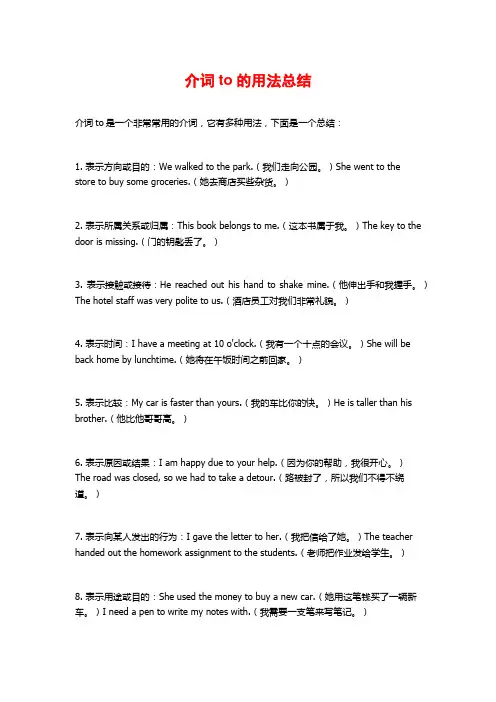
介词“To”的用法
一、To作介词
1. 用来表示“向,朝,达到”
I went to the cinema yesterday.
他去年去了北京。
He went to Beijing last year.
2. 用来表示“到,达到”
He ran to the station.
他跑到车站去了。
He walked to the restaurant.
他走到饭店去了。
3. 用来表示“用,采用”
He listened to the radio.
他听收音机。
She turned to her mother for advice.
她向妈妈求助。
4. 用来表示“对,关于”
We talked to our teacher about the problem.
我们和老师讨论这个问题。
She wrote a letter to her friend.
她给朋友写了一封信。 - 2 - 5. 用来表示“给,传递,送到”
He gave the present to his mother.
他把礼物送给了他的妈妈。
She sent the letter to her brother.
她把信给弟弟。
6. 用来表示“靠近,相近,接近”
The dog came to us.
狗走近我们。
The house is close to the river.
这房子离河很近。
二、To作介短语
1. to one's surprise:使某人惊讶的是
To our surprise, he came here on time.
令我们惊讶的是,他准时来了。
2. to begin with:首先
To begin with, you should prepare enough materials.
首先,你应该准备足够的材料。
3. to sb's delight:使某人高兴的是
To their delight, they got excellent grades.
令他们高兴的是,他们考了优秀的分数。
4. to one's relief:使某人宽慰的是
To my relief, he passed the exam. - 3 - 令我宽慰的是,他通过了考试。
5. to make matters worse:更糟糕的是
To make matters worse, I missed the train.
更糟糕的是,我错过了火车。
6. to sb's delight:使某人大喜的是
To my delight, he accepted our invitation.
令我大喜的是,他接受了我们的邀请。


![介词to的常见用法[1]](https://imgs-1438308264.cos.ap-hongkong.myqcloud.com/48c4060316fc700aba68fc05.webp)