
Representative volume element of asphalt pavement for electromagnetic measurements
- 格式:pdf
- 大小:2.44 MB
- 文档页数:10


英语语⾔学复习专题英语语⾔学复习专题A Review on English LinguisticsTiger ZhouSchool of Foreign Languages,Shanghai Dianji University⼀.Explain the following terms1.dualityDuality refers to the fact that language is a system,which consists of two sets of structures,or two levels.At the lower level,there is a structure of sounds,which are meaningless by themselves. At the higher level,there is a structure of meanings where the sounds of language can be grouped and regrouped into a large number of units of meaning./doc/6b316456657d27284b73f242336c1eb91b37336b.html plementary distributionWhen two or more than two allophones of the same phoneme do not distinguish meaning and occur in different phonetic environments,then the allophones are said to be in complementary distribution.3.categoryCategory refers to a group of linguistic items which fulfill the same of familiar functions in a particular language such as sentence,a noun phrase or a verb.4.phrase structure ruleA certain word can only co-occur with certain other words.There must be certain grammatical mechanism that ensures the appropriate positions that specifiers,heads and complements occupy in phrase structure.Such special type of grammatical mechanism that regulates the arrangement of elements that make up a phrase is called a phrase structure rule.5.homonymyHomonymy refers to the phenomenon that words having different meanings have the same form,i.e.different words are identical in sound or spelling,or in both.6.displacementDisplacement means that language can be used to refer to things which are present or not present,real or imagined matters in the past,present,or future,or in far away places.In other words,language can be used to refer to contexts removed from the immediate situations of the speaker.This property provides speakers with an opportunity to talk about a wide range of things, free from barriers caused by separation in time or place.7.minimal pairsWhen two different forms are identical in every way except for one sound segment which occurs in the same place in the strings,the two sound combinations are said to form a minimal pair.8.deep structureIt is the structure that is formed by the XP rule in accordance with the head’s sub-categorization properties and that corresponds most closely to the meaningful grouping of words.9.contextIt is generally considered as constituted by the knowledge shared by the speaker and the hearer.10.hyponymyHyponymy refers to the sense relation between a more general,more inclusive word and a more specific word.(The word which is more general in meaning is called the superordinate,and the more specific words are called its hyponyms.)⼆.Short AnswersChapter1Introduction2.What are the major branches of linguistics?What does each of them study?The major branches of linguistics are:(1)phonetics:it studies the sounds used in linguistic communication;(2)phonology:it studies how sounds are put together and used to convey meaning in communication;(3)morphology:it studies the way in which linguistic symbols representing sounds are arranged and combined to form words;(4)syntax:it studies the rules which govern how words are combined to form grammatically permissible sentences in languages;(5)semantics:it studies meaning conveyed by language;(6)pragmatics:it studies the meaning in the context of language use.3.In what basic ways does modern linguistics differ from traditional grammar?The general approach thus traditionally formed to the study of language over the years is roughly referred to as“traditional grammar.”Modern linguistics differs from traditional grammar in several basic ways.Firstly,modem linguistics is descriptive while traditional grammar is prescriptive.Second,modem linguistics regards the spoken language as primary,not the written.Traditional grammarians,on the other hand,tended to emphasize,maybe over-emphasize,the importance of the written word,partly because of its permanence.from traditional grammar also in that it does not force languages4.Is modern linguistics mainly synchronic or diachronic?Why?In modem linguistics,a synchronic approach seems to enjoy priority over a diachronic one. Because people believed that unless the various states of a language in different historical periods are successfully studied,it would be difficult to describe the changes that have taken place in its historical development.6.How is Saussure's distinction between langue and parole similar to Chomsky's distinction between competence and performance?Saussure's distinction and Chomsky's are very similar,they differ at least in that Saussure took a sociological view of language and his notion of langue is a matter of social conventions,and Chomsky looks at language from a psychological point of view and to him competence is a property of the mind of each individual.8.What are the main features of human language that have been specified by C.Hockett to show that it is essentially different from animal communication system?The main features of human language are termed design features.They include:a)ArbitrarinessLanguage is arbitrary.This means that there is no logical connection between meanings and sounds.A good example is the fact that different sounds are used to refer to the same object in different languages.b)ProductivityLanguage is productive or creative in that it makes possible the construction and interpretation of new signals by its users.This is why they can produce and understand an infinitely large number of sentences,including sentences they have never heard before.c)DualityLanguage consists of two sets of structures,or two levels.At the lower or the basic level there is a structure of sounds,which are meaningless by themselves.But the sounds of language can be grouped and regrouped into a large number of units of meaning,which are found at the higher level of the system.d)DisplacementLanguage can be used to refer to things which are present or not present,real or imagined matters in the past,present,or future,or in far-away places.In other words,language can be used to refer to contexts removed from the immediate situations of the speaker.This is what “displacement”means.e)Cultural transmissionWhile human capacity能⼒for language has a genetic basis,i.e.,we were all born with the ability to acquire language,the details of any language system are not genetically transmitted,but instead have to be taught and learned.Chapter2Phonology2.What is voicing and how is it caused?Voicing is a quality of speech sounds and a feature of all vowels and some consonants in English. It is caused by the vibration of the vocal cords.3.Explain with examples how broad transcription and narrow transcription differ?The transcription with letter-symbols only is called broad transcription.This is the transcription normally used in dictionaries and teaching textbooks for general purposes.The latter,i.e.the transcription with letter-symbols together with the diacritics is called narrow transcription.This is the transcription needed and used by the phoneticians in their study of speech sounds.With the help of the diacritics they can faithfully represent as much of the finedetails as it is necessary for their purpose.The example is the consonant[p].We all know that[p]is pronounced differently in the two words pit and spit.In the word pit,the sound[p]is pronounced with a strong puff of air,but in spit the puff of air is withheld to some extent.In the case of pit,the[p]sound is said to be aspirated and in the case ofspit,the[p]sound is unaspirated.This difference is not shown in broad transcription, but in narrow transcription,a small raised“h”is used to show aspiration,thus pit is transcribed as [p?it]and spit is transcribed as[spit].3.What criteria are used to classify the English vowels?Vowels may be distinguished as front,central,and back according to which part of the tongue is held highest.To further distinguish members of each group,we need to apply another criterion,i.e. the openness of the mouth.Accordingly,we classify the vowels into four groups:close vowels, semi-close vowels,semi-open vowels,and open vowels.A third criterion that is often used in the classification of vowels is the shape of the lips.In English,all the front vowels and the central vowels are unrounded vowels,i.e.,without rounding the lips,and all the back vowels,with the exception of[a:],are rounded.Then theEnglish vowels can also be classified according to the length of the sound.The long vowels are all tense vowels and the short vowels are lax vowels. 4. A.Give the phonetic symbol for each of the following sound descriptions:1)voiced palatal affricate[?]2)voiceless labiodental fricative[f]3)voiced alveolar stop[d]4)front,close,short[?]5)back,semi-open,long[?:]6)voiceless bilabial stop[p]B.Give the phonetic features of each of the following sounds:1)[d]voiceless alveolar stop2)[l]voiced alveolar liquid3)[?]voiceless palatal affricate4)[w]voiced bilabial glide5)[?]back,close,(rounded)short6)[?]front,open,(unrounded)short9.Explain with examples the sequential rule,the assimilation rule,and the deletion rule.Rules that govern the combination of sounds in a particular language are called sequential rules.There are many such sequential rules in English.For example,if a word begins with a[l]or a [r],then the next sound must be a vowel.That is why[lbik][lkbi]are impossible combinations in English.They have violated the restrictions on the sequencing of phonemes.The assimilation rule assimilates one sound to another by“copying”a feature of a sequential phoneme,thus making the two phones similar.Assimilation of neighboring sounds is, for the most part,caused by articulatory or physiological processes.When we speak,we tend to increase the ease of articulation.This“sloppy慵懒的;马虎的”tendency may become regularized as rules of language.Deletion rule tells us when a sound is to be deleted although it is orthographically represented.Wehave noticed that in the pronunciation of such words as sign,design,and paradigm,there is no[g]sound although it is represented in spelling by the letter g.But in their corresponding formssignature,designation,and paradigmatic,the[g]represented by the letter g is pronounced.The rule can be stated as:Delete a[g]when it occurs before a final nasal consonant.Given the rule,the phonemic representation of the stems in sign–signature,resign–resignation,paradigm–paradigmatic will include the phoneme/g/,which will be deleted according to the regular rule if no suffix is added.10.What are suprasegmental features?How do the major suprasegmental features of English function in conveying meaning?The phonemic features that occur above the level of the segments are called suprasegmental features.The main suprasegmental features include stress,intonation,and tone.The location of stress in English distinguishes meaning.There are two kinds of stress:word stress and sentence stress.For example,a shift of stress may change the part of speech of a word from a noun,to a verb although its spelling remains unchanged.Tones are pitch variations which can distinguish meaning just like phonemes.Intonation plays an important role in the conveyance of meaning in almost every language,especially in a language like English.When spoken in different tones,the same sequence of words may have different meanings.Chapter3Morphology1.Divide the following words into their separate morphemes by placing a“+”between each morpheme and the next:a.micro+filmb.be+draggle+edc.announce+mentd.pre+digest+ione.tele+communicate+ionf.fore+fatherg.psycho+physics h.mechan+ist6.The following sentences contain both derivational and inflectional affixes.Underline all of the derivational affixes and circle(blacken)the inflectional affixes.a)The farmer’s cow s escap ed.b)It was rain ing.c)Those sock s are inexpensive.d)Jim need s the new er copy.e)The strong est rower continu ed.f)She quickly clos ed the book.g)The alphabetization went well.Chapter4Syntax1.What is syntax?Syntax is a branch of linguistics that studies how words are combined to form sentences and the rules that govern the formation of sentences.2.What is phrase structure rule?The grammatical mechanism that regulates the arrangement of elements(i.e.specifiers,heads, and complements)that make up a phrase is called a phrase structure rule.The phrase structural rule for NP,VP,AP,and PP can be written as follows:NP→(Det)N(PP)...VP→(Qual)V(NP)...AP→(Deg)A(PP)...PP→(Deg)P(NP)...The general phrasal structural rule(X stands for the head N,V,A or P):The XP rule:XP→(specifier)X(complement)3.What is category?How to determine a word’s category?Category refers to a group of linguistic items which fulfill the same or similar functions in a particular language such as a sentence,a noun phrase or a verb.To determine a word’s category,three criteria are usually employed,namely meaning, inflection and distribution.A word’s distributional facts together with information about its meaning and inflectional capabilities help identify its syntactic category.4.What is coordinate structure and what properties does it have?The structure formed by joining two or more elements of the same type with the help of a conjunction is called coordinate structures.Coordinate structures exhibits four important properties:a)There is no limit on the number of coordinated categories that can appear prior to theconjunction.b)A category at any level(a head or an entire XP)can becoordinated.c)Coordinated categories must be of the same type.d)The category type of the coordinate phrase is identical to the category type of theelements being conjoined.6.What is deep structure and what is surface structure?There are two levels of syntactic structure.The first,formed by the XP rule in accordance with the head’s sub-categorization properties,is called deep structure(or D-structure).The second, corresponding to the final syntactic form of the sentence which results from appropriate transformations,is called surface structure(or S-structure).8.The following phrases include a head,a complement,and a specifier.Draw the appropriate tree structure for each.13.The derivations of the following sentences involve the inversion transformation.Give the deep structure and the surface structure of each of thesesentences.a)Would you come tomorrow?b)What did Helen bring to the party?c)Who broke the window?Chapter5Semantics1.What are the major views concerning the study of meaning?1)The naming theory was proposed by the ancient Greek scholar Plato.According to this theory,the linguistic forms or symbols,in other words,the words used in a language are simply labels of the objects they stand for.So words are just names or labels for things.2)The conceptualist view has been held by some philosophers and linguists from ancient times.This view holds that there is no direct link between a linguistic form and what it refers to(i.e.,between language and the real world);rather,in the interpretation of meaning they are linked through the mediation of concepts in the mind.3)Contextualism holds that meaning should be studied in terms of situation,use,context ––elements closely linked with language behavior.The representative of this approach was J.R. Firth,famous British linguist.4)Behaviorism attempts to define the meaning of a language form as the“situation in which the speaker utters it and the response it calls forth in the hearer.”This theory,somewhat close to contextualism,is linked with psychological interest.2.What are the major types of synonyms in English?The major types of synonyms are dialectal synonyms,stylistic synonyms,emotive or evaluative synonyms,collocational synonyms,and semantically different synonyms.3.Explain with examples“homonymy”,“polysemy”,and“hyponymy”.1)Homonymy refers to the phenomenon that words having different meanings have the same form,i.e.,different words are identical in sound or spelling,or in both.When two words are identical in sound,they are homophones.When two words are identical in spelling,they are homographs.When two words are identical in both sound and spelling,they are complete homonyms.2)While different words may have the same or similar meaning,the same one word may have more than one meaning.This is what we call polysemy,and such a word is called a polysemic word.There are many polysemic words in English,The fact is the more commonly used a word is, the more likely it has acquired more than one meaning.3)Hyponymy refers to the sense relation between a more general,more inclusive word anda more specific word.The word which is more general in meaning is called the superordinate, and the more specific words are called itshyponyms.Hyponyms of the same superordinate areco-hyponyms to each other.Hyponymy is a relation of inclusion;in terms of meaning,the superordinate includes all its hyponyms.5.Identify the relations between the following pairs of sentences:1)“T om’s wife is pregnant”presupposes“T om has a wife.”2)“My sister will soon be divorced”presupposes“My sister is a married woman.”3)“He likes seafood”is entailed by”He likes crabs.”4)“They are going to have another baby”presupposes“They have a child.”8.Try to analyze the following sentences in terms of predication analysis:1)The man sells ice-cream.MAN,ICE-CREAM(SELL)2)Is the baby sleeping?BABY(SLEEP)3)It is snowing.(SNOW)4)The tree grows well.TREE(GROW)Chapter6Pragmatics1.What does pragmatics study?How does it differ from traditional semantics?Generally speaking,pragmatics is the study of meaning in the context.It studies meaning in a dynamic way and as a process.In order to have a successful communication,the speaker and hearer must take the context into their consideration so as to effect the right meaning and intention.The development and establishment of pragmatics in the1960s and1970s resulted mainly from the expansion of the study of semantics.However,it is different from the traditional semantics.The major difference between them lies in that pragmatics studies meaning in a dynamic way,while semantics studies meaning in a static way.Pragmatics takes context into consideration while semantics does not.Pragmatics takes care of the aspect of meaning that is not accounted for by semantics.2.Why is the notion of context essential in the pragmatic study of linguistic communication?The notion of context is essential to the pragmatic study of language.It is generally considered as constituted by the knowledge shared by the speaker and the hearer.Various contents of shared knowledge have been identified,e.g.knowledge of the language they use,knowledge of what has been said before,knowledge about the world in general,knowledge about the specific situation in which linguistic communication is taking place,and knowledge about each other.Context determines the speaker’s use of language and also the heater’s interpretation of what is said to him. Without such knowledge,linguistic communication would not be possible,and without considering such knowledge,linguistic communication cannot be satisfactorily accounted for in a pragmatic sense.Look at the following sentences:(1)How did it go?(2)It is cold in here.(3)It was a hot Christmas day so we went down to the beach in the afternoon and had a good time swimming and surfing.Sentence(1)might be used in a conversation between two students talking about an examination,or two surgeons talking about an operation,or in some other contexts;(2)might be said by the speaker to ask the hearer to turn on the heater,or leave the place,or to put on more clothes,or to apologize for the poor condition of the room,depending on the situation of context;(3)makes sense only if the hearer has the knowledge that Christmas falls in summer in the southern hemisphere.3.How are sentence meaning and utterance meaning related,and how do they differ?A sentence is a grammatical concept,and the meaning of a sentence is often studied as the abstract,intrinsic property of the sentence itself in terms of predication.But if we think of a sentence as what people actually utter in the course of communication,it becomes an utterance, and it should be considered in the situation in which it is actually uttered(or used).So it is impossible to tell if“The dog is barking”is a sentence or an utterance.It can be either.It all depends on how we look at it and how we are going to analyze it.If we take it as a grammatical unit and consider it as a self-contained unit in isolation from context,then we are treating it as a sentence.If we take it as something a speaker utters in a certain situation with a certain purpose, then we are treating it as an utterance.Therefore,while the meaning of a sentence is abstract,and decontextualized,that of anutterance is concrete,and context-dependent.The meaning of an utterance is based on sentence meaning;it is the realization of the abstract meaning of a sentence in a real situation of communication,or simply in a context.Now,take the sentence“My bag is heavy”as an example. Semantic analysis of the meaning of the sentence results in the one-place predication BAG(BE HEAVY).Then a pragmatic analysis of the utterance meaning of the sentence varies with the context in which it is uttered.For example,it could be uttered by a speaker as a straightforward statement, telling the hearer that his bag is heavy.It could also be intended by the speaker as an indirect,polite request,asking the hearer to help him carry the bag.Another possibility is that the speaker is declining someone’s request for help.All these are possible interpretations of the same utterance “My bag is heavy”.How it is to be understood depends on the context in which it is uttered and the purpose for which the speaker utters it.While most utterances take the form of grammatically complete sentences,some utterances do not,and some cannot even be restored to complete sentences.5.According to Austin,what are the three acts a person is possibly performing while making an utterance.Give an example.According to Austin’s new model,a speaker might be performing three acts simultaneously when speaking:locutionary act,illocutionary act,and perlocutionary act.A locutionary act is the act of uttering words,phrases,clauses.It is the act of conveying literal meaning by means of syntax,lexicon and phonology.An illocutionary act is the act of expressing the speaker’s intention;it is the act performed in saying something.A perlocutionary act is the act performed by or resulting from saying something;it is the consequence of,or the change brought about by the utterance;it is the act performed by saying something.Let’s look at an example:You have left the door wide open.The locutionary act performed by the speaker is his utterance of the words“you”,“have”,“door”,“open”,etc.,thus expressing what the words literally mean. The illocutionary act performed by the speaker is that by making such an utterance he has expressed his intention of speaking,i.e.asking someone to close the door,or making a complaint, depending on the context.The perlocutionary act refers to the effect of the utterance.If the hearer gets the speaker’s message and sees that the speaker means to tell him to close the door,the speaker has successfully brought about the change in the real world he has intended to;then the perlocutionary act is successfully performed.7.What is indirect language use?How is it explained in the light of speech act theory?When someone is not saying in an explicit and straightforward manner what he means to say, rather he is trying to put across his message in an implicit,roundabout way,we can say he is using indirect language.8.What are the four maxims of the CP?Try to give your own examples to show how flouting these maxims gives rise to conversational implicature? Cooperative Principle,abbreviated as CP.It goes as follows:Make your conversational contribution such as required at the stage at which it occurs by the accepted purpose or direction of the talk exchange in which you are engaged.To be more specific,there are four maxims under this general principle:1)The maxim of quantitya)Make your contribution as informative as required(for the current purpose of the exchange).b)Do not make your contribution more informative than is required.2)The maxim of qualitya)Do not say what you believe to be false.b)Do not say that for which you lack adequate evidence.3)The maxim of relationa)Be relevant.4)The maxim of mannera)Avoid obscurity of expression.b)Avoid ambiguity.c)Be brief(avoid unnecessary prolixity).d)Be orderly.。
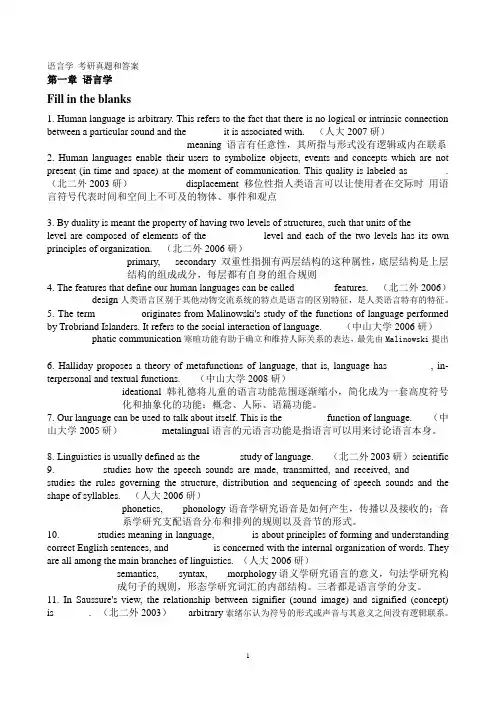
语言学考研真题和答案第一章语言学Fill in the blanks1. Human language is arbitrary. This refers to the fact that there is no logical or intrinsic connection between a particular sound and the _______it is associated with. (人大2007研)meaning 语言有任意性,其所指与形式没有逻辑或内在联系2. Human languages enable their users to symbolize objects, events and concepts which are not present (in time and space) at the moment of communication. This quality is labeled as _______. (北二外2003研)displacement 移位性指人类语言可以让使用者在交际时用语言符号代表时间和空间上不可及的物体、事件和观点3. By duality is meant the property of having two levels of structures, such that units of the _______ level are composed of elements of the __________ level and each of the two levels has its own principles of organization. (北二外2006研)primary, secondary 双重性指拥有两层结构的这种属性,底层结构是上层结构的组成成分,每层都有自身的组合规则4. The features that define our human languages can be called _______ features. (北二外2006)design人类语言区别于其他动物交流系统的特点是语言的区别特征,是人类语言特有的特征。

胡壮麟《语言学教程》(修订版)测试题Chapter 1 Introductions to LinguisticsI. Choose the best answer. (20%)1. Language is a system of arbitrary vocal symbols used for human__________A. contactB. communicationC. relationD. community2. Which of the following words is entirely arbitrary?A. treeB. typewriterC. crashD. bang3. The function of the sentence “Water boils at 100 degrees Centigrade.” is__________.A. interrogativeB. directiveC. informativeD. performative4. In Chinese when someone breaks a bowl or a plate the host or the people present are likely to say“碎碎(岁岁)平安”as a means of controlling the forces which they believes feel might affect their lives. Which functions does it perform?A. InterpersonalB. EmotiveC. PerformativeD. Recreational5. Which of the following property of language enables language users to overcome the barriers caused by time and place, due to this feature of language, speakers of a language are free to talk about anything in any situation?A. TransferabilityB. DualityC. DisplacementD. Arbitrariness6. Study the following dialogue. What function does it play according to the functions of language?—A nice day, isn’t it?— Right! I really enjoy the sunlight.A. EmotiveB. PhaticC. PerformativeD. Interpersonal7. __________ refers to the actual realization of the ideal language user’s knowledge of the rules of his language in utterances.A. PerformanceB. CompetenceC. LangueD. Parole8. When a dog is barking, you assume it is barking for something or at someone that exists hear and now. It couldn’t be sor rowful for some lost love or lost bone. This indicates the design feature of __________.A. cultural transmissionB. productivityC. displacementD. duality9. __________ answers such questions as how we as infants acquire our first language.A. PsycholinguisticsB.Anthropological linguisticsC. SociolinguisticsD. Applied linguistics10. __________ deals with language application to other fields, particularly education.A. Linguistic theoryB. Practical linguisticsC. Applied linguisticsD. Comparative linguisticsII. Decide whether the following statements are true or false. (10%)11. Language is a means of verbal communication. Therefore, the communication way used by the deaf-mute is not language.12. Language change is universal, ongoing and arbitrary.13. Speaking is the quickest and most efficient way of the human communicationsystems.14. Language is written because writing is the primary medium for all languages.15. We were all born with the ability to acquire language, which means the details of any language system can be genetically transmitted.16. Only human beings are able to communicate.17. F. de Saussure, who made the distinction between langue and parole in the early 20th century, was a French linguist.18. A study of the features of the English used in Shakespeare’s time is an example of the diachronic study of language.19. Speech and writing came into being at much the same time in human history.20. All the languages in the world today have both spoken and written forms.III. Fill in the blanks. (10%)21. Language, broadly speaking, is a means of __________ communication.22. In any language words can be used in new ways to mean new things and can be combined into innumerable sentences based on limited rules. This feature is usually termed __________.23. Language has many functions. We can use language to talk about itself. This function is __________.24. Theory that primitive man made involuntary vocal noises while performing heavy work has been called the __________ theory.25. Linguistics is the __________ study of language.26. Modern linguistics is __________ in the sense that the linguist tries to discover what language is rather than lay down some rules for people to observe.27. One general principle of linguistic analysis is the primacy of __________ over writing.28. The description of a language as it changes through time is a __________ study.29. Saussure put forward two important concepts. __________ refers to the abstract linguistic system shared by all members of a speech community.30. Linguistic potential i s similar to Saussure’s langue and Chomsky’s __________.IV. Explain the following terms, using examples. (20%)31. Design feature32. Displacement33. Competence34. Synchronic linguisticsV. Answer the following questions. (20%)35. Why do people take duality as one of the important design features of human language? Can you tell us what language will be if it has no such design feature? (南开大学,2004)36. Why is it difficult to define language? (北京第二外国语大学,2004)VI. Analyze the following situation. (20%)37. How can a linguist make his analysis scientific? (青岛海洋大学,1999)Key:[In the reference keys, I won’t give examples or further analysis. That seems too much work for me. Therefore, this key is only for reference. In order to answer this kind of question, you need more examples. So you should read the textbook carefully. – icywarmtea]I.1~5 BACCC 6~10 BACACII.11~15 FFTFF 16~20 FFFFFIII.21. verbal 22. productivity / creativity 23. metalingual function 24. yo-he-ho25. scientific 26. descriptive27. speech 28. diachronic linguistic29. langue 30. competenceIV.31. Design feature: It refers to the defining properties of human language that tell the difference between human language and any system of animal communication.32. Displacement: It means that human languages enable their users to symbolize objects, events and concepts, which are not present (in time and space) at the moment of communication.33. Competence: It is an essential part of performance. It is the speaker’s knowledge of his or her language; that is, of its sound structure, its words, and its grammatical rules. Competence is, in a way, an encyclopedia of language. Moreover, the knowledge involved in competence is generally unconscious. A transformational-generative grammar is a model of competence.34. Synchronic linguistics: It refers to the study of a language at a given point in time. The time studied may be either the present or a particular point in the past; synchronic analyses can also be made of dead languages, such as Latin. Synchronic linguistics is contrasted with diachronic linguistics, the study of a language over a period of time.V.35.Duality makes our language productive. A large number of different units can be formed out of a small number of elements – for instance, tens of thousands of words out of a small set of sounds, around 48 in the case of the English language. And out of the huge number of words, there can be astronomical number of possible sentences and phrases, which in turn can combine to form unlimited number of texts. Most animal communication systems do not have this design feature of human language.If language has no such design feature, then it will be like animal communicational system which will be highly limited. It cannot produce a very large number of sound combinations, e.g. words, which are distinct in meaning.36.It is difficult to define language, as it is such a general term that covers too many things. Thus, definitions for it all have their own special emphasis, and are not totally free from limitations.VI.37.It should be guided by the four principles of science: exhaustiveness, consistency, economy and objectivity and follow the scientific procedure: form hypothesis –collect data –check against the observable facts – come to a conclusion.Chapter 2 Speech SoundsI. Choose the best answer. (20%)1. Pitch variation is known as __________ when its patterns are imposed on sentences.A. intonationB. toneC. pronunciationD. voice2. Conventionally a __________ is put in slashes (/ /).A. allophoneB. phoneC. phonemeD. morpheme3. An aspirated p, an unaspirated p and an unreleased p are __________ of the p phoneme.A. analoguesB. tagmemesC. morphemesD. allophones4. The opening between the vocal cords is sometimes referred to as__________.A. glottisB. vocal cavityC. pharynxD. uvula5. The diphthongs that are made with a movement of the tongue towards the center are known as __________ diphthongs.A. wideB. closingC. narrowD. centering6. A phoneme is a group of similar sounds called __________.A. minimal pairsB. allomorphsC. phonesD. allophones7. Which branch of phonetics concerns the production of speech sounds?A. Acoustic phoneticsB. Articulatory phoneticsC. Auditory phoneticsD. None of the above8. Which one is different from the others according to places of articulation?A. [n]B. [m]C. [ b ]D. [p]9. Which vowel is different from the others according to the characteristics of vowels?A. [i:]B. [ u ]C. [e]D. [ i ]10. What kind of sounds can we make when the vocal cords are vibrating?A. VoicelessB. V oicedC. Glottal stopD. ConsonantII. Decide whether the following statements are true or false. (10%)11. Suprasegmental phonology refers to the study of phonological properties of unitslarger than the segment-phoneme, such as syllable, word and sentence.12. The air stream provided by the lungs has to undergo a number of modification to acquire the quality of a speech sound.13. Two sounds are in free variation when they occur in the same environment and do not contrast, namely, the substitution of one for the other does not produce a different word, but merely a different pronunciation.14. [p] is a voiced bilabial stop.15. Acoustic phonetics is concerned with the perception of speech sounds.16. All syllables must have a nucleus but not all syllables contain an onset and a coda.17. When pure vowels or monophthongs are pronounced, no vowel glides take place.18. According to the length or tenseness of the pronunciation, vowels can be divided into tense vs. lax or long vs. short.19. Received Pronunciation is the pronunciation accepted by most people.20. The maximal onset principle states that when there is a choice as to where to place a consonant, it is put into the coda rather than the onset.III. Fill in the blanks. (20%)21. Consonant sounds can be either __________ or __________, while all vowel sounds are __________.22. Consonant sounds can also be made when two organs of speech in the mouth are brought close together so that the air is pushed out between them, causing __________.23. The qualities of vowels depend upon the position of the __________ and the lips.24. One element in the description of vowels is the part of the tongue which is at the highest point in the mouth. A second element is the __________ to which that part of the tongue is raised.25. Consonants differ from vowels in that the latter are produced without __________.26. In phonological analysis the words fail / veil are distinguishable simply because of the two phonemes /f/ - /v/. This is an example for illustrating __________.27. In English there are a number of __________, which are produced by moving from one vowel position to another through intervening positions.28. __________ refers to the phenomenon of sounds continually show the influence of their neighbors.29. __________ is the smallest linguistic unit.30. Speech takes place when the organs of speech move to produce patterns of sound. These movements have an effect on the __________ coming from the lungs.IV. Explain the following terms, using examples. (20%)31. Sound assimilation32. Suprasegmental feature33. Complementary distribution34. Distinctive featuresV. Answer the following questions. (20%)35. What is acoustic phonetics?(中国人民大学,2003)36. What are the differences between voiced sounds and voiceless sounds in terms of articulation?(南开大学,2004)VI. Analyze the following situation. (20%)37. Write the symbol that corresponds to each of the following phonetic descriptions; then give an English word that contains this sound. Example: voiced alveolar stop [d] dog. (青岛海洋大学,1999)(1) voiceless bilabial unaspirated stop(2) low front vowel(3) lateral liquid(4) velar nasal(5) voiced interdental fricative答案I.1~5 ACDAA 6~10 DBABBII.11~15 TTTFF 16~20 TTTFFIII.21. voiced, voiceless, voiced 22. friction23. tongue 24. height25. obstruction 26. minimal pairs27. diphthongs 28. Co-articulation29. Phonemes 30. air streamIV.31. Sound assimilation: Speech sounds seldom occur in isolation. In connected speech, under the influence of their neighbors, are replaced by other sounds. Sometimes two neighboring sounds influence each other and are replaced by a third sound which is different from both original sounds. This process is called sound assimilation.32. Suprasegmental feature: The phonetic features that occur above the level of the segments are called suprasegmental features; these are the phonological properties of such units as the syllable, the word, and the sentence. The main suprasegmental ones includes stress, intonation, and tone.33. Complementary distribution: The different allophones of the same phoneme never occur in the same phonetic context. When two or more allophones of one phoneme never occur in the same linguistic environment they are said to be in complementary distribution.34. Distinctive features: It refers to the features that can distinguish one phoneme from another. If we can group the phonemes into two categories: one with this feature and the other without, this feature is called a distinctive feature.V.35.Acoustic phonetics deals with the transmission of speech sounds through the air. When a speech sound is produced it causes minor air disturbances (sound waves). Various instruments are used to measure the characteristics of these sound waves.36.When the vocal cords are spread apart, the air from the lungs passes between them unimpeded. Sounds produced in this way are described as voiceless; consonants [p, s, t] are produced in this way. But when the vocal cords are drawn together, the air from the lungs repeatedly pushes them apart as it passes through, creating a vibration effect. Sounds produced in this way are described as voiced. [b, z, d] are voiced consonants.VI.37.Omit.Chapter 3 LexiconI. Choose the best answer. (20%)1. Nouns, verbs and adjectives can be classified as __________.A. lexical wordsB. grammatical wordsC. function wordsD. form words2. Morphemes that represent tense, number, gender and case are called __________ morpheme.A. inflectionalB. freeC. boundD. derivational3. There are __________ morphemes in the word denationalization.A. threeB. fourC. fiveD. six4. In English –ise and –tion are called __________.A. prefixesB. suffixesC. infixesD. stems5. The three subtypes of affixes are: prefix, suffix and __________.A. derivational affixB. inflectional affixC. infixD. back-formation6. __________ is a way in which new words may be formed from already existing words by subtracting an affix which is thought to be part of the old word.A. affixationB. back-formationC. insertionD. addition7. The word TB is formed in the way of __________.A. acronymyB. clippingC. initialismD. blending8. The words like comsat and sitcom are formed by __________.A. blendingB. clippingC. back-formationD. acronymy9. The stem of disagreements is __________.A. agreementB. agreeC. disagreeD. disagreement10. All of them are meaningful except for __________.A. lexemeB. phonemeC. morphemeD. allomorphII. Decide whether the following statements are true or false. (10%)11. Phonetically, the stress of a compound always falls on the first element, while the second element receives secondary stress.12. Fore as in foretell is both a prefix and a bound morpheme.13. Base refers to the part of the word that remains when all inflectional affixes are removed.14. In most cases, prefixes change the meaning of the base whereas suffixes change the word-class of the base.15. Conversion from noun to verb is the most productive process of a word.16. Reduplicative compound is formed by repeating the same morpheme of a word.17. The words whimper, whisper and whistle are formed in the way of onomatopoeia.18. In most cases, the number of syllables of a word corresponds to the number of morphemes.19. Back-formation is a productive way of word-formations.20. Inflection is a particular way of word-formations.III. Fill in the blanks. (20%)21. An __________ is pronounced letter by letter, while an __________ is pronounced as a word.22. Lexicon, in most cases, is synonymous with __________.23. Orthographically, compounds are written in three ways: __________, __________ and __________.24. All words may be said to contain a root __________.25. A small set of conjunctions, prepositions and pronouns belong to __________ class, while the largest part of nouns, verbs, adjectives and adverbs belongs to __________ class.26. __________ is a reverse process of derivation, and therefore is a process of shortening.27. __________ is extremely productive, because English had lost most of its inflectional endings by the end of Middle English period, which facilitated the use of words interchangeably as verbs or nouns, verbs or adjectives, and vice versa.28. Words are divided into simple, compound and derived words on the __________ level.29. A word formed by derivation is called a __________, and a word formed by compounding is called a __________.30. Bound morphemes are classified into two types: __________ and __________.IV. Explain the following terms, using examples. (20%)31. Blending32. Allomorph33. Closed-class word34. Morphological ruleV. Answer the following questions. (20%)35. How many types of morphemes are there in the English language? What are they?(厦门大学,2003)36. What are the main features of the English compounds?VI. Analyze the following situation. (20%)37. Match the terms under COLUMN I with the underlined forms from COLUMN II (武汉大学,2004)I II(1) acronym a. foe(2) free morpheme b. subconscious(3) derivational morpheme c. UNESCO(4) inflectional morpheme d. overwhelmed(5) prefix e. calculation Key:I.1~5 AACBB 6~10 BCADBII.11~15 FTFTT 16~20 FTFFFIII.21. initialism, acronym 22. vocabulary23. solid, hyphenated, open 24. morpheme25. close, open 26. back-formation27. conversion 28. morpheme29. derivative, compound 30. affix, bound rootIV.31. Blending: It is a process of word-formation in which a new word is formed by combining the meanings and sounds of two words, one of which is not in its full form or both of which are not in their full forms, like newscast (news + broadcast), brunch (breakfast + lunch) 32. Allomorph: It is any of the variant forms of a morpheme as conditioned by position or adjoining sounds.33. Close-class word: It is a word whose membership is fixed or limited. Pronouns, prepositions, conjunctions, articles, etc. are all closed-class words.34. Morphological rule: It is the rule that governs which affix can be added to what type of base to form a new word, e.g. –ly can be added to a noun to form an adjective.V.Omit.VI.37.(1) c (2) a (3) e (4) d (5) bChapter 4 SyntaxI. Choose the best answer. (20%)1. The sentence structure is ________.A. only linearB. only hierarchicalC. complexD. both linear and hierarchical2. The syntactic rules of any language are ____ in number.A. largeB. smallC. finiteD. infinite3. The ________ rules are the rules that group words and phrases to form grammatical sentences.A. lexicalB. morphologicalC. linguisticD. combinational4. A sentence is considered ____ when it does not conform to the grammati¬cal knowledge in the mind of native speakers.A. rightB. wrongC. grammaticalD. ungrammatical5. A __________ in the embedded clause refers to the introductory word that introduces the embedded clause.A. coordinatorB. particleC. prepositionD. subordinator6. Phrase structure rules have ____ properties.A. recursiveB. grammaticalC. socialD. functional7. Phrase structure rules allow us to better understand _____________.A. how words and phrases form sentences.B. what constitutes the grammaticality of strings of wordsC. how people produce and recognize possible sentencesD. all of the above.8. The head of the phrase “the city Rome” is __________.A. the cityB. RomeC. cityD. the city Rome9. The phrase “on the shelf” belon gs to __________ construction.A. endocentricB. exocentricC. subordinateD. coordinate10. The sentence “They were wanted to remain quiet and not to expose themselves.” is a __________ sentence.A. simpleB. coordinateC. compoundD. complexII. Decide whether the following statements are true or false. (10%)11. Universally found in the grammars of all human languages, syntactic rules that comprise the system of internalized linguistic knowledge of a language speaker are known as linguistic competence.12. The syntactic rules of any language are finite in number, but there is no limit to the number of sentences native speakers of that language are able to produce and comprehend.13. In a complex sentence, the two clauses hold unequal status, one subordinating the other.14. Constituents that can be substituted for one another without loss of grammaticality belong to the same syntactic category.15. Minor lexical categories are open because these categories are not fixed and new members are allowed for.16. In English syntactic analysis, four phrasal categories are commonly recognized and discussed, namely, noun phrase, verb phrase, infinitive phrase, and auxiliary phrase.17. In English the subject usually precedes the verb and the direct object usually follows the verb.18. What is actually internalized in the mind of a native speaker is a complete list of words and phrases rather than grammatical knowledge.19. A noun phrase must contain a noun, but other elements are optional.20. It is believed that phrase structure rules, with the insertion of the lexicon, generate sentences at the level of D-structure.III. Fill in the blanks. (20%)21. A __________ sentence consists of a single clause which contains a subject and a predicate and stands alone as its own sentence.22. A __________ is a structurally independent unit that usually comprises a number of words to form a complete statement, question or command.23. A __________ may be a noun or a noun phrase in a sentence that usually precedes the predicate.24. The part of a sentence which comprises a finite verb or a verb phrase and which says something about the subject is grammatically called __________.25. A __________ sentence contains two, or more, clauses, one of which is incorporated into the other.26. In the complex sentence, the incorporated or subordinate clause is normally called an __________ clause.27. Major lexical categories are __________ categories in the sense that new words are constantly added.28. __________ condition on case assignment states that a case assignor and a case recipient should stay adjacent to each other.29. __________ are syntactic options of UG that allow general principles to operate in one way or another and contribute to significant linguistic variations between and among natural languages.30. The theory of __________ condition explains the fact that noun phrases appear only in subject and object positions.IV. Explain the following terms, using examples. (20%)31. Syntax32. IC analysis33. Hierarchical structure34. Trace theoryV. Answer the following questions. (20%)35. What are endocentric construction and exocentric construction? (武汉大学,2004)36. Distinguish the two possible meanings of “more beautiful flowers” by means of IC analysis. (北京第二外国语大学,2004)VI. Analyze the following situation. (20%)37. Draw a tree diagram according to the PS rules to show the deep structure of the sentence:The student wrote a letter yesterday.Key:I.1~5 DCDDD 6~10 ADDBAII.11~15 TTTTF 16~20 FTFTTIII.21. simple 22. sentence23. subject 24. predicate25. complex 26. embedded27. open 28. Adjacency29. Parameters 30. CaseIV.31. Syntax: Syntax refers to the rules governing the way words are combined to form sentences in a language, or simply, the study of the formation of sentences.32. IC analysis: Immediate constituent analysis, IC analysis for short, refers to the analysis of a sentence in terms of its immediate constituents –word groups (phrases), which are in turn analyzed into the immediate constituents of their own, and the process goes on until the ultimate sake of convenience.33. Hierarchical structure: It is the sentence structure that groups words into structural constituents and shows the syntactic category of each structural constituent, such as NP, VP and PP.34. Trace theory: After the movement of an element in a sentence there will be a trace left in the original position. This is the notion trace in T-G grammar. It’s suggested that if we have the notion trace, all the necessary information for semantic interpretation may come from the surface structure. E.g. The passive Dams are built by beavers. differs from the active Beavers built dams. in implying that all dams are built by beavers. If we add a trace element represented by the letter t after built in the passive as Dams are built t by beavers, then the deep structure information that the word dams was originally the object of built is also captured by the surface structure. Trace theory proves to be not only theoretically significant but also empirically valid.V.35.An endocentric construction is one whose distribution is functionally equivalent, or approaching equivalence, to one of its constituents, which serves as the center, or head, of the whole. A typical example is the three small children with children as its head. The exocentric construction, opposite to the first type, is defined negatively as a construction whose distribution is not functionally equivalent to any of its constituents. Prepositional phrasal like on the shelf are typical examples of this type.36.(1) more | beautiful flowers(2) more beautiful | flowersChapter 5 Meaning[Mainly taken from lxm1000w’s exercises. – icywarmtea]I. Choose the best answer. (20%)1. The naming theory is advanced by ________.A. PlatoB. BloomfieldC. Geoffrey LeechD. Firth2. “We shall know a word by the company it keeps.” This statement represents _______.A. the conceptualist viewB. contexutalismC. the naming theoryD. behaviorism3. Which of the following is NOT true?A. Sense is concerned with the inherent meaning of the linguistic form.B. Sense is the collection of all the features of the linguistic form.C. Sense is abstract and decontextualized.D. Sense is the aspect of meaning dictionary compilers are not interested in.4. “Can I borrow your bike?”_______ “You have a bike.”A. is synonymous withB. is inconsistent withC. entailsD. presupposes5. ___________ is a way in which the meaning of a word can be dissected into meaning components, called semantic features.A. Predication analysisB. Componential analysisC. Phonemic analysisD. Grammatical analysis6. “Alive” and “dead” are ______________.A. gradable antonymsB. relational antonymsC. complementary antonymsD. None of the above7. _________ deals with the relationship between the linguistic element and the non-linguistic world of experience.A. ReferenceB. ConceptC. SemanticsD. Sense8. ___________ refers to the phenomenon that words having different meanings have the same form.A. PolysemyB. SynonymyC. HomonymyD. Hyponymy9. Words that are close in meaning are called ______________.A. homonymsB. polysemiesC. hyponymsD. synonyms10. The grammaticality of a sentence is governed by _______.A. grammatical rulesB. selectional restrictionsC. semantic rulesD. semantic featuresII. Decide whether the following statements are true or false. (10%)11. Dialectal synonyms can often be found in different regional dialects such as British English and American English but cannot be found within the variety itself, for example, within British English or American English.12. Sense is concerned with the relationship between the linguistic element and the non-linguistic world of experience, while the reference deals with the inherent meaning of the。
