
chapter 2 英汉练习答案
- 格式:ppt
- 大小:52.50 KB
- 文档页数:9


Chapter Two Linguistics
1. Define the following terms.
1) syntagmatic relation vs paradigmatic relation
2) langue vs parole
3) competence vs performance
4) descriptive linguistics vs historical linguistics
5) theoretical linguistics vs applied linguistics
6) deccriptive linguistics vs prescriptive linguistics
7) synchronic vs diachronic linguistics
8) macrolinguistics vs microlinguistics
9) Comparative historical linguistics vs contrastive linguistics
2. Decide whether the following statements are true (T) or false (F).
1) ( ) Prescriptive linguistics is more popular than descriptive linguistics
because it can tell us how to speak correct language.
2) ( ) Competencce and performance refer respectively to a language user’s
underlying knowledge about the system of rules and the actual use of language
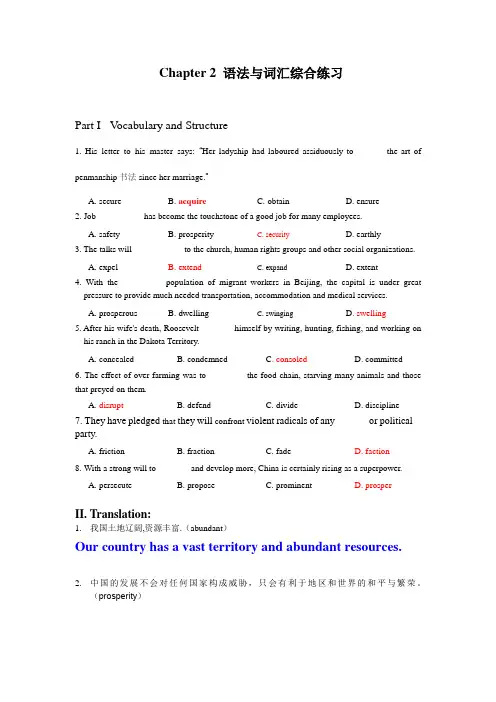
Chapter 2 语法与词汇综合练习
Part I Vocabulary and Structure
1. His letter to his master says: “Her ladyship had laboured assiduously to ______ the art of
penmanship书法since her marriage.”
A. secure B. acquire C. obtain D. ensure
2. Job __________ has become the touchstone of a good job for many employees.
A. safety B. prosperity C. security D. earthly
3. The talks will ___________ to the church, human rights groups and other social organizations.
A. expel B. extend C. expand D. extent
4. With the _________ population of migrant workers in Beijing, the capital is under great
pressure to provide much needed transportation, accommodation and medical services.
A. prosperous B. dwelling C. swinging D. swelling
5. After his wife's death, Roosevelt _______ himself by writing, hunting, fishing, and working on
his ranch in the Dakota Territory.
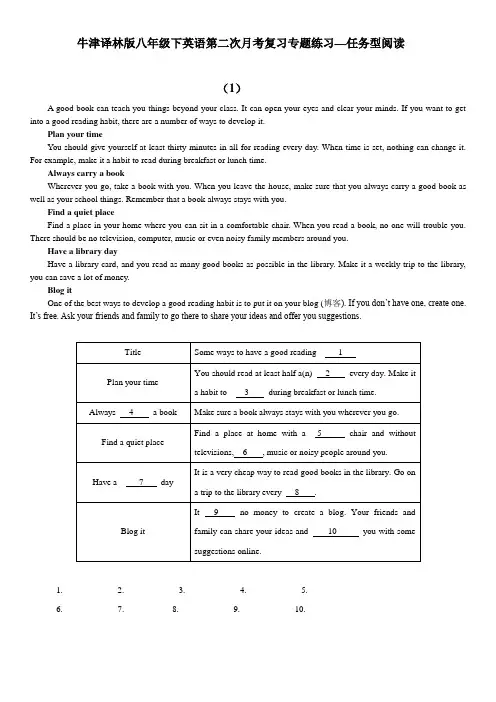
牛津译林版八年级下英语第二次月考复习专题练习—任务型阅读
(1)
A good book can teach you things beyond your class. It can open your eyes and clear your minds. If you want to get into a good reading habit, there are a number of ways to develop it. Plan your time You should give yourself at least thirty minutes in all for reading every day. When time is set, nothing can change it. For example, make it a habit to read during breakfast or lunch time. Always carry a book Wherever you go, take a book with you. When you leave the house, make sure that you always carry a good book as well as your school things. Remember that a book always stays with you. Find a quiet place Find a place in your home where you can sit in a comfortable chair. When you read a book, no one will trouble you. There should be no television, computer, music or even noisy family members around you. Have a library day Have a library card, and you read as many good books as possible in the library. Make it a weekly trip to the library, you can save a lot of money. Blog it One of the best ways to develop a good reading habit is to put it on your blog (博客). If you don’t have one, create one. It’s free. Ask your friends and family to go there to share your ideas and offer you suggestions. Title Some ways to have a good reading 1

才聪学习网——考研真题、考资格证、考试题库,考生首选官网!
英译汉教程连淑能配套练习题库|才聪学习网
连淑能《英译汉教程》配套题库(含考研真题)
目录
Chapter 1 Lexical Translation(词法翻译)
1.1 Diction(选词法)
1.2 Conversion(转换法)
1.3 Addition(增补法)
1.4 Omission(省略法)
1.5 Repetition(重复法)
Chapter 2 Syntactical Translation(句法翻译)
2.1 Inversion(倒置法)
2.2 Negation(反译法)
2.3 Division(拆译法)
2.4 Condensation(缩译法)
2.5 Translation of the Passive(被动句的译法) 才聪学习网——考研真题、考资格证、考试题库,考生首选官网!
2.6 Translation of Long Sentences(长句译法)
Chapter 3 Translation of cultural factors(文化因素的翻译)
3.1 Translation of Culture-loaded Expressions(文化词语译法)
3.2 Translation of Proper Nouns and Technical Terms(专有名词和专门术语译法)
Chapter 4 Style and Translation(文体与翻译)
4.1 Political Writing(政治文体)
4.2 Journalistic Writings(新闻报刊文体)
4.3 Popular Science Writing(科普文体)
4.4 Practical Writing(应用文体)
4.5 Literary Style(文学文体)
•