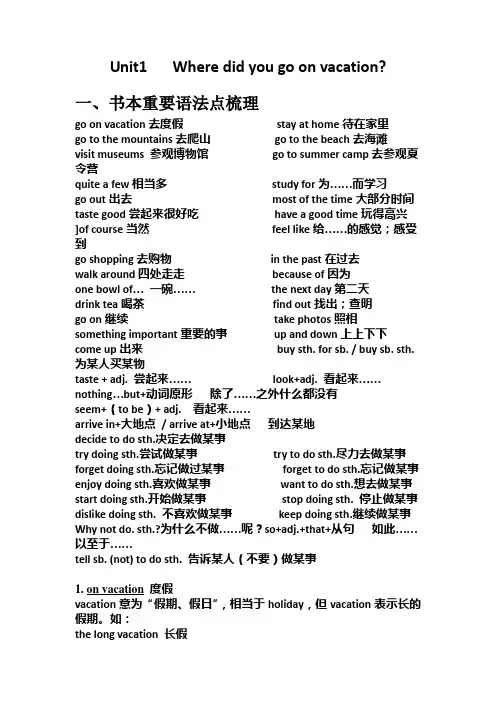
最全面人教版八年级上册英语第十单元知识点归纳总结
- 格式:docx
- 大小:43.58 KB
- 文档页数:22
最全面人教版八年级上册英语第十单元知识点归纳总结
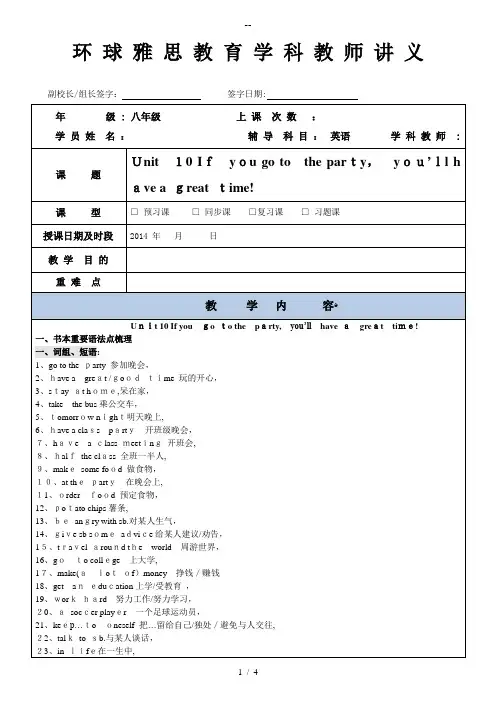
Unit 10: If You Go to the Party。You'll Have a Great Time!
In this unit。we will XXX related to social events。travel。and advice。
Vocabulary:
A) Meeting - XXX。
B) Travel - the act of going from one place to another。often
for leisure or business purposes。
C) Expert - XXX。
D) Normal - something that is XXX。
E) Mile - a unit of measurement used to express distance。
F) Careful - XXX。
G) Solve - to find a n to a problem or difficulty。
H) Trust - to have faith or confidence in someone or
something。
I) Experience - something that one has XXX。
J) Else - XXX
Phrases:
A) Have a great/good/wonderful time - to enjoy oneself。
B) Go to college - to XXX。
C) It's best (not) to do something - an n used to give advice。
D) Run away - to leave a place or XXX it。
E) Keep。to oneself - to not share n or XXX。
Now。let's look at some examples of how to use these words
and XXX:
A) "I have XXX."
B) "XXX."
C) "She's an expert in the field of neuroscience."
D) "It's XXX."
E) "XXX."
F) "XXX."
G) "We need to solve this problem before it gets any worse."
H) "I trust you to make the right n."
I) "My trip to Japan was an amazing experience."
J) "Is there anything else I can help you with?"
Phrases:
A) "I'm sure you'll have a great time at the party tonight."
B) "XXX to go to college next year to study engineering."
C) "It's best not to eat too much junk food if you want to stay
healthy."
D) "He decided to run away from home because he couldn't
handle the pressure."
E) "I usually keep XXX."
In n。XXX ns。travel。and when XXX and using these
words and phrases in context。you can XXX.
1.Attending the party will definitely bring you a great time
and XXX.
2."I think I'll wear jeans to the party," said John.
If you do。the teachers won't let you in," replied Mary.
3.The students are discussing the le for a class party.
4."What if they hold the party today?" asked Tom.
Half of the class won't come," replied Lily.
5."XXX their own food?" asked Sarah.
If we do。they'll only bring junk food like chips and
chocolate," replied Jack.
6."Let's order food from a restaurant," suggested Emily.
They'll be too lazy to cook," said David.
7."I'm not sure what to do about attending XXX'XXX," said
XXX.
8."I'm not sure how to get to the party," said Bob.
9.Giving XXX ns. 可以分为时间状语、地点状语、方式状语、原因状语、条件状语等等。
❷条件状语从句常用if引导,表示某种条件下发生的情况。例如:If it rains。we will stay at home.如果下雨,我们会呆在家里。
❸条件状语从句的谓语动词通常用一般现在时表示将来可能发生的情况,也可以用其他时态,但要根据具体情况而定。
❹当主句和从句的主语相同时,从句中的主语和be动词可以省略,例如:If you come。I will be happy.如果你来了,我会很高兴。
B部分
1、反义词
❶反义词指的是意义相反的词语,例如:hot-cold。big-small。happy-sad等等。
❷反义词的研究可以帮助我们更好地理解单词的意思,同时也可以丰富我们的词汇量。
2、过去式和过去分词
❶动词的过去式和过去分词是英语语法中的重要部分,掌握好这两个时态可以帮助我们更好地理解英语语言。 ❷动词的过去式通常是在词尾加上-ed,例如:walked。talked。played等等。
❸不规则动词的过去式和过去分词则需要单独记忆,例如:go-went-gone。do-did-done等等。
❹过去式和过去分词的用法也不同,过去式通常用于表示过去发生的动作,而过去分词则用于被动语态和完成时态等等。
时间 when。while。as。since。before。after。until。as
soon as。the moment
地点 where。wherever
原因 because。since。as。now that。seeing that。XXX
方式 how。as if。as though
目的 so that。in order that。lest
结果 so。that。such。that
条件 if。unless。provided that。as long as。on n that
让步 although。even though。though。while。whereas
比较 as。than
状语从句是一种重要的从句,它可以帮助我们更准确、更生动地表达语意。我们需要注意引导词的使用以及从句和主句之间的语法关系,才能正确地使用状语从句。 XXX on the use of if in XXX means "如果;假如;倘若"
and is used to introduce nal clauses。which can be placed before
or after the main clause。If the XXX the sentence。a comma
should be used to separate it from the main clause.
For example。"If you go there。I'll go too" means "如果你去那儿,我也会去"。"My mother will take me to the park if she
is free" means "我妈妈如果有空,就会带我去公园".
When using if in a nal clause。the main clause should follow
the "will" rule。This means that the main clause should use the
future tense (will)。XXX should use the present tense.
For example。"If he comes。he will bring his lin" means "他如果来,就会带来他的小提琴"。The main clause can also
contain modal verbs such as may。might。can。must。or should.
For example。"If the traffic lights are red。you must。and
wait" means "如果红绿灯亮了,你必须停下来等待".