语法专题:状语从句(含练习和答案)
- 格式:doc
- 大小:42.00 KB
- 文档页数:7
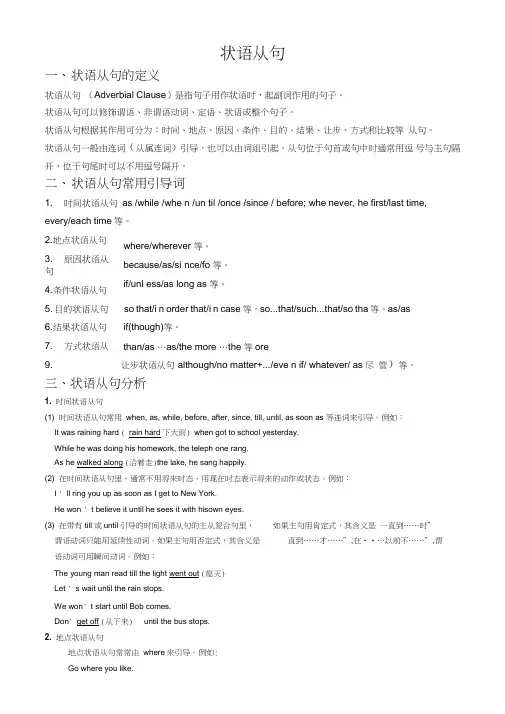
状语从句一、状语从句的定义状语从句(Adverbial Clause)是指句子用作状语时,起副词作用的句子。
状语从句可以修饰谓语、非谓语动词、定语、状语或整个句子。
状语从句根据其作用可分为:时间、地点、原因、条件、目的、结果、让步、方式和比较等从句。
状语从句一般由连词(从属连词)引导,也可以由词组引起。
从句位于句首或句中时通常用逗号与主句隔开,位于句尾时可以不用逗号隔开。
二、状语从句常用引导词1.时间状语从句as /while /when /until /once /since / before; whenever, he first/last time,every/each time等。
2.地点状语从句where/wherever等。
3.原因状语从句because/as/since/for等。
4.条件状语从句if/unless/as long as等。
5.目的状语从句so that/in order that/in case等。
6.结果状语从句so...that/such...that/so that等。
7.方式状语从句as/as if(though) 等。
8.比较状语从句than/as…as/the more…the more等。
9.让步状语从句although/no matter+.../even if/ whatever/ as(尽管)等。
三、状语从句分析1. 时间状语从句(1)时间状语从句常用when, as, while, before, after, since, till, until, as soon as等连词来引导。
例如:It was raining hard(rain hard 下大雨)when got to school yesterday.While he was doing his homework, the telephone rang.As he walked along(沿着走)the lake, he sang happily.(2)在时间状语从句里,通常不用将来时态,用现在时态表示将来的动作或状态。
例如:I’ll ring you up as soon as I get to New York.He won’t believe it until he sees it with his own eyes.(3)在带有till或until引导的时间状语从句的主从复合句里,如果主句用肯定式,其含义是“一直到……时”,谓语动词只能用延续性动词。
如果主句用否定式,其含义是“直到……才……”, “在……以前不……”, 谓语动词可用瞬间动词。
例如:The young man read till the light went out(熄灭).Let’s wait until the rain stops.We won’t start until Bob comes.Don’t get off(从下来)until the bus stops.2. 地点状语从句地点状语从句常常由where来引导。
例如:Go where you like.Where there is a will, there is a way.3. 原因状语从句(1)原因状语从句通常由because, since, as引导。
例如:He didn’t come to school because he was ill.As it is raining, we shall not (不得;不应该)go the zoo.Since you can’t answer the question, I’ll ask someone else.(2)because表示直接原因,语气最强。
Because引导的原因状语从句多放在主句之后。
回答由why提出的问题,只能用because。
As和since语气较弱,一般用来表示明显的原因。
由as和since引导的原因状语从居多放在句首。
例如:------Why aren’t going there?------Because I don’t w ant to.As he has no car, he can’t get there easily.Since we have no money, we can’t buy it.(3)because和so不能同用在一个句子里。
Because后接句子,because of后接名词、代词或动名词短语。
4. 条件状语从句(1)条件状语从句通常由if, unless引导。
例如:What shall we do if it snows tomorrow?Don’t leave the buildin g unless I tell you to.(2)在条件状语从句里,谓语动词通常用现在时态表示将来的动作或状态。
例如:I’ll help you with your English if am free tomorrow.He won’t be late unless he is ill.(3)“祈使句+ and (or)+ 陈述句” 在意思上相当于一个带有条件状语从句的复合句。
例如:Hurry up, or you’ll be late. =If you don’t hurry up, you’ll be late.Study hard and you will pass the exam. =If you study hard, you will pass the exam.5. 目的状语从句(1)目的状语从句通常由so that, in order that(为了,以便)引导。
例如:We started early so that we could catch the first train.We used the computer in order that we might save time.(2)so that既可引导目的状语从句,又可引导结果状语从句。
区别这两种从句的办法有两个:1)目的状语从句里往往带有情态动词can, could, may, might等。
2)从意思上看,目的状语从句往往表示的目的很明确。
例如:Speak clearly so that they may understand you. (目的状语从句)Jack is badly ill so that he has to rest. (结果状语从句)6. 结果状语从句(1)结果状语从句由so…that, such…that, so that引导。
例如:He is so poor that he can’t buy a bike for his son.She is such a good teacher that everybody likes her.My pencil fell under the desk, so that I couldn’t see it.(2)so…that语such...that可以互换。
例如:在由so...that引导的结果状语从句中,so是副词,与形容词连用。
其结构是: “...so + 形容词(副词)+ that + 从句”。
例如:He was so glad that he couldn’t say a word.Mother lives so far away that we hardly ever(几乎不,从来不)see her.在由such…that引导的结果状语从句中,such是形容词,它修饰的可以是单数或复数可数名词,也可以是不可数名词;名词前面可以带形容词,也可不带。
如果是单数可数名词,前面需加不定冠词a或an。
例如:It was such a hot day that nobody wanted to do anything.He had such long arms that he could almost touch the ceiling.(天花板)He made such rapid progress that he did very well in the mid-term.有时上述两种结构是可以互换的。
例如:It was such a wonderful film that all of us wanted to see it again.=The film was so wonderful that all of us wanted to see it again.It is such an important match that nobody wants to miss it.=The match is so important that nobody wants to miss it.(3)如果名词前由many, much, little, few等词修饰时,只能用so, 不用such。
例如:Soon there were so many deer that they ate up all the wild roses.He has so little time that he can’t go to the cinema(去看电影)with you.7. 方式状语从句(1)方式状语从句通常由as, (just) as…so…, as if, as though, by,with引导,多用来谈论某人的行为或者做某事的方式。
(2)as, (just) as…so…引导的方式状语从句通常位于主句后,但在(just) as…so…结构中位于句首,这时as从句带有比喻的含义,意思是"正如…","就像",多用于正式文体,例如:As water is to fish, so air is to man.You must try to hold the tool as I do.(3)as if 和as though 引导的从句中的时态取决于说话者对所谈内容的态度。
若说话者认为其看法是真的或可能会成为事实,从句谓语就按常规变化。
例如:He looks as if he is angry.如果从句的内容是不真实的,是与事实相反的,从句的谓语时态要用虚拟语气。
主句谓语用一般现在时态,对从句的谓语形式没有影响。
这两个连词经常用在be,act,appear,behave,fell,look,seem,smell,sound,taste及其他描写行为举止的动词之后,引导一个方式从句。
例如:He looks as if (as though) he had been hit by lightning.他那样子就像被雷击了似的。